














Key to Mysterious Ocean Glow Proposed

Scientists may have an explanation behind the rare nighttime events in which the ocean glows bright blue as far as the eye can see in all directions.
A new study details a process in plankton that would potentially account for this widespread bioluminescent phenomenon, which was confirmed by satellites in 2005 (see above image).
Scientists already knew that tiny, unicellular plankton called dinoflagellates create the distinctive blue flashes in some waters. How they flash their blue light was less clear.
A key aspect of the potential mechanism for bioluminescence in dinoflagellates involves voltage-gated proton channels — channels in membranes that can be opened or closed by chemical or electrical events.
Study team member J. Woodland Hastings suggested almost 40 years ago that dinoflagellates had voltage-gated proton channels. But they were confirmed only by the new study, which identified and tested dinoflagellate genes similar to genes for voltage-gated proton channels previously identified in humans, mice and sea squirts.
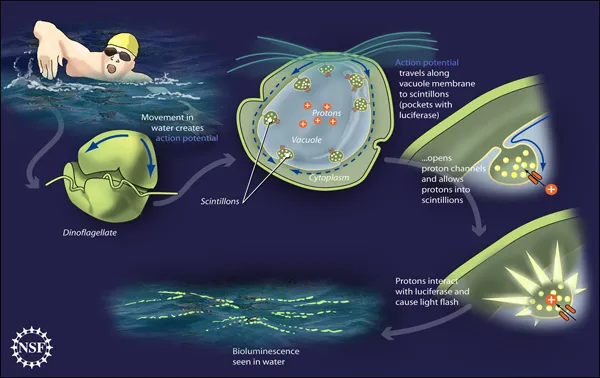
According to the study, here is how the light-generating process in dinoflagellates may work: As dinoflagellates float, mechanical stimulation generated by the movement of surrounding water sends electrical impulses around an internal compartment within the organism, called a vacuole, which holds an abundance of protons (positively charged particles). These electrical impulses open voltage-sensitive proton channels that connect the vacuole to tiny pockets dotting the vacuole membrane, known as scintillons.
Once opened, the voltage-sensitive proton channels may funnel protons from the vacuole into the scintillons. Protons entering the scintillons then activate luciferase — a protein stored in scintillons that produces flashes of light. The flashes would be most visible during blooms of dinoflagellates, when the tiny creatures rapidly reproduce and cover a larger area of sea. (Some of these blooms produce toxins that are harmful to other creatures in the marine environment, as well as to humans.)
Get the world’s most fascinating discoveries delivered straight to your inbox.
The study appears in the Oct. 17 issue of the journal Proceedings of the National Academy of Sciences (PNAS).
- Gallery: Eye-Catching Bioluminescent Wonders
- Gallery: Creatures from the Census of Marine Life
- The World's Biggest Oceans and Seas
Follow OurAmazingPlanet for the latest in Earth science and exploration news on Twitter @OAPlanet and on Facebook.
