PARIS — Russia's long-delayed Spektr-R radio telescope successfully launched July 18 aboard a Zenit rocket from the Baikonur Cosmodrome in Kazakhstan, the country's Federal Space Agency said.
There was no immediate word on the operational status of the new radio observatory beyond the fact that it was placed into the planned elliptical orbit that peaks nearly 207,000 miles (330,000 kilometers) above the Earth, and reaches a low of about 621 miles (1,000 km).
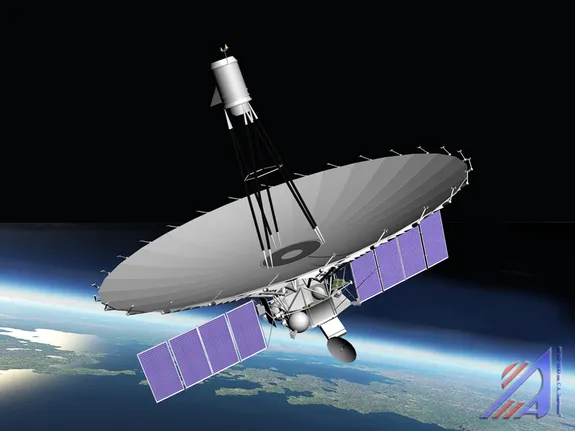
Featuring a giant 30-foot (10-meter) wide antenna, the Spektr-R observatory is part of the international Radioastron astronomy project.
"The aim of the mission is to use the space telescope to conduct interferometer observations in conjunction with the global ground radio telescope network in order to obtain images, coordinates, motions and evolution of angular structure of different radio emitting objects in the universe," Federal Space Agency officials said in a statement. "Scientists also expect to obtain more information about pulsars and interstellar plasma, black holes and neutron stars in the Milky Way." [Strangest Things in Space]
Scientists from more than 20 nations, including the United States, are participating in the project, either through contributions of on-board hardware or access to the terrestrial antennas that, working with Spektr-R, will permit interferometry measurements during the observatory's planned five years of operations.
Russia's new Spektr-R radio telescope launches into space atop a Zenit rocket on July 18, 2011 from Baikonur Cosmodrome in Kazakhstan. The Spektr-R observatory will study black holes, pulsars and other deep space objects.
(Image credit: Russian Federal Space Agency (Roscosmos))
Spektr-R was originally scheduled for launch in 2004 or 2005 before encountering multiple delays in its construction. It has been in development for more than a decade.
Most recently, the launch date was put into question following a dispute between commercial and Russian government satellite missions, notably Spektr-R, on which Zenit customer would receive the limited supply of Zenit rocket parts.
Sign up for the Live Science daily newsletter now
Get the world’s most fascinating discoveries delivered straight to your inbox.
Spektr-R was launched aboard a Russian-Ukrainian Zenit-3M rocket equipped with a Fregat-SG upper stage. It was built by Lavochkin Association of Moscow.
The Radioastron mission is being coordinated by the Astro Space Center of Moscow, which is part of the Lebedev Physical Institute of the Russian Academy of Sciences.
This story was provided by SPACE.com, sister site to LiveScience. This article was provided by Space News, dedicated to covering all aspects of the space industry. SPACE.com staff contributed to this report from New York City.