













Tree Frog's Sticky Secrets Revealed

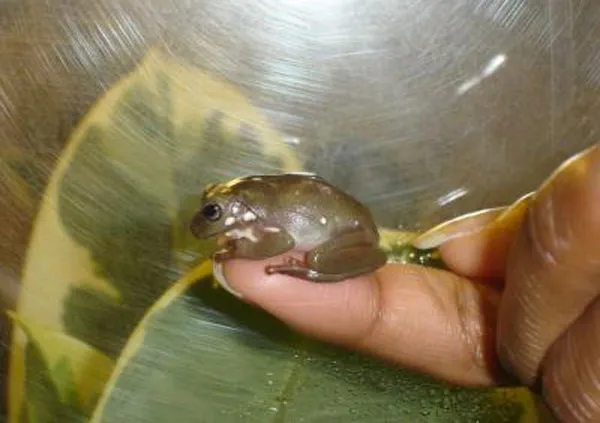
It must have been a wild ride for the tree frogs in the lab.
Scientists placed the frogs on a tilting, rotatable platform to measure the angles at which the frogs lost their grip. Adding dust caused them to slip sooner, but the frogs would take a few steps and regain their footing.
That ability to clean their feet so quickly, which scientists now understand, could lead to new self-cleaning surfaces and adhesives. [Why Frogs Are Green]
"When the frogs did not move the adhesive forces recovered much more slowly," said study researcher Niall Crawford at the University of Glasgow. "This shows that just taking a step enables frogs to clean their feet and restore their adhesion ability."
The frogs in the study, White's tree frogs, have sticky pads on their toes. Scientists learned in 2007 that the angle of the toe pads and a secretion of mucus were involved in the frogs' ability to stick to wet, smooth leaves, rough, dry trees and other surfaces.
The study showed that tiny hexagonal patterns allow some parts of the foot pad to remain in contact with the surface and create friction, while the channels between allow the mucus to spread throughout the pad. This mucus allows the frog to stick and then, when they move, also carries away any dirt.
If this can be translated into a man-made design it could provide a re-useable, effective adhesive. (Geckos have also been studied for their natural super adhesive.)
Get the world’s most fascinating discoveries delivered straight to your inbox.
"Tree frog feet may provide a design for self-cleaning sticky surfaces, which could be useful for a wide range of products especially in contaminating environments - medical bandages, tire performance, and even long lasting adhesives," Crawford explained today at the Society for Experimental Biology Annual Conference in Glasgow.
