














How One Expert Creates Beard of Bees (Very Carefully!)
This Research in Action article was provided to LiveScience in partnership with the National Science Foundation.
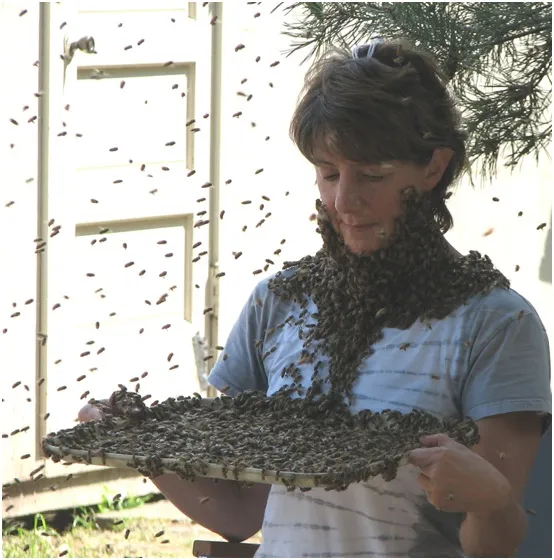
Among the many unique talents of Marla Spivak — a MacArthur Foundation Fellow at the University of Minnesota and an NSF-funded bee researcher — is her ability to safely create bee beards. Here she explains her technique. WARNING! Please do not try this at home!
If a bee beard is created carefully, the beard-wearer will not get stung "99 percent of the time."
The first step in creating a bee beard is to take a queen from the hive of a well-fed, gentle colony. Next, the queen should be safely caged. The caged queen is then strapped to the bottom of the subject's chin. (The subject should not make any sudden or quick motions during this process.)
The next step is to remove the bees from the queen's hive and shake them in front of the subject. Because bees naturally cluster around their queen and because they can sense pheromones (chemical signals) emitted by the caged queen, the bees cluster around her and inevitably crawl up the person's neck and face.
To remove the beard from the person, the queen is removed and returned to her hive. Then, when the person jumps and shakes, the bees fall off. The bees then return to their hive and again cluster around their queen.
Any opinions, findings, and conclusions or recommendations expressed in this material are those of the author and do not necessarily reflect the views of the National Science Foundation. See the Research in Action archive.
Get the world’s most fascinating discoveries delivered straight to your inbox.