













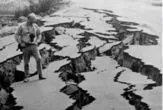
Earthquake faults are worn smooth over time by friction, like the brake pads of an old car, according to a new study.
The finding, detailed in the March issue of the journal Geology, suggests old and new faults might generate different types of earthquakes.
Researchers were able to see the wear patterns by using a fairly new technology called laser imaging detection and ranging (LIDAR) to create detailed topographical maps of the vertical sides of exposed fault lines. Like radar, LIDAR sends out a pulse of energy and then records information from bounced back reflections. LIDAR is more sensitive than radar, and can collect data points as close as every 0.12 inches during scans of enormous rock faces.
- Video: Earthquake Forecasting
Over the course of two years, the researchers analyzed about 15 sites in southern California, Oregon, Nevada and Utah. The findings support the idea that old and young faults have fundamentally different structures and that faults evolve over time.
The study found that while mature faults tend to be smooth at small scales, they have regular features on larger scales. In contrast, younger faults tend to be rough on all scales with no discernable pattern.
“The thing that was really surprising was that the mature faults have a really distinct structure, little hills on them, at the 10-meter scale,” said study team member Emily Brodsky, a University of California, Santa Cruz geologist.
This is surprising because most geologists thought fault lines are fractal, meaning they exhibit the same structure and complexity regardless of the scale of observation.
Get the world’s most fascinating discoveries delivered straight to your inbox.
The researchers say the next step is to figure out what implications their findings have for earthquakes. Because old and new faults are so different, everything about the earthquakes they generate—their birth, strength and propagation—could be different as well, the researchers speculate.
“We don’t know how the amount of shaking from the same size earthquake acts on different kinds of faults,” Brodsky said. “It could be that the smoother, mature faults give you a less bumpy ride.”
- Earthquake Facts and Myths
- Images: Deadly Earthquakes
- Will California Ever Fall into the Ocean?
- World's Tallest Building Possibly Causing Earthquakes
- U.S. Unprepared for Next Great Quake
- The Big Earthquake Quiz
- All About Earthquakes