













Blood Cells Change Shape to Fit Through Tiny Vessels

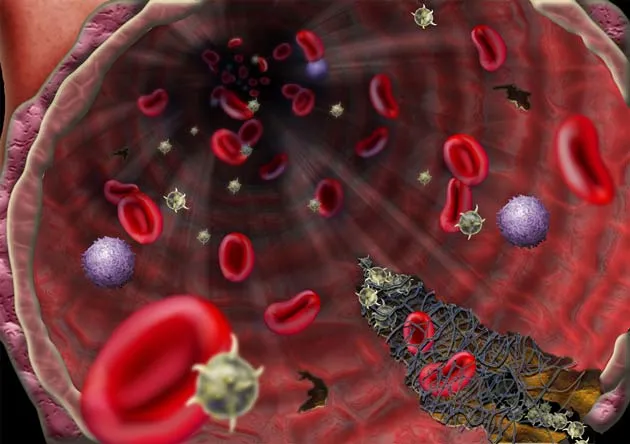
Human red blood cells rushing through the body to carry oxygen and carbon dioxide to and from the organs are forced to squeeze through smaller and smaller blood vessels. A new study has discovered how exactly the teeny hat-shaped cells deform themselves to fit through these micro-tunnels.
The research could help scientists better understand certain blood disorders like malaria and sickle cell anemia.
Blood cells must squeeze through the body's smallest blood vessels, called capillaries, to do their job, but capillaries often become narrower than the cells in their normal disc shape. So the cells must deform to fit through them.
To change shape, the cells rearrange protein components of their internal scaffolding, called the cytoskeleton.
The rearrangement happens when the cell is squeezed as it tries to fit through a tiny capillary--the bonds holding the proteins together break, allowing the blood cells to behave like a liquid and stretch into a bullet shape.
"Now we can study how molecular structure affects the shape, which affects the mechanical properties, and both of which affect mobility," said study author Subra Suresh of MIT.
Mobility is a key factor in diseases like malaria, which makes red blood cells less deformable, and the genetic disorder sickle cell anemia, which gives red blood cells a sickle shape that prevents them from flowing through the blood vessels.
Get the world’s most fascinating discoveries delivered straight to your inbox.
With this new discovery, published in the March 22 online edition of Proceedings of the National Academy of Sciences, scientists will be able to examine how these disorders affect the cells at the molecular level.

Andrea Thompson is an associate editor at Scientific American, where she covers sustainability, energy and the environment. Prior to that, she was a senior writer covering climate science at Climate Central and a reporter and editor at Live Science, where she primarily covered Earth science and the environment. She holds a graduate degree in science health and environmental reporting from New York University, as well as a bachelor of science and and masters of science in atmospheric chemistry from the Georgia Institute of Technology.