













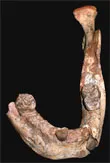
The long childhoods and delayed maturity common in modern humans are traits that date back to at least the early members of our own species in Africa.
Previous research had found that fossils from earlier hominids, such as Australopithecus and Homo erectus, possessed short growth periods that were more similar to chimpanzees than living humans. So it was unclear when a lengthier period of child development emerged in human evolution. The new analyses of teeth belonging to a child living in North Africa 160,000 years ago reveal longer-term growth patterns similar to those found among modern European children.
The finding, detailed in the March 12 issue of the journal for the Proceedings of the National Academy of Sciences, suggests some of the traits commonly attributed to our species appeared relatively late in the 6-million-year history of human evolution.
“The early fossil humans tended to grow fast, have a shorter childhood and resemble chimpanzees in terms of their developmental profile,” said study team member Tanya Smith of the Max Planck Institute for Evolutionary Anthropology in Germany. “This is the oldest fossil we have that we see something like living humans [rather] than earlier humans or apes.”
Like tree rings
The researchers used a new imaging technique, called X-ray synchrotron microtomagraphy, to reconstruct tooth growth of an early human child without damaging the fossilized lower jawbone [image].
Tooth growth, particularly the age when the first molar tooth appears, is a valuable clue to the growth rates of fossil humans. As a person ages, their teeth forms new layers of enamel [image] which, like annual rings in trees, can be used to determine their developmental rate and time of death.
Get the world’s most fascinating discoveries delivered straight to your inbox.
“There are these daily lines and longer period lines in the teeth that are laid down during growth and that persist through millions of years,” Smith told LiveScience.
The study found that the child, estimated to be about 8 years old at time of death, showed prolonged dental development similar to that of living humans. The child’s estimated time of first molar eruption occurred around 6 years of age, which is similar to modern children. In contrast, molar eruption first occurs around 4 years of age for chimps.
"People speculate that by having a longer childhood, there's an increased period of time for learning," Smith said. "Organisms that have a greater learning period develop more complex social behaviors and have more complex social systems."
To be human
The new finding also helps sheds light on when some of the traits we consider uniquely human first appeared.
“We don’t have any securely dated material that’s older than 200,000 years that people call Homo sapiens. These early fossils show a mix of primitive and derived features and paleoanthropologists are still debating whether they’re modern or on the way to being modern,” Smith said. “This study is interesting because it gives another feature that’s very characteristic” of modern humans.
The researchers hope the new technique, developed by Smith’s colleague Paul Tafforeau of the European Synchrotron Radiation Facility in France, will be used to analyze other early hominin fossils.
“It would be great to bring in Homo erectus or some juvenile Neanderthal and really get at them with this approach,” Smith said.