













Dinosaurs Mingled with Cousins of Ducks and Chickens
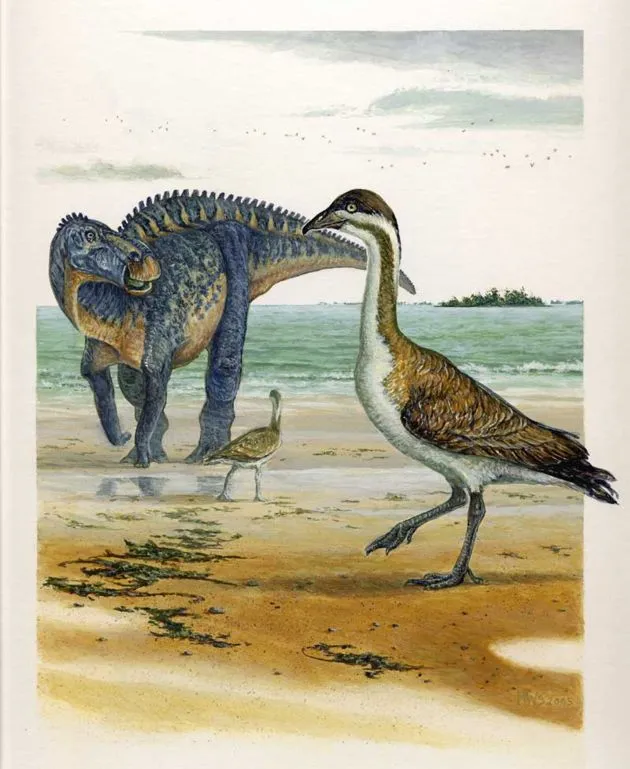
Evolutionary cousins of chickens and ducks roamed the Earth with dinosaurs more than 65 millions years ago, according to a new study that runs counter to a key assumption about when birds got their footing on the planet.
The newly identified bird species, Vegavis iaai, lived during the Cretaceous period some 65 million years ago. This species somehow survived the Cretaceous/Tertiary (K/T) mass extinction event that wiped out the dinosaurs. They belonged to the class Aves, which includes radiations of all living birds.
Specifically, Vegavis belonged to an order of Aves called Anserifomes, which includes waterfowl. Within this order, Vegavis is most closely related to true ducks and geese, in the family Anatidae. It is not considered a direct ancestor of modern ducks or chickens, however.
Julia Clarke of North Carolina State University led the research team that re-examined a fossil found in Antarctica in 1992. New analysis using computer tomography (CT) scans gave a better view of the rock-encased bone than previous attempts. The images of the partial skeleton revealed that Vegavis was a new species and revealed its importance to avian evolution.
"We have more data than ever to propose at least the beginnings of the radiation of all living birds in the Cretaceous," Clarke says. "We now know that duck and chicken relatives coexisted with non-avian dinosaurs. This does not mean that today's chicken and duck species lived with non-avian dinosaurs, but that the evolutionary lineages leading to today's chicken and duck species did."
The first known bird, Archaeopteryx, lived 147 million years ago, but it is commonly believed that it was an evolutionary dead-end and its descendants never gave rise to modern birds.
Clarke's findings, as reported in the Jan. 20 edition of Nature, provide the first proof that cousins of living bird species co-existed with dinosaurs.
Get the world’s most fascinating discoveries delivered straight to your inbox.
Before the classification of Vegavis, the fossil record of living bird lineages in the Cretaceous period was very unreliable. Some scientists supported a "big bang" theory of bird evolution, where today's living bird lineages only became established after non-avian dinosaurs were wiped out by the K/T mass extinction.
Clarke's findings dispute the "big bang" theory of bird evolution and provide strong evidence that living bird lineages existed before the mass extinction.