













History of Ancient Supercontinent's Breakup Detailed
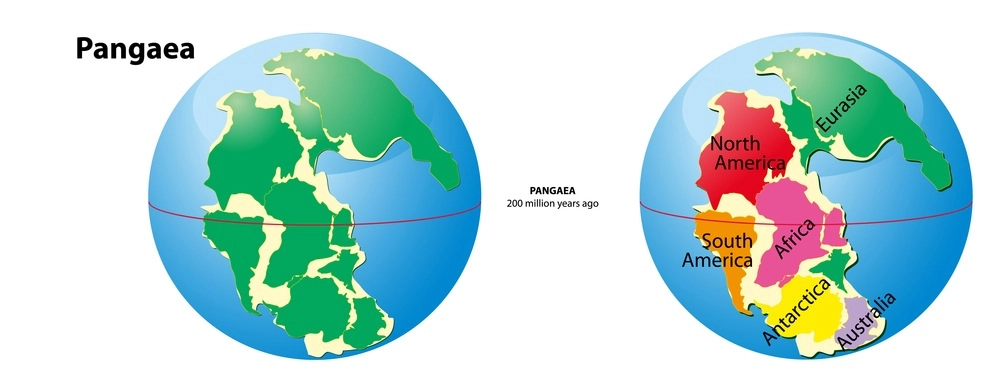
Dinosaurs roamed, mammals started to flourish, the first birds and lizards evolved, and a massive supercontinent began to split apart on Earth about 180 million years ago. Yet, the details of the breakup of one of the largest landmasses in history have stumped scientists until now.
The breakup of the supercontinent Gondwana eventually formed the continents in the Southern Hemisphere. Exactly how this happened has been debated by geologists for years. Most theories say Gondwana broke into many different pieces, but new research suggests the large land mass simply split in two.
Researcher Graeme Eagles of the University of London said he was suspicious of the theory that Gondwana had divided into many smaller continents because it was inconsistent with what is known about all other supercontinent breakups, including the breakup of Pangea into Gondwana and Laurasia.
Other continents in the geologic past, such as Rodinia, the oldest known continent, and Pangaea, followed a pattern of splitting along tectonic lines into fewer, larger pieces, geologists think. Eagles wondered if a similar process could explain the break-up of Gondwana.
By studying data from where the continent first began to fracture, he determined that Gondwana split into eastern and western plates. Then, about 30 million years later, as crocodiles and sharks were evolving, the two plates split apart, and one continent became two.
The study, detailed this month in Geophysical Journal International, was funded by the Alfred Wegener Institute in Germany. Eagles analyzed magnetic and gravity data from Gondwana and used a computer model to study its breakup and come up with the new model.
Previously, scientists thought that “hot spots” played a role in the breakup of Gondwana. Hot spots are areas like those found at Yellowstone National Park, where very hot material gurgles just below the surface. The theory was that hot material rose to the surface, creating a bulge, which caused pieces of the land to break apart.
Get the world’s most fascinating discoveries delivered straight to your inbox.
But, nowhere else has this hot spot theory been found to be true.
“This adds new constraints in the way we think about how supercontinents break up,” Eagles said.
Whether or not Eagles’ theory will rewrite geological history remains to be seen. “It’s too early to say,” he said. There are a few areas where other scientists may find flaws. For example, the locations of India and Sri Lanka on Gondwana are a possible point of contention, he said. Under Eagles' new model, the two countries are in different locations than previously thought.
- 101 Amazing Earth Facts
- Maps of Ancient Earth Need Revising
- Humans Force Earth into New Geologic Epoch