
 Live Science Plus


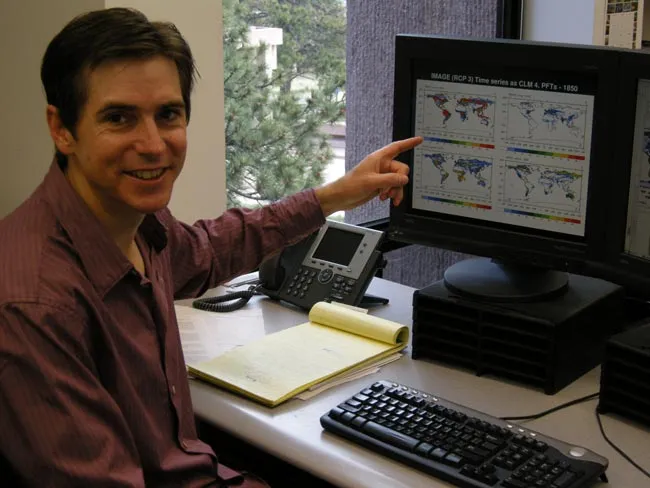
This Behind the Scenes article was provided to LiveScience in partnership with the National Science Foundation. Imagine a climate model as a black box. You put something in, you get something out. But what happens when the output is completely unexpected? "If you don’t get the results you expect, that’s when you start to ask why," said climate modeler Peter Lawrence from the University of Colorado at Boulder’s Cooperative Institute for Research in Environmental Sciences. Working with Tom Chase, a colleague at the institute, the researchers were comparing climate simulations from the Community Land Model — part of a select group of global models used in the Intergovernmental Panel on Climate Change’s 2007 climate change report — against observations. The model simulations weren't checking out. Despite adding more leafy vegetation to the modeled planet's land surface, Lawrence and Chase found the simulated climate consistently produced less rainfall than real-world observations revealed. "Imagine adding more tropical rainforest to the planet and getting a drier, more desert-like climate," said Chase. "It just didn’t make sense."
Their hunch? There was a snag in the model’s water cycle. Water on land eventually makes its way into the atmosphere through two processes. In one, the sun’s heat directly evaporates moisture from leaf surfaces, soils, and open water sources. In the other, known as transpiration, water is lost from plants during the gas exchange associated with photosynthesis. The two processes are often described together as evapo-transpiration. According to Chase, transpiration is an important global humidifier, contributing nearly half of all evapo-transpiration worldwide. But in the Community Land Model, transpiration was contributing just 15 percent — instead, evaporation from bare soils was putting three times as much water into the atmosphere. "Water is a very strong climate modifier," said Chase. "It impacts surface temperature, precipitation, and cloud formation. If we can’t capture fundamental hydrological processes in our climate models, we have no way to determine how human activities are affecting the climate system."
