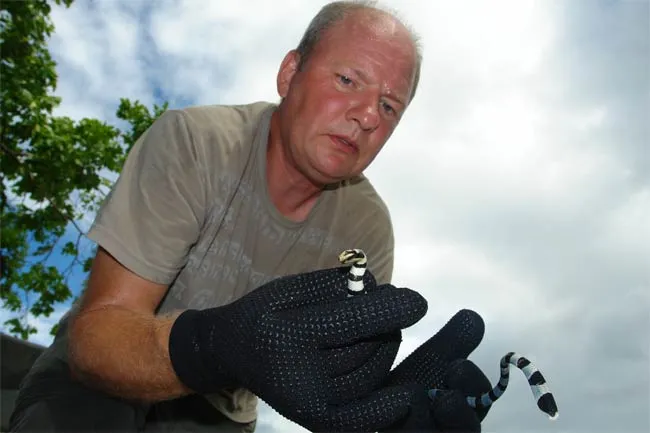
'Two-Headed' Snake Fakes Predators
Get the world’s most fascinating discoveries delivered straight to your inbox.
You are now subscribed
Your newsletter sign-up was successful
Want to add more newsletters?
Delivered Daily
Daily Newsletter
Sign up for the latest discoveries, groundbreaking research and fascinating breakthroughs that impact you and the wider world direct to your inbox.
Once a week
Life's Little Mysteries
Feed your curiosity with an exclusive mystery every week, solved with science and delivered direct to your inbox before it's seen anywhere else.
Once a week
How It Works
Sign up to our free science & technology newsletter for your weekly fix of fascinating articles, quick quizzes, amazing images, and more
Delivered daily
Space.com Newsletter
Breaking space news, the latest updates on rocket launches, skywatching events and more!
Once a month
Watch This Space
Sign up to our monthly entertainment newsletter to keep up with all our coverage of the latest sci-fi and space movies, tv shows, games and books.
Once a week
Night Sky This Week
Discover this week's must-see night sky events, moon phases, and stunning astrophotos. Sign up for our skywatching newsletter and explore the universe with us!
Join the club
Get full access to premium articles, exclusive features and a growing list of member rewards.
One species of venomous sea snake shows the advantages of being two-faced. This slithering reptile twists its tail so its hind end appears to predators as a second head.
The clever sea snake, called the yellow-lipped sea krait (Laticauda colubrine), relies on the ruse to keep it safe from sharks and other enemies. Even though L. colubrine packs some of the most potent venom, the animal becomes relatively defenseless while foraging, a time when its head is stuck in crevices of coral reefs rather than on the lookout for attacks.
The thinking goes, if predators detect a vigilant head they'll steer clear. Apparently the trick can even fools unsuspecting scientists.
Arne Redsted Rasmussen of the Royal Danish Academy of Fine Arts, School of Conservation in Copenhagen discovered the phenomenon while diving off the coast of the Bunaken Island in Indonesia. There, he watched as a yellow-lipped sea krait probed the crevices of corals. From his perspective, the snake seemed to be foraging with its tail, since its "head" was facing the scientist.
Shortly thereafter, the diving scientist watched as the snake pulled "another head" out of the crevice. He noted that each time the snake poked its snout into a coral opening, its tail twisted around the length of the snake's body and began to move about (like any head would) to, apparently, monitor the scene and keep a lookout for danger.
When the snake swam away, this perceived head showed itself as the snake's flattened paddle-like tail.
Rasmussen and Johan Elmberg of Kristianstad University College in Sweden found L. colubrine has a bright yellow horseshoe marking on both its tail tip and snout, distinctive from the rest of its body.
Get the world’s most fascinating discoveries delivered straight to your inbox.
They also analyzed other sea krait species from museum collections, finding a similar distinctive color pattern in nearly 100 such species. The museum findings suggest other sea snakes might employ the guise observed in L. colubrine, the researchers say. But further studies are needed to firm up this hypothesis, Elmberg noted.
The new discovery will be published this week in the journal Marine Ecology.
- 7 Shocking Snake Stories
- More Snake News, Images & Information
- The World's Deadliest Animals
Jeanna Bryner is managing editor of Scientific American. Previously she was editor in chief of Live Science and, prior to that, an editor at Scholastic's Science World magazine. Bryner has an English degree from Salisbury University, a master's degree in biogeochemistry and environmental sciences from the University of Maryland and a graduate science journalism degree from New York University. She has worked as a biologist in Florida, where she monitored wetlands and did field surveys for endangered species, including the gorgeous Florida Scrub Jay. She also received an ocean sciences journalism fellowship from the Woods Hole Oceanographic Institution. She is a firm believer that science is for everyone and that just about everything can be viewed through the lens of science.