













Wise Elephants Fear Roads
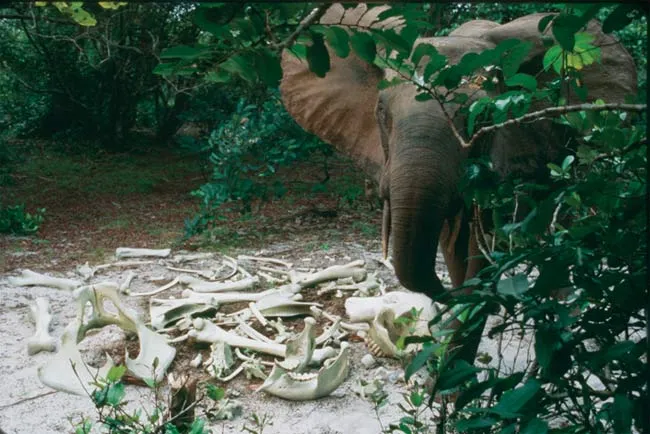
Endangered forest elephants are avoiding roads at all costs, having learned to associate roads with danger due to rampant poaching in Central Africa.
"Forest elephants are basically living in fear of their lives in prisons created by roads," lead researcher of a new study on the elephants Stephen Blake, now at the Max Planck Institute for Ornithology in Germany, said today. "They are roaming around the woods like frightened mice rather than tranquil formidable giants of their forest realm."
While some scientists consider the forest elephant its own species, others say it's one of two subspecies of African elephants, along with the savanna, or bush, elephant called Loxodonta africana africana. The forest elephant is smaller and has more oval-shaped ears compared with savanna elephants. While savanna elephants sport tusks that curve outward, forest elephants wear downward-pointing tusks.
Blake and Wildlife Conservation Society scientists tracked 28 forest elephants with GPS collars that were living in six conservation areas in the Congo, Central African Republic and Gabon.
The results showed that roads, particularly those outside of parks and protected areas, attract poachers and so have become daunting barriers to elephant movements.
Researchers say the pachyderm strategy could become dangerously confining as roadless space becomes even sparser. Over time, the elephants would have less access to food resources and increased competition for food, which could lead to aggressive social interactions among the elephants and thus less social cohesion and possible lowered reproductive success, the researchers say. The end result could be a decline in forest elephant populations.
In 2007, Blake and his colleagues reported a drop-off of forest elephants along roadways in five countries in Africa due to poaching for ivory tusks, with the elephants retreating into protected areas with or without road access.
Get the world’s most fascinating discoveries delivered straight to your inbox.
In fact, past research has shown that up to 5 percent of Africa's population of elephants was killed by poachers for the year ending in August 2006. That poaching supports a large, international black-market trade in the ivory from elephants' tusks.
Even so, Blake and his colleagues say there is still time to make smart development decisions, which include diverting roads away from wilderness areas and reducing poaching of elephants.
"A small yet very feasible shift in development planning, one that is actually good for poor local forest people and for wildlife and wilderness, would be a tremendous help to protect forest elephants and their home," Blake said. "Planning roads to give forest elephants breathing space so that at least those in the deep forest can relax, as well as reduce the death and fear that comes with roads by reducing poaching, would be trivial in terms of cost but massively important for conservation."
The research is detailed in the Oct. 27 issue of the journal PLoS ONE.
- Images: The World’s Biggest Beasts
- DNA Tests of Illegally Traded Ivory Could Save Elephants
- Top 10 Species Success Stories
Jeanna Bryner is managing editor of Scientific American. Previously she was editor in chief of Live Science and, prior to that, an editor at Scholastic's Science World magazine. Bryner has an English degree from Salisbury University, a master's degree in biogeochemistry and environmental sciences from the University of Maryland and a graduate science journalism degree from New York University. She has worked as a biologist in Florida, where she monitored wetlands and did field surveys for endangered species, including the gorgeous Florida Scrub Jay. She also received an ocean sciences journalism fellowship from the Woods Hole Oceanographic Institution. She is a firm believer that science is for everyone and that just about everything can be viewed through the lens of science.