













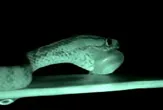
If the French had teeth like the Iwasaki snail-eating snake, they wouldn’t need tongs and tiny forks to eat escargot.
The Japanese snake, Pareas iwasakii, preys mostly on snails and slugs, but its jaws are too weak to crush snail shells. Instead, it uses pin-sharp teeth to grab a snail’s body and tug it from its shell. Most snails have shells that swirl to the right in a clockwise direction. So the snake has evolved an upper jaw with more teeth on the right side than the left.
A new study finds that the lopsided-jaw design helps the snake extract and scarf down its slimy meal.
- Video: Right-swirling shell makes for easy pickings
Researchers led by Masaki Hoso at Kyoto University filmed four Iwasaki snakes feeding on snails with either left- or right-swirling shells. Videos show the snakes sneaking up on a snail, grabbing it by its foot, and then yanking it out of its shell with alternate retractions of their left and right jaws, a movement that some researchers call “mandible walking.”
They found that snakes took a longer time and required more jaw retractions to extract the soft bodies of snails with left-swirling shells.
- Video: Snake Struggles with left-swirling shell
The study, to be detailed in an upcoming issue of the journal Biology Letters, reveals how this toothy adaptation opened up a unique menu for some snakes.
“Our results demonstrate that symmetry break in dentition is a key innovation that has opened a unique ecological niche for snake predators,” the researchers write.
Get the world’s most fascinating discoveries delivered straight to your inbox.
In a sample of 28 snakes, the researchers found each one had an average of 17.5 teeth on its left jaw and 24.9 teeth on the right. The asymmetry was present even in unhatched snakes, suggesting the trait is genetically determined.
The results also confirm the defensive benefits of a left-swirling, or sinistral, shell for snails. A separate study recently found that crabs that preyed on snails had a tougher time with left-swirling snails.
“The remarkable diversity of sinistral snails in Southeast Asia may be attributable to ‘right-handed predation’ by snakes,” the researchers wrote.
- Secret Weapons of Small Creatures
- How Does a Snake Swallow a Larger Snake?
- Left-Handed Snails Tougher Prey Than Righties
- Images: Snakes of the World
- Amazing Animal Abilities