
 Live Science Plus


How Reindeer Deal with Endless Winter Nights
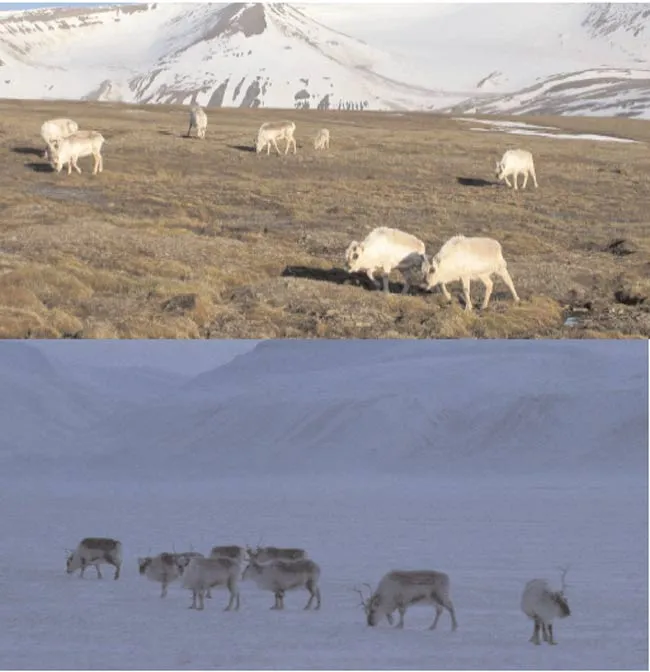
Norwegian reindeer have plenty of time to join in reindeer games.
When the Sun stays up around the clock during the Arctic summer, the reindeer ditch their daily routines for a life cycle that better suits constant daylight.
Animals and plants normally set their biological clocks by the rising and setting of the Sun. In humans, this internal rhythmic cycle organizes when we wake up, when we're most active, and when the pillow beckons.

In the very far North, however, the Sun is up for six months and then down for six months, creating days of either 24-hour light or darkness. In spring and fall above the Arctic Circle, the transition can take weeks.
Many animals can maintain their internal rhythm if the change is abrupt, such as when a migratory bird flies to a region with longer hours of daylight. But fewer can keep it ticking when light fades in or out gradually, as it does when seasons change in the Arctic.
"This requires a 'strong' biological clock, one that is able to run on its own," Karl-Arne Stokkan of the University of Tromsø, Norway told LiveScience. "We think reindeer, and other Arctic animals, have a weak clock."
What reindeer really do
Get the world’s most fascinating discoveries delivered straight to your inbox.
Stokkan's team monitored the daily feeding and movement of two reindeer species living at different latitudes—mountain reindeer Rangifer tarandus tarandus on mainland Norway (70 degrees North) and Svalbard reindeer R. t. platyrhynchus at 78 degrees North.
At these latitudes, reindeer spend winters in perpetual twilight and the Sun never sets during summer.
The reindeer spend 18 weeks a year, in autumn and spring, with a marked day/night cycle. During these few weeks, both species more or less follow the rhythm of a 24-hour day, Stokkan said. During the summer months, however, they developed a total lack of daily rhythm. The Svalbard reindeer lacked behavioral rhythm in winter as well.
With no internal clock to run their day, Stokkan posits the animals likely take infrequent naps of various durations, alternating between stretches of activity.
A good thing
Having a weak biological clock seems to have benefits.
Activity in the winter and summer appears driven more by their digestive system than sunlight, and the reindeer feed whenever the weather permits, Stokkan said. This eating pattern is optimal for the microbial-assisted digestion typical of reindeer and other hoofed animals.
Reducing the influence of the internal clock may also enhance the animals' responsiveness and speed of adaptation to changes in the light/dark cycle and may play a key role in migratory birds and mammals emerging from hibernation.
The research is detailed in the Dec. 22 issue of the journal Nature.
- Sleep Poorly? You're Not Alone
- The Human Brain Seen as Master of Time
- Dogs, Dozing and Dieting: A Winning Combination
- Insomnia Mania: Newborn Mammals Don't Sleep for a Month
- Wild New Idea: The Deer Cam
Rudolph ...
Wild caribou and domestic reindeer are considered to be a single species throughout the world. They are members of the deer family.
In Eurasia people long ago began taming wild caribou, leading to the domestic herds of reindeer common in many countries today.
Native peoples in Scandinavia and across northern Eurasia to the Bering Strait base their economies on herding reindeer. In Russia there are about 2.2 million of them.
Some have been bred for pulling sleds, others for meat.
SOURCES: National Park Service, National Audubon Society