













Huge Stockpile of Oxygen Found Deep Inside Earth
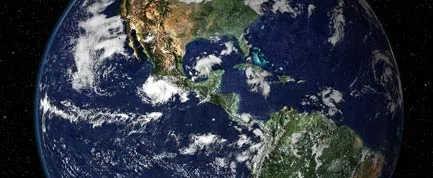
A mineral that acts like a sponge beneath Earth's surface stores more oxygen than expected, keeping our planet from becoming dry and inhospitable like Mars.
The key to the abundant oxygen storage is the mineral majorite, which exists deep below Earth's surface in the mantle. Without the oxygen stockpile, Earth would probably be a barren planet hostile to life, authors of a study suggest in the Sept. 27 issue of the journal Nature.
The researchers examined majorite in the lab under conditions mimicking the Earth's deep interior and also near the planet's surface. The results showed that under deep-Earth conditions of high temperature and pressure, majorite stores large amounts of oxygen. When the temperature and pressure were decreased, as occurs near Earth's surface, the majorite decomposed and released the oxygen.
"The Earth's upper mantle can store, therefore, much more oxygen than previously expected," said lead author Arno Rohrbach, a doctoral student at the University of Bonn's Mineralogical Institute in Germany.
In nature, the deep stores of oxygen (in the form of majorite) ride convection currents up toward Earth's surface. Along the way, the pressure and temperature decrease, and at some point majorite breaks down.
"That's where the stored oxygen is released," said study team member Christian Ballhaus of Bonn's Mineralogical Institute. "Near the surface it is made available for all the oxidation reactions that are essential for life on Earth."
This process could also be responsible for some of Earth's water, Rohrbach said. Unlocked oxygen can bind with hydrogen that constantly seeps from Earth's interior to form water, making for a water-rich atmosphere. "Primordial hydrogen, trapped during the accretion/formation of planet Earth, is degassing constantly from the Earth's interior," Rohrbach told LiveScience.
Get the world’s most fascinating discoveries delivered straight to your inbox.
Once the water is made, Earth's magnetic field helps to keep it in place. "The magnetic field prevents the atmosphere from being 'blown away' by solar winds," Rohrbach said.
- 101 Amazing Earth Facts
- Image Gallery: Earth from Above
- Top 10 Unexplained Phenomena
Jeanna Bryner is managing editor of Scientific American. Previously she was editor in chief of Live Science and, prior to that, an editor at Scholastic's Science World magazine. Bryner has an English degree from Salisbury University, a master's degree in biogeochemistry and environmental sciences from the University of Maryland and a graduate science journalism degree from New York University. She has worked as a biologist in Florida, where she monitored wetlands and did field surveys for endangered species, including the gorgeous Florida Scrub Jay. She also received an ocean sciences journalism fellowship from the Woods Hole Oceanographic Institution. She is a firm believer that science is for everyone and that just about everything can be viewed through the lens of science.