It's quick and easy to access Live Science Plus, simply enter your email below. We'll send you a confirmation and sign you up for our daily newsletter, keeping you up to date with the latest science news.
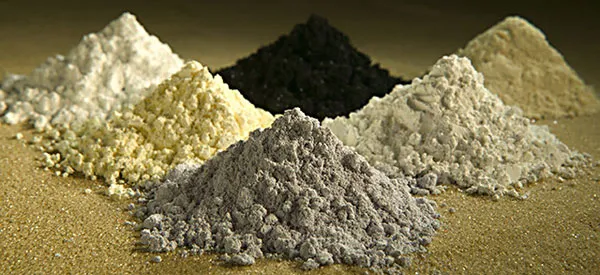
These rare-earth oxides are used as tracers to determine which parts of a watershed are eroding. Clockwise from top center: praseodymium, cerium, lanthanum, neodymium, samarium, and gadolinium.
(Image credit: U.S. Department of Agriculture / Peggy Greb.)
Rare earths – which include exotic-sounding elements like dysprosium, cerium, and ytterbium – are actually more abundant than other familiar metals, but tend to become concentrated in less exploitable ore deposits, according to the U.S. Geological Survey. Consequently, most of the world’s supply of these elements comes from only a few sources.
Mineral deposits reported to contain rare earth elements were discovered in Afghanistan in 2010. The deposits may be worth $1 trillion.
Consumers may not know that their computer hard drives, TV screens, and smartphones contain rare earth elements. The often-irreplaceable metals also support everything from green technologies to military hardware.
For example, europium makes the red color for television monitors and energy-efficient LED light bulbs, while neodymium makes some of the most powerful magnets found in everyday electronics, wind turbines and hybrid cars.
Light rare earth elements include the metals ranging from lanthanum to gadolinium on the periodic table of elements, while heavy rare earth metals range from terbium to lutetium.
So-called green technologies often depend upon rare earth elements. For instance, Toyota uses an estimated 7,500 tons of lanthanum and 1,000 tons of neodymium per year to build its Prius cars, according to Jack Lifton, an independent consultant who works with U.S. Rare Earths, a company that owns the rights to rare earth element resources in the U.S.
Rare earth minerals are just as crucial for military applications, such as lasers, radar, missile-guidance systems, satellites and aircraft electronics.
Sign up for the Live Science daily newsletter now
Get the world’s most fascinating discoveries delivered straight to your inbox.
China and the U.S. have some of the largest rare earth mineral deposits, but other deposits exist in countries such as Australia, Brazil, India, Malaysia, South Africa, Sri Lanka and Thailand, according to the USGS.
Mining is just the first step. Extracting the individual rare earth metals from the raw ore requires thousands of stainless steel tanks holding many chemical solutions, according to Jim Hedrick, a former USGS rare earth specialist. The overall refining process converts ore into oxides, and then converts the oxides into refined metals.
Only China currently has the equipment to refine rare earth metals from start to finish, and it supplies as much as 97 percent of the world's rare earth oxides. Opening one mine and building a separation plant might cost anywhere from $500 million to $1 billion, Hedrick said.
Rare earths play a crucial role in the manufacture of modern electronics gear.
Jeremy has written for publications such as Popular Science, Scientific American Mind and Reader's Digest Asia. He obtained his masters degree in science journalism from New York University, and completed his undergraduate education in the history and sociology of science at the University of Pennsylvania.

 Live Science Plus