 Live Science Plus





You are now subscribed
Your newsletter sign-up was successful
Want to add more newsletters?

Delivered Daily
Daily Newsletter
Sign up for the latest discoveries, groundbreaking research and fascinating breakthroughs that impact you and the wider world direct to your inbox.

Once a week
Life's Little Mysteries
Feed your curiosity with an exclusive mystery every week, solved with science and delivered direct to your inbox before it's seen anywhere else.

Once a week
How It Works
Sign up to our free science & technology newsletter for your weekly fix of fascinating articles, quick quizzes, amazing images, and more

Delivered daily
Space.com Newsletter
Breaking space news, the latest updates on rocket launches, skywatching events and more!

Once a month
Watch This Space
Sign up to our monthly entertainment newsletter to keep up with all our coverage of the latest sci-fi and space movies, tv shows, games and books.

Once a week
Night Sky This Week
Discover this week's must-see night sky events, moon phases, and stunning astrophotos. Sign up for our skywatching newsletter and explore the universe with us!
Join the club
Get full access to premium articles, exclusive features and a growing list of member rewards.
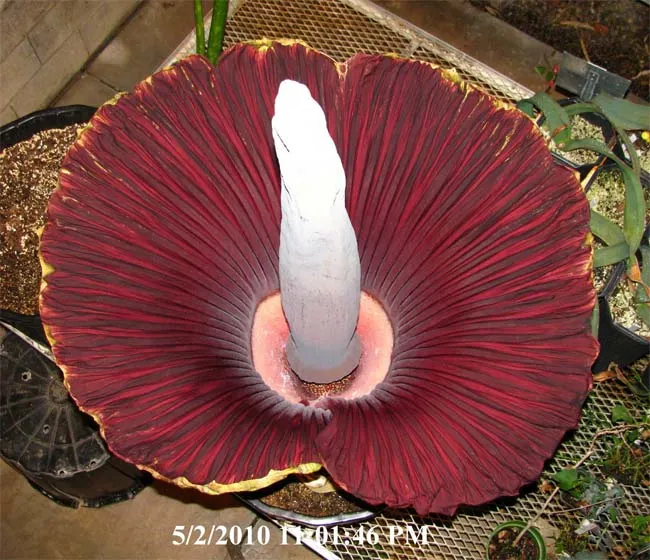
A foul-smelling, aptly named "corpse flower" at Western Illinois University has bloomed, releasing a powerful aroma of rotting meat.
Gardeners at the university have been meticulously watching the bloom for days, predicting it would open as early as last week.
This specimen is one of a small group of these flowers that have bloomed in cultivation since the 1880s. The 44.5-inch (113-centimeter) tall plant lives in the Western Illinois University Botany Greenhouse, tended by greenhouse gardener Jeff Hillyer.
"This Titan has never bloomed before," Hillyer told LiveScience. For the past eight years the plant has been growing vegetatively, only producing a single, umbrella-like leaf, Hillyer explained. "It was the first one I've ever been involved with, so it was all new to me."
The bloom (or inflorescence) of the flower is actually composed of thousands of flowers. The odor gets especially strong as the plant heats up during the blooming process.
"The plant actually gets warmer," Hillyer said. "It kind of cooks the chemicals to pump the odor out there."
Once the flower fully opens, if it is not pollinated it closes up and collapses. The plant began to open on Sunday, and remained open for about half a day, before closing back up.
"Yes, it still smells, but it's not overbearing like it was yesterday evening," Hiller wrote on his blog as the bloom began to close.
The Titan Arum is native to the equatorial rainforests of central Sumatra in western Indonesia. It was first discovered in 1878 by Italian botanist Odoardo Beccari, who collected the seeds and provided them to England's Royal Botanic Gardens in Kew, which recorded the first bloom of this species in cultivation in 1889. The first United States bloom occurred at the New York Botanical Gardens in June 1937.
The seeds for the Western Illinois University plant were collected in 1993 by James Symon in Sumatra while filming for Sir David Attenborough's BBC documentary "The Private Life of Plants." The plants that WIU has grown from those seeds are among the first generation of plants cultivated in the United States. (That means they are essentially from the 1930s.)
- Top 10 Poisonous Plants
- 101 Amazing Earth Facts
- Do Plants Have Sex?

