






'Mating' Robots Take a Fast-Forward Leap in Digital Darwinism
Get the world’s most fascinating discoveries delivered straight to your inbox.
You are now subscribed
Your newsletter sign-up was successful
Want to add more newsletters?
Delivered Daily
Daily Newsletter
Sign up for the latest discoveries, groundbreaking research and fascinating breakthroughs that impact you and the wider world direct to your inbox.
Once a week
Life's Little Mysteries
Feed your curiosity with an exclusive mystery every week, solved with science and delivered direct to your inbox before it's seen anywhere else.
Once a week
How It Works
Sign up to our free science & technology newsletter for your weekly fix of fascinating articles, quick quizzes, amazing images, and more
Delivered daily
Space.com Newsletter
Breaking space news, the latest updates on rocket launches, skywatching events and more!
Once a month
Watch This Space
Sign up to our monthly entertainment newsletter to keep up with all our coverage of the latest sci-fi and space movies, tv shows, games and books.
Once a week
Night Sky This Week
Discover this week's must-see night sky events, moon phases, and stunning astrophotos. Sign up for our skywatching newsletter and explore the universe with us!
Join the club
Get full access to premium articles, exclusive features and a growing list of member rewards.
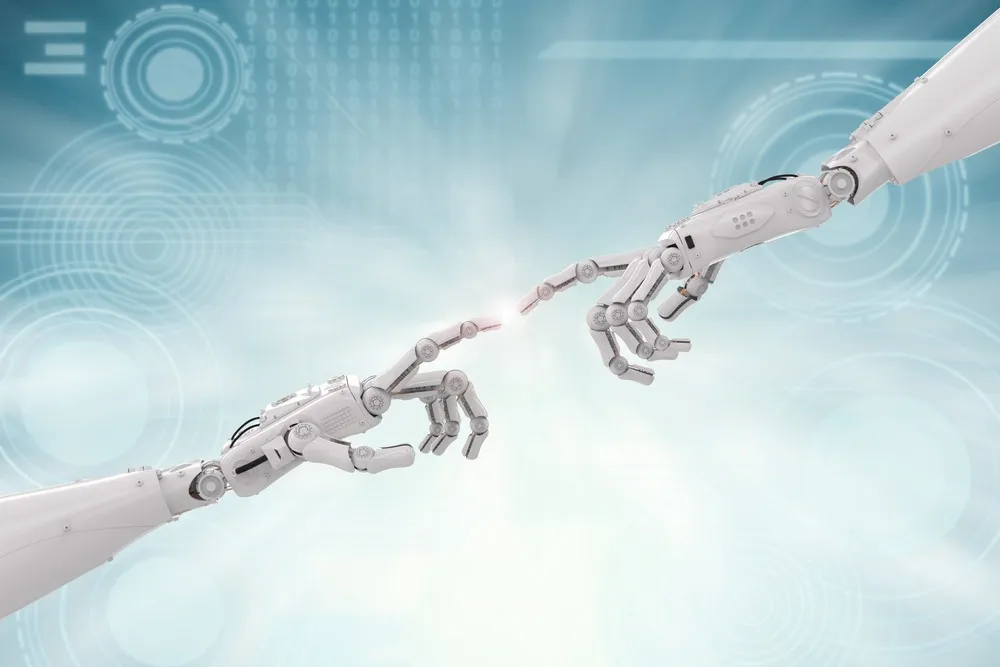
We might as well just give up control over the planet right now. In recently published research, scientists detail a set of experiments in which robots — real, physical machines — improved themselves through a kind of digital Darwinism. The bots, each drawing from a collective "gene pool," competed with one another over multiple generations, gradually swapping genetic material in a process akin to sexual reproduction. The research article appeared in the journal Frontiers in Robotics and AI. While this kind of evolutionary robotics research has been around a while, the new study presents an important step forward in assessing the evolutionary dynamics of physically embodied robots — and it suggests that we're mashing the fast-forward button on the impending robotic revolution. Researchers from Vassar College set up an experiment in which 10 small-wheeled robots — all of them a model of the Ana BBot, manufactured by Johuco Ltd. — were issued the same task: to gather beams of light while avoiding certain obstacles. Each bot was also issued its own set of "genes" — a specific pattern of wires connected to pins on a circuit board.
RELATED: Stopping Killer Robots at the Source (Code) It turns out that the experiment didn't reveal anything particularly dramatic. The robots didn't evolve better light-capturing or object-avoidance skills. But the experiment did reveal the importance of tracking the developmental factor in evolutionary robotics. "It is important to note that our goal was not to show adaptive evolution per se, but rather to test the hypothesis that epigenetic factors can alter the evolutionary dynamics of a population of physically embodied robots," wrote Brawer and Hill. Notably, all the bots had lost mobility entirely by the end of the experiment, since the mating algorithm allowed low-fitness individuals to remain in the gene pool and reproduce. So maybe there's still hope for us after all.
Originally published on Seeker.
Get the world’s most fascinating discoveries delivered straight to your inbox.
