More than 200 feet (60 meters) below the ocean's surface, where the water is cold and only about 1 percent of the daylight above penetrates, is a dim, blue world filled with little-understood creatures. Now, researchers have discovered that the corals that inhabit this "twilight zone" have a never-before-seen adaptation that enables them to eke out enough light energy to survive.
The photosynthetic algae that live on and power these corals have unusual cellular "machinery" that enables them to conduct photosynthesis more efficiently than species that live at shallower depths, the researchers reported Oct. 17 in the journal Frontiers in Marine Science.
"It's unlike anything we've seen on land, or anything we've even seen in the shallow reefs," said David Gruber, a marine biologist at the City University of New York and one of the researchers on the study. [See Photos of the Deep 'Twilight' Coral Reefs]
On land and in the water, plants use cellular structures called light-harvesting complexes, or photosynthetic antennas, to capture photons (particles of light) and transfer them to the photosynthetic complexes that convert light into usable energy. The photosynthetic antennas are made of various proteins and chlorophyll pigments. In dim forests on land, plants in the underbrush often evolve very large antenna complexes to wring every drop of light out of the sky, Gruber said.
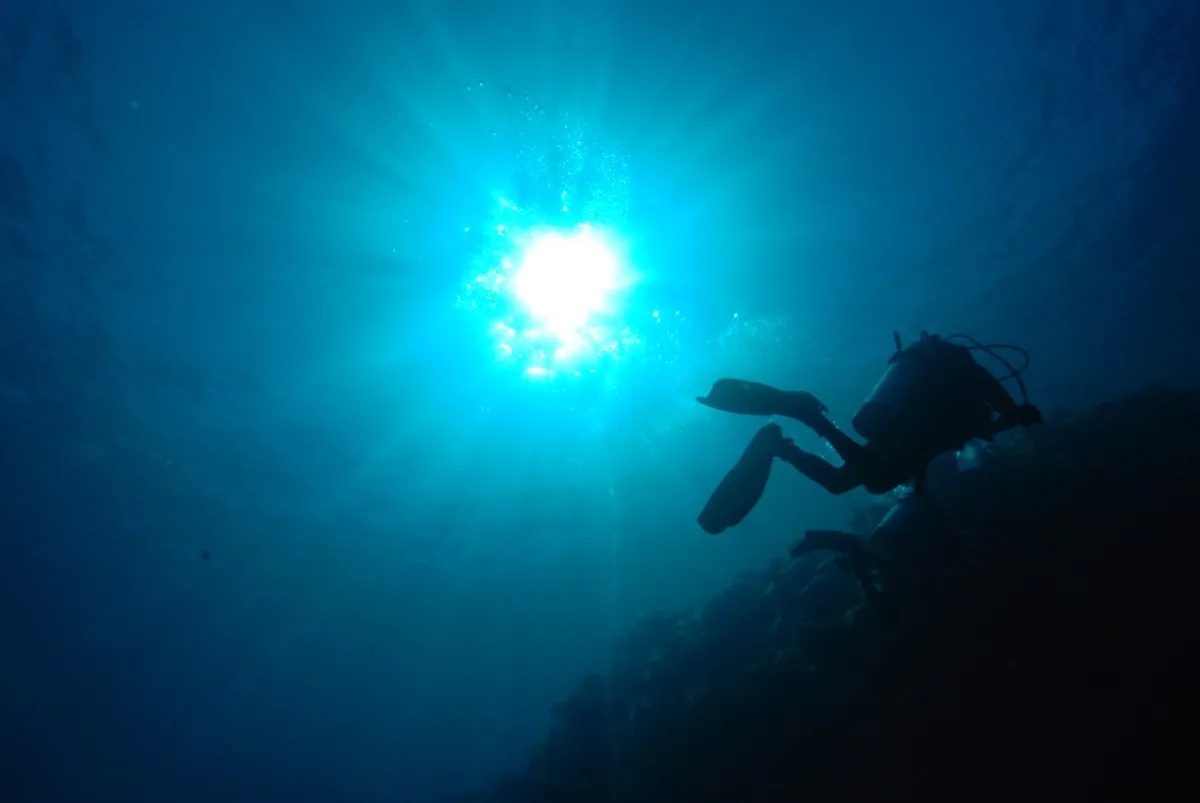
Mesophotic reefs, also known as twilight reefs, exist in a perpetual state of dim blueness.
(Image credit: Mike Lombardi)
But that's not what the researchers found 213 feet (65 m) down in the northern Red Sea when they collected coral called Stylophora pistillata from reefs there. Inside the coral is symbiotic algae called Symbiodinium, which provide the coral oxygen and energy from photosynthesis in exchange for nutrients and protection. This makes for relatively easy living in shallow reefs, where sunlight is abundant. But below about 130 feet (40 m), the ocean gets dim. This is the "mesophotic" zone, where it's always twilight. At about 330 feet (100 m), only 1 percent of the sunlight above can reach down below. And only blue wavelengths of light can penetrate.
It might make sense for algae living in the mesophotic zone to build huge photosynthetic antennas. But that's not what Symbiodinium does. In fact, when Gruber and colleagues from the Hebrew University of Jerusalem and the University of Haifa, both in Israel, analyzed the deep-living algae, they found that the algae antenna structures were actually smaller than that of shallower Symbiodinium algae.
Extreme environment
Instead of building bigger antennas, the algae modified its light-gathering system. Plants like algae have two types of cellular machines for converting light into sugars: photosystem I and photosystem II. Symbiodinium relies more heavily on photosystem II but positions the cellular machinery close to the machinery of photosystem I. This makes it easier for the two systems to share energy. They also adjust the types of light-snatching proteins in their cellular membranes, the researchers said. [Images: Colorful Corals of the Deep Barrier Reef]
Sign up for the Live Science daily newsletter now
Get the world’s most fascinating discoveries delivered straight to your inbox.
Diving to these coral habitats is hard for humans; commercial scuba divers don't usually go below about 130 feet. To get to the twilight zone of the Red Sea, the researchers, led by lead diver Shai Einbinder, donned tri-gas rebreather systems, which enable divers to go lower while facing a smaller risk of serious problems such as nitrogen narcosis (an altered state of consciousness that occurs when nitrogen enters the bloodstream at the increased pressures seen at extreme water depths). Still, divers stay down only a few minutes because they must ascend very slowly to equilibrate to the lower pressures at the surface and thus avoid decompression sickness, also known as "the bends", Gruber said.
Over the course of four years of diving, the scientists took some samples of deep-reef coral and transferred them to shallow environments, and took shallow corals and transferred them to deeper areas. They did this slowly, moving the corals only 16 feet (5 m) every two weeks. They found that the corals collected in water depths of about 10 feet could hang on to life at 213 feet. Corals from the deep, however, couldn't survive at shallow depths. They lacked the natural compounds that protect corals from the sun's damaging ultraviolet light.
"They didn't have the 'sunscreen,'" Gruber said. "The light was just burning them out."
The researchers studied only one species of algae, and there are probably many more adaptations among the photosynthesizers of mesophilic reefs, Gruber said.
"I'm never unimpressed by the way nature evolved unique traits to allow life in some of the most seemingly unhospitable places," he said.
Stephanie Pappas is a contributing writer for Live Science, covering topics ranging from geoscience to archaeology to the human brain and behavior. She was previously a senior writer for Live Science but is now a freelancer based in Denver, Colorado, and regularly contributes to Scientific American and The Monitor, the monthly magazine of the American Psychological Association. Stephanie received a bachelor's degree in psychology from the University of South Carolina and a graduate certificate in science communication from the University of California, Santa Cruz.