Live Science Plus






Why Do Birds Sing the Same Song Over and Over?
You are now subscribed
Your newsletter sign-up was successful
Want to add more newsletters?

Delivered Daily
Daily Newsletter
Sign up for the latest discoveries, groundbreaking research and fascinating breakthroughs that impact you and the wider world direct to your inbox.

Once a week
Life's Little Mysteries
Feed your curiosity with an exclusive mystery every week, solved with science and delivered direct to your inbox before it's seen anywhere else.

Once a week
How It Works
Sign up to our free science & technology newsletter for your weekly fix of fascinating articles, quick quizzes, amazing images, and more

Delivered daily
Space.com Newsletter
Breaking space news, the latest updates on rocket launches, skywatching events and more!

Once a month
Watch This Space
Sign up to our monthly entertainment newsletter to keep up with all our coverage of the latest sci-fi and space movies, tv shows, games and books.

Once a week
Night Sky This Week
Discover this week's must-see night sky events, moon phases, and stunning astrophotos. Sign up for our skywatching newsletter and explore the universe with us!
Join the club
Get full access to premium articles, exclusive features and a growing list of member rewards.
The twittering of birds can fill any spring or summer day with music: All you have to do is open your window to hear crows "caw," killdears call "kill-deah! kill-deah!" and chickadees sing "chickadee-dee-dee."
But come back an hour later, and you'll still hear them singing the same song, repeatedly. That's because they're hard at work. These avian singers tend to be male, and are crooning their hearts out to guard their territory and attract a mate, said Gail Buhl, education program manager at the Raptor Center at the University of Minnesota.
On the territorial front, the melody says, "This is my area and I'm letting everyone else, especially every other male in the area, know that this is my space," Buhl told Live Science. [Does Wedding Rice Make Birds Explode?]
Other animals mark their territory by urinating or by rubbing their scent everywhere. Even people mark areas with fences. But "birds don't do it that way, they will sing," Buhl said. "And they will sing that song over and over again."
And, hey, if that song attracts a mate in the process, more power to the male. Granted, there are nearly 10,000 species of birds in the world, and every species is different, but oftentimes the female is the one that picks the mate, not vice versa, Buhl said.
The males' songs basically express, "Hey, females, if you're passing by, listen to me because I've got a beautiful song! I'm a healthy male! You should stop by and check me out!" Buhl told Live Science.
This mating ritual is costly for both sexes, in that it uses energy. While the male is singing, he can't look for food, and his calls make him more visible to predators, Buhl said. For females, it takes a lot of energy to lay eggs and raise young, so she wants to be sure she chooses the right mate before putting all her eggs in one basket, so to speak.
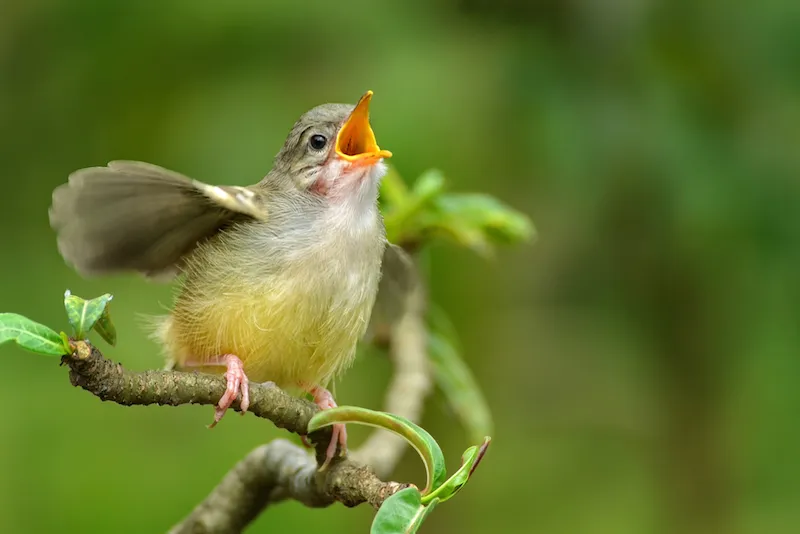
Once the chicks hatch, people might hear another repetitive bird note. When chicks are hungry, they often call to their parents for food — saying something along the lines of, "Mom, I'm hungry! I'm over here!" Buhl said.
If this call sounds annoying, that's because it's meant to be, she said. Just like a seat-belt buzzer, the call is designed to get attention, and fast.
During the winter, birds often sing fewer notes, or just one note, to each other. These notes are simply a way to alert the flock of their whereabouts and to announce whether there's any food nearby, Buhl said.
Interestingly, just like a New Yorker can sound different from a Southerner, the same species of birds living in different areas can have different dialects.
"It usually happens if you have big physical barriers, like mountains [in the way]," Buhl said. "Over time, their song changes just a little bit."
So if you're on vacation and hear a slightly different chickadee-dee-dee song, know that it's likely the same species, but with a different dialect, she said.
Follow Laura Geggel on Twitter @LauraGeggel. Follow Live Science's Life's Little Mysteries @LLMysteries, Facebook & Google+.