














Does Wedding Rice Make Birds Explode?

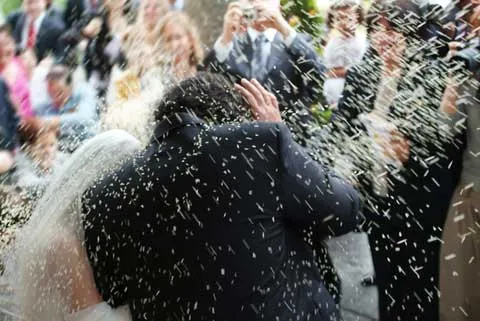
While pigeon pyrotechnics would certainly be a unique way to cap off your special day, throwing wedding rice won't make birds blow up.
It's not clear where this urban legend came from, but it got a popularity boost in 1985 when a Connecticut state representative proposed a law to prevent the tossing of rice at weddings. Then, in 1988, advice columnist Ann Landers printed a letter from a bride-to-be worried about "sounding like some kind of a nut" for asking her guests not to toss rice at her.
Both the state representative and the anonymous advice-seeker expressed the same concern: That rice would expand after being eaten by wild birds, bursting open their digestive tracts and killing them.
Related: What if someone objects at your wedding?
Landers advised the reader to ask the wedding party to pass along the no-rice rule to guests. (Presumably, any out-of-the-loop revelers could be tackled mid-toss in the name of avian conservation.)
But there was just one problem with her advice: There is no evidence that rice poses any danger to birds. Landers printed a retraction just three months later in the form of a letter from Cornell ornithologist Steven Sibley.
"Rice is not threat to birds," Sibley wrote. "It must be boiled before it will expand. Furthermore all the food that birds swallow is ground up by powerful muscles and grit in their gizzards."
Get the world’s most fascinating discoveries delivered straight to your inbox.
Still, no one bothered to test the legend, and it never completely died. In 2002, University of Kentucky biologist Jim Krupa asked 600 students in his undergraduate biology classes if it was safe to throw rice at weddings. Forty-five percent of the students said no, and cited exploding birds as the reason.
Krupa saw a teaching opportunity. He had his students test the myth as a lesson on the scientific method. The students performed a series of experiments on the expansion of different types of grains, the strength of bird digestive organs and the snack preferences of several common bird species. In their results, published in 2005 in the journal The American Biology Teacher, the students found that the only grain that expanded enough to possibly pose a danger was instant rice not the kind usually thrown at weddings.
Nonetheless, the students prevailed on Krupa to feed his own birds instant rice to see what happened. Krupa, by this time confident that the birds would be safe, agreed. He fed 60 doves and pigeons a diet of nothing but instant rice and water for 12 hours, monitoring them for signs of distress.
He found nothing. No burst gizzards, no deaths, not even a regurgitation. But it did turn out that the birds and rice were an explosive combination in a different way.
"They just loved it," Krupa said, "and now they're kind of addicted to it."

Stephanie Pappas is a contributing writer for Live Science, covering topics ranging from geoscience to archaeology to the human brain and behavior. She was previously a senior writer for Live Science but is now a freelancer based in Denver, Colorado, and regularly contributes to Scientific American and The Monitor, the monthly magazine of the American Psychological Association. Stephanie received a bachelor's degree in psychology from the University of South Carolina and a graduate certificate in science communication from the University of California, Santa Cruz.