













Psychology of Immigration: Why Responses to Migrant Crisis Vary

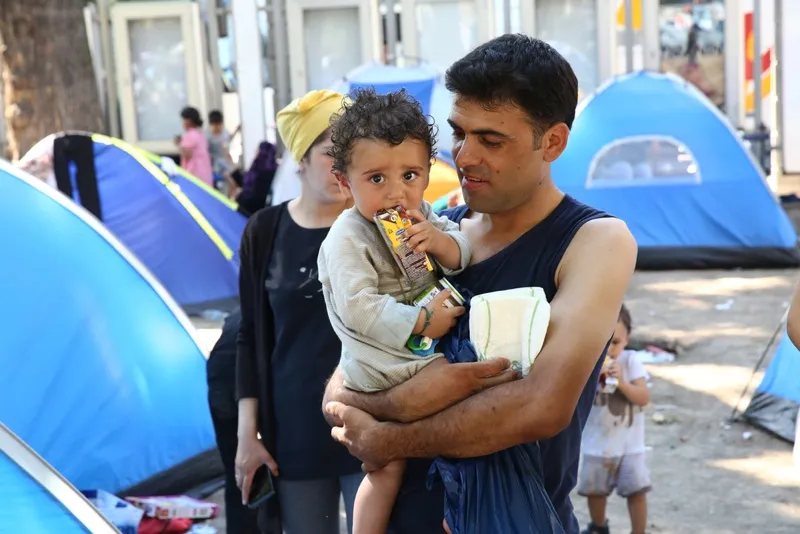
The ongoing migrant crisis in Europe has provided some starkly different images: Germans applauding as migrants arrived at a train station after a long journey through Austria and Hungary, on the one hand; and naked migrants hosed down in frigid temperatures at a refugee center in Italy, on the other. In Poland, Germany and other nations, protestors rally against plans of resettlement as others counterprotest in favor of welcoming asylum seekers.
There's also a gulf of difference between how European citizens and their governments are responding to the influx of asylum seekers from Syria, North Africa and other Middle Eastern nations.
All of these responses arise out of a mix of politics, economic realities and the evolution of the human brain (which involves our caveman instincts), experts say. [Refugee Crisis: Why There's No Science to Resettlement]
"One of the first things to appreciate is that the anti-immigrant reactions are really natural, and in some ways fundamental to who we are," said Steven Neuberg, a psychologist at Arizona State University who researches prejudice and in-group/out-group relations. "But by natural, I don't mean that it's good — whether it's good or not is determined by different moral systems that we have."
The threat of the "other"
Evolutionarily, the brain is primed for specific threats that would have loomed over our earliest relatives, such as dangers to physical safety, infectious disease and threats to resources, Neuberg told Live Science. People are also on guard against threats to their own group's values. Values, after all, translate into rules and laws that might constrain behavior.
Often, it hardly matters what those foreign values are. Neuberg and his colleagues have found that undergraduates view feminist activists and fundamentalist Christians as equally threatening, despite the fact that the two groups couldn't be further apart ideologically.
Get the world’s most fascinating discoveries delivered straight to your inbox.
"Both groups are perceived as wanting to constrain [the students'] options," Neuberg said.
Immigrants, whether refugees or migrants looking for a better life, can trigger automatic responses to these ancestral threats, Neuberg said. People from other groups are seen as potentially threatening to one's own group.
"Out-group males, in particular, are seen all throughout the world as having a high likelihood of posing threats of physical violence," Neuberg said. Indeed, those who oppose resettlement in Europe have singled out the young men among the asylum seekers. Croatian Right Party leader Anto Dapic told the media he'd be willing to support temporary aid to women and children, "but not young men who look like they just left the gym," reported the Irish Times.
That many of the refugees are Muslim and trying to enter secular or traditionally Christian countries exacerbates the in-group/out-group gap, Neuberg said. Clashes between those values can lead to real conflict. In New York, for example, strongly orthodox Hasidic Jew storekeepers put up signs banning sleeveless shirts and low-cut necklines; they were sued by the New York Commission on Human Rights for discriminating against women. The lawsuit was ultimately settled without any fines, but with the requirement that signs must specify no discrimination on the basis of gender, race or religion in the future.
The desire to protect oneself from outsiders is heightened for those who already feel vulnerable, Neuberg said, meaning that Europe's economic troubles are likely to heighten the tensions. [Understanding the 10 Most Destructive Human Behaviors]
That seems to be the case. Immigration has been widespread in Europe since the end of World War II, said Mabel Berezin, a Cornell University sociologist. And in Western Europe, particularly, birth rates are low, meaning that countries arguably need immigration to support their social systems. The economic crisis of 2008, however, created a feeling of scarcity among Europeans. The subsequent economic debacle in Greece has also put everyone on edge.
"Suddenly you get this incredibly awful humanitarian crisis and you're being asked not only to share your money but share your space with more and more people," Berezin told Live Science. The result has been a troubling rise in right-wing nationalism, she said.
Past "them" vs. "us"
But not everyone in Europe wants to close the doors. Some 12,000 Icelandic citizens, for example, signed an open letter to their government asking to take in more asylum seekers.
Some of the varying responses among different nations can be chalked up to economics, Neuberg said. Germans, with their relatively strong economy, may feel they have more to share than Hungarians.
But it's also clear that humans can overcome their evolutionary wiring, Neuberg said.
"The human brain is really interesting," he said. "We can exert control over our more fundamental impulses, and we do that. We see wonderful acts of what most of us would view as exemplified moral behavior."
Acting against basic impulses is hard, though, Neuberg said, which is why we tend to praise those who do it, calling them heroes. Certain factors make the fight easier: Someone who feels less vulnerable, for example, is going to feel less threatened by outsiders, he said.
And then there's the ability to empathize with others. A heartbreaking picture of a 3-year-old Syrian boy, Aylan Kurdi, who drowned during a perilous crossing from Turkey to Greece, galvanized world sentiment for the asylum seekers. In many ways, that picture helped close the gap between "them" and "us," Neuberg said. Aylan was wearing a red T-shirt and Velcro sneakers when he died; he looked like any child on any playground in the Untied States or Europe. In identifying with the boy, Neuberg said, people could easily identify with his grief-stricken father, putting themselves in his shoes. It's a process psychologists call perspective taking.
"It's easy to perspective-take and see what it would be like to be a father and have this happen," Neuberg said. "And once you start perspective taking, it's easier to see folks as part of the 'we.'"
Follow Stephanie Pappas on Twitterand Google+. Follow us @livescience, Facebook& Google+. Original article on Live Science.

Stephanie Pappas is a contributing writer for Live Science, covering topics ranging from geoscience to archaeology to the human brain and behavior. She was previously a senior writer for Live Science but is now a freelancer based in Denver, Colorado, and regularly contributes to Scientific American and The Monitor, the monthly magazine of the American Psychological Association. Stephanie received a bachelor's degree in psychology from the University of South Carolina and a graduate certificate in science communication from the University of California, Santa Cruz.