Live Science Plus





You are now subscribed
Your newsletter sign-up was successful
Want to add more newsletters?

Delivered Daily
Daily Newsletter
Sign up for the latest discoveries, groundbreaking research and fascinating breakthroughs that impact you and the wider world direct to your inbox.

Once a week
Life's Little Mysteries
Feed your curiosity with an exclusive mystery every week, solved with science and delivered direct to your inbox before it's seen anywhere else.

Once a week
How It Works
Sign up to our free science & technology newsletter for your weekly fix of fascinating articles, quick quizzes, amazing images, and more

Delivered daily
Space.com Newsletter
Breaking space news, the latest updates on rocket launches, skywatching events and more!

Once a month
Watch This Space
Sign up to our monthly entertainment newsletter to keep up with all our coverage of the latest sci-fi and space movies, tv shows, games and books.

Once a week
Night Sky This Week
Discover this week's must-see night sky events, moon phases, and stunning astrophotos. Sign up for our skywatching newsletter and explore the universe with us!
Join the club
Get full access to premium articles, exclusive features and a growing list of member rewards.
Countless scientists, including the ancient philosopher Aristotle, have wondered how the chameleon changes color. Now, researchers have uncovered the lizard's secret: The reptile has two layers of special cells, the top of which can relax or excite itself to create different visible colors, the researchers found. Check out these eye-catching photos of colorful chameleons. [Read the full story about how chameleons change color]
Complementary colors

The male panther chameleon (Furcifer pardalis) lives in Madagascar. Male chameleons often change color during social interactions, such as when they express dominance over another chameleon or when wooing a member of the opposite sex. The lizards may also use their color-changing abilities to camouflage themselves from predators. (Photo credit: Michel Milinkovitch)
Curled tail
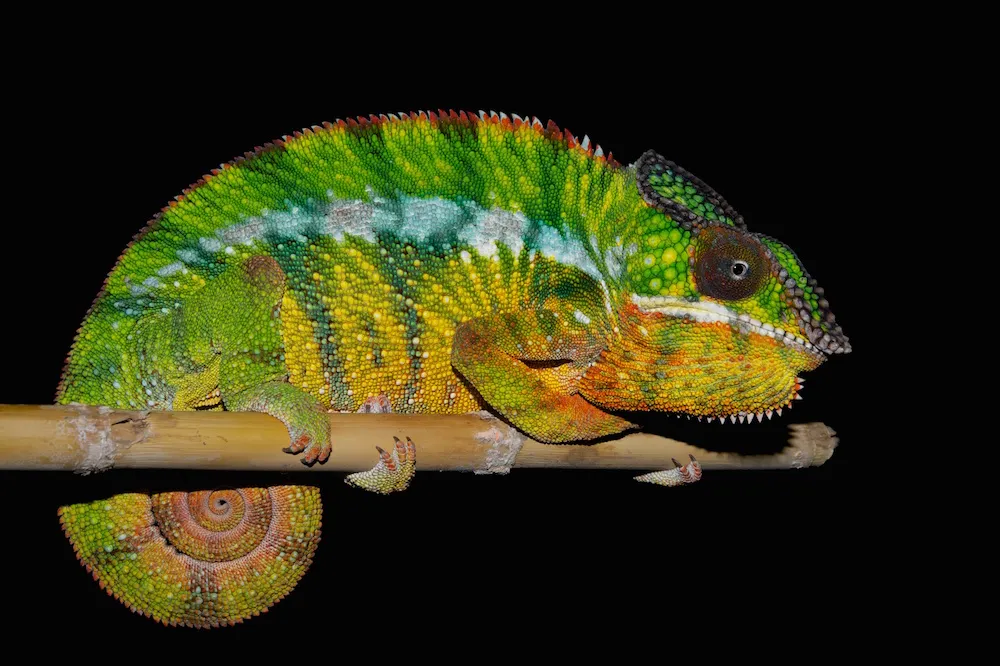
Chameleons, such as F. pardalis, have long projectile tongues, independently movable eyes and two toes that point forward and two that point backward, according to the researchers of a new study. Chameleons also move at a very slow pace. (Photo credit: Michel Milinkovitch)
Green camouflage

Some animals change color when their skin cells disperse or aggregate different pigments, but chameleons don't operate this way. "We realized that the general interpretation on how chameleon change color cannot be correct," said study senior author Michel Milinkovitch, a professor of genetics and evolution at the University of Geneva in Switzerland. (Photo credit: Michel Milinkovitch)
Flashy colors
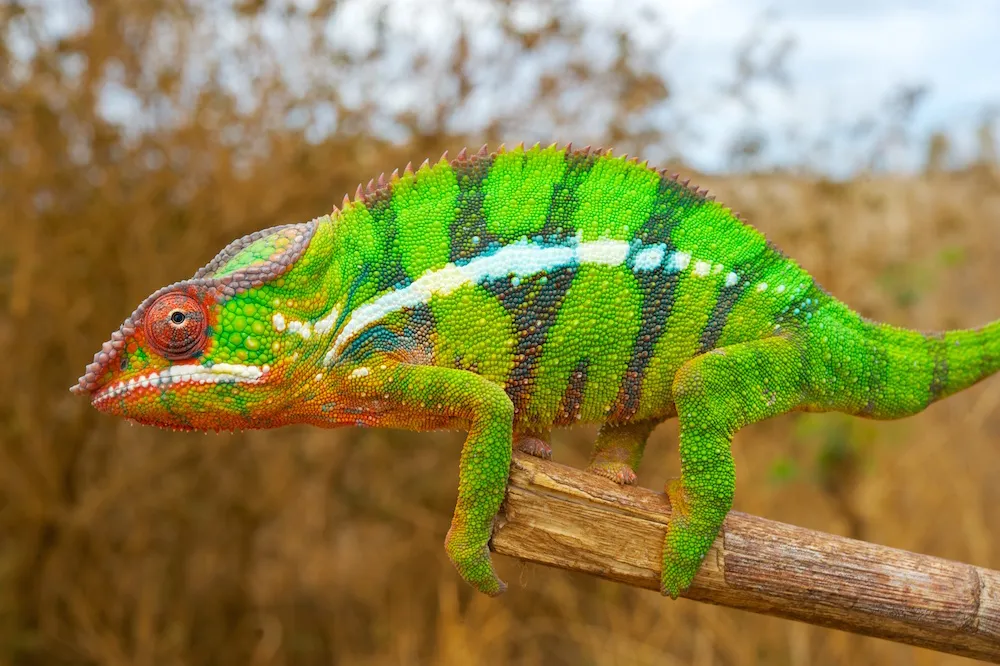
Chameleons have two layers of special skin cells, the researchers found. The upper layer, which is more prominent in males than in females and juveniles, can change color by changing its structure and how it reflects lights, they said. (Photo credit: Michel Milinkovitch)
Chilling out

The bottom layer of cells appear to reflect near-infrared light from the sun. While these cells may not help chameleons change color, they may help the lizards stay cool on hot, sunny days, the researchers said. (Photo credit: Michel Milinkovitch)
Inspirational cells

The chameleon's color-changing abilities may inspire new technologies that shift color, just like the lizard has been doing for hundreds of millions of years, Milinkovitch said. (Photo credit: Michel Milinkovitch)
Color shift

This male chameleon changed color, from green to yellow. Its red markings also became more vibrant as it altered its hues. (Photo credit: Michel Milinkovitch)
Follow Laura Geggel on Twitter @LauraGeggel. Follow Live Science @livescience, Facebook & Google+.