 Live Science Plus


You are now subscribed
Your newsletter sign-up was successful
Want to add more newsletters?

Delivered Daily
Daily Newsletter
Sign up for the latest discoveries, groundbreaking research and fascinating breakthroughs that impact you and the wider world direct to your inbox.

Once a week
Life's Little Mysteries
Feed your curiosity with an exclusive mystery every week, solved with science and delivered direct to your inbox before it's seen anywhere else.

Once a week
How It Works
Sign up to our free science & technology newsletter for your weekly fix of fascinating articles, quick quizzes, amazing images, and more
Delivered daily
Space.com Newsletter
Breaking space news, the latest updates on rocket launches, skywatching events and more!
Once a month
Watch This Space
Sign up to our monthly entertainment newsletter to keep up with all our coverage of the latest sci-fi and space movies, tv shows, games and books.

Once a week
Night Sky This Week
Discover this week's must-see night sky events, moon phases, and stunning astrophotos. Sign up for our skywatching newsletter and explore the universe with us!
Join the club
Get full access to premium articles, exclusive features and a growing list of member rewards.
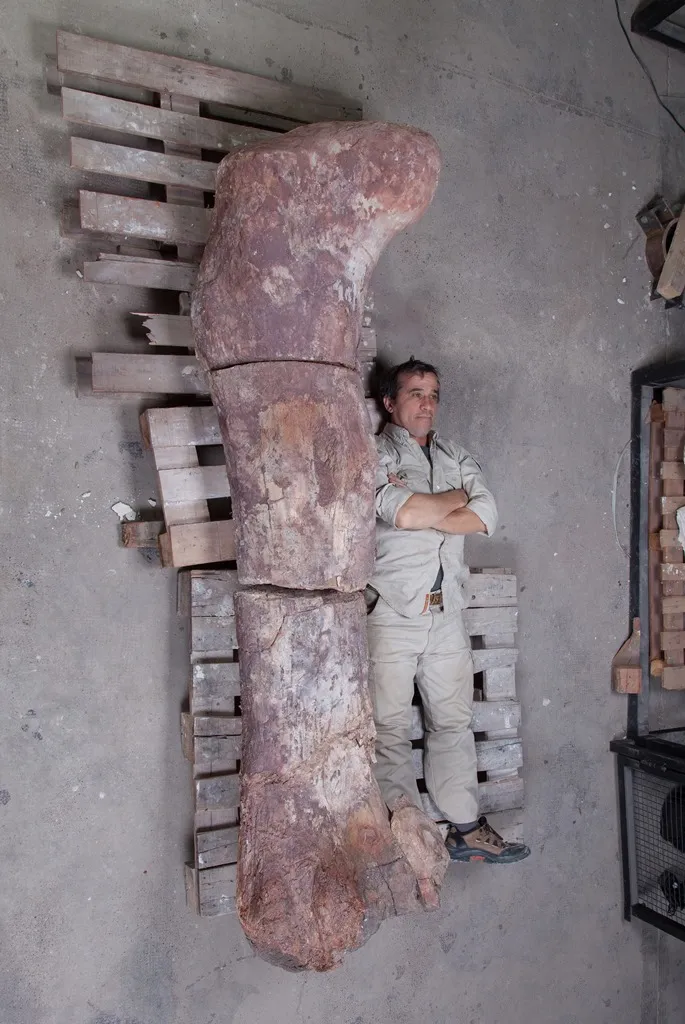
The bones of seven huge dinosaurs that each weighed more than a dozen elephants and had femurs bigger than a human adult have been discovered in Argentina, scientists announced.
The plant-eating beasts plodded across South America 95 million years ago, during the Mesozoic Era, and they may represent a new species. The creatures may even be the biggest dinosaurs known, outshining their long-tailed, long-necked titanosaur cousins like Argentinosaurus, said the paleontologists who excavated the bones.
Using jackhammers, shovels and even bulldozers, researchers of the Museum of Paleontology Egidio Feruglio in Argentina's Patagonia region removed the fossils from a site in the center of Chubut province, about 160 miles (260 kilometers) from the city of Trelew. A farm worker first discovered dinosaur bones there in 2011. So far, scientists have found more than 200 fossils at the site, including leg bones, vertebrae, teeth and tail bones. [See Photos of the Dino Discovery]
The amazing state of preservation of the bones is rare. The animals, all adults, appear to have died around the same time. The researchers speculate that they they succumbed to dehydration or got stuck in the mud while gathering around small pools of water to drink. In this deadly graveyard, the reptiles may have become food for scavengers like carnivorous dinosaurs in the Tyrannotitan genus.
Based on the fossils of the newfound herbivore sauropod, which has yet to receive a name, scientists think it would have stretched 131 feet (40 meters) in length and weighed 80 tons (73 tonnes).
"It's like two semi trucks, one after another, and the equivalent of more than 14 African elephants' weight together," researcher José Luis Carballido, of Museum of Paleontology Egidio Feruglio in Argentina's Patagonia region, said in a statement.
Follow Megan Gannon on Twitter and Google+. Follow us @livescience, Facebook & Google+. Original article on Live Science.

