It's quick and easy to access Live Science Plus, simply enter your email below. We'll send you a confirmation and sign you up for our daily newsletter, keeping you up to date with the latest science news.
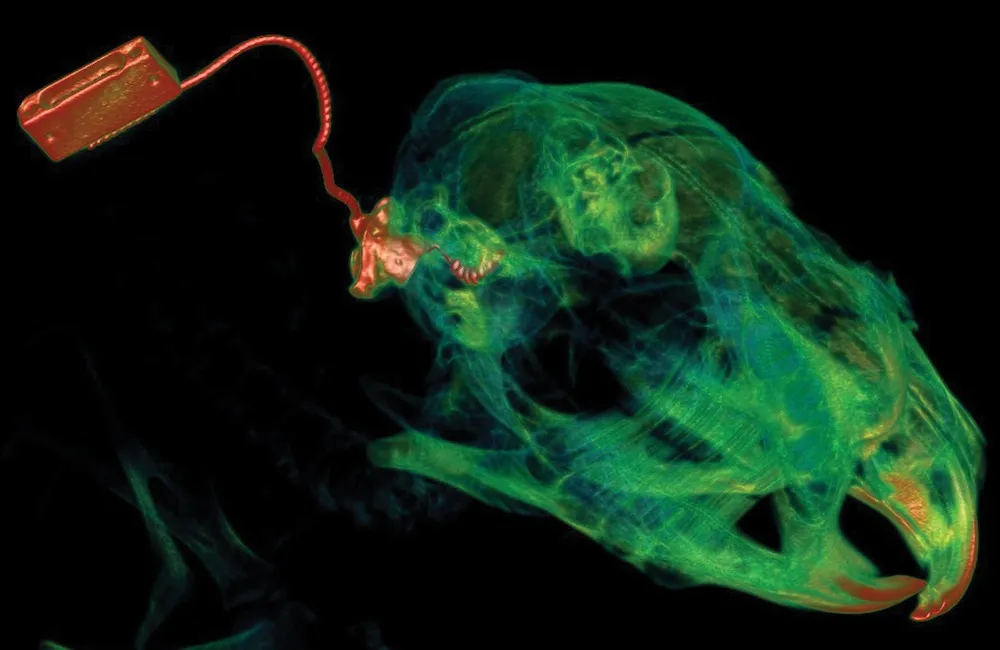
MicroCT imaging showing a cochlear implant in the left ear of a guinea pig.
(Image credit: Image from the UNSW Australia Biological Resources Imaging Laboratory and National Imaging Facility of Australia, with T.-T. Hung and A. Kwek, and UNSW Translational Neuroscience Facility, J. Pinyon and G. Housley)
People who are deaf might be able to regain most of their hearing one day, thanks to a new treatment that uses a cochlear implant to deliver genetic instructions to fix their auditory nerves, new research suggests.
In experiments on deaf guinea pigs, researchers found that the new technique, which uses cochlear implants to deliver DNA directly to the nerves, restored the animals' hearing to a near-normal level, according to the report, published today (April 23) in the journal Science Translational Medicine. Cochlear implants are electronic devices that can be surgically implanted to restore hearing in people whose deafness is caused by certain conditions.
If proven effective in humans, this experimental use of a cochlear implant to fix the nerves could offer significant improvement over current implants, the researchers said. For one, it could allow patients to hear and music.
"People with cochlear implants do well with understanding speech, but their perception of pitch can be poor, so they often miss out on the joy of music," study researcher Gary Housley, an animal physiologist at the University of New South Wales in Australia, said in a statement. [Video: Designing the Next Generation of Cochlear Implants]
Better implants
Hearing loss usually results from the loss of hair cells in a snail-shaped region of the inner ear called the cochlea, which converts acoustic vibrations into nerve signals that the brain can interpret as sounds. Cochlear implants have been used since the 1970s to take over the function of hair cells, but the devices can't completely restore a person's hearing to normal.
Researchers have long known that delivering chemicals called neurotrophins, which are crucial to nerve function and survival, to the cochlea can help nerve endings regenerate. But so far, there hasn't been a safe, effective way to get these chemicals into the cochlea cells.
Sign up for the Live Science daily newsletter now
Get the world’s most fascinating discoveries delivered straight to your inbox.
In the new study, the researchers implanted guinea pigs with cochlear implants that used pulses of electricity to place DNA snippets close enough to the nerves that they could take up the DNA and start producing the chemicals. (In contrast, traditional gene therapy that uses a virus to deliver genetic material to the cells has been less successful.)
The results showed that the guinea-pig nerve cells used the DNA to produce their own neurotrophins, which helped the nerves regenerate.
Dramatic hearing boost
The researchers then tested the guinea pigs' hearing using a method commonly used to test the hearing of newborn babies. The researchers placed electrodes on the guinea pigs' heads to measure cochlear nerve responses to sounds.
The results were dramatic: Animals that had been almost completely deaf were able to hear at near-normal levels.
Comparison of the cochlear nerve after neurotrophin gene therapy (top) versus the untreated cochlea from the same animal (bottom).
(Image credit: Image courtesy of UNSW Australia Translational Neuroscience Facility, J. Pinyon and G. Housley)
Although the cells stopped churning out neurotrophins after a few months, the nerve regeneration produced by the cochlear implant persisted, the researchers said.
The next step will be to test the cochlear-implant gene therapy in human clinical trials. This type of electrical therapy might also be useful in treating neurological disorders such as Parkinson's disease and psychiatric conditions such as depression, scientists say.
The research was supported in part by funding from the biotechnology company Cochlear Ltd.
Tanya was a staff writer for Live Science from 2013 to 2015, covering a wide array of topics, ranging from neuroscience to robotics to strange/cute animals. She received a graduate certificate in science communication from the University of California, Santa Cruz, and a bachelor of science in biomedical engineering from Brown University. She has previously written for Science News, Wired, The Santa Cruz Sentinel, the radio show Big Picture Science and other places. Tanya has lived on a tropical island, witnessed volcanic eruptions and flown in zero gravity (without losing her lunch!). To find out what her latest project is, you can visit her website.