 Live Science Plus


You are now subscribed
Your newsletter sign-up was successful
Want to add more newsletters?

Delivered Daily
Daily Newsletter
Sign up for the latest discoveries, groundbreaking research and fascinating breakthroughs that impact you and the wider world direct to your inbox.

Once a week
Life's Little Mysteries
Feed your curiosity with an exclusive mystery every week, solved with science and delivered direct to your inbox before it's seen anywhere else.

Once a week
How It Works
Sign up to our free science & technology newsletter for your weekly fix of fascinating articles, quick quizzes, amazing images, and more
Delivered daily
Space.com Newsletter
Breaking space news, the latest updates on rocket launches, skywatching events and more!

Once a month
Watch This Space
Sign up to our monthly entertainment newsletter to keep up with all our coverage of the latest sci-fi and space movies, tv shows, games and books.

Once a week
Night Sky This Week
Discover this week's must-see night sky events, moon phases, and stunning astrophotos. Sign up for our skywatching newsletter and explore the universe with us!
Join the club
Get full access to premium articles, exclusive features and a growing list of member rewards.
Updated at 2:06 p.m. ET, Friday, Sept. 13.
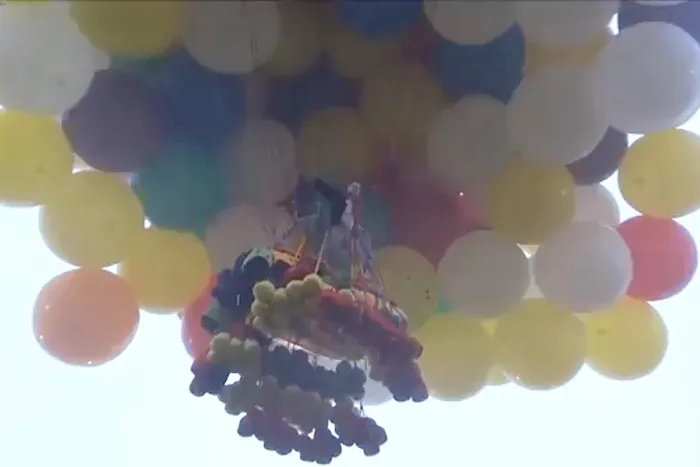
Balloonist Jonathan Trappe, who was attempting to set a new world record by becoming the first person to cross the Atlantic Ocean by cluster ballooning, has abandoned his effort and landed in a remote part of Canada.
An experienced cluster balloonist, Trappe has floated over the English Channel and once traveled for 14 hours by balloon, setting a world record. "This is far greater than anything achieved before," Trappe said before liftoff. "I'm looking at 62 hours or longer."
But Trappe's latest attempt was short-lived: He reported "technical difficulties" late Thursday evening, landed his craft and spent the night in an isolated area of coastal Canada, according to Reuters.
Cluster ballooning is an extreme activity that began in 1982, when Larry Walters of San Pedro, Calif., strapped 45 helium balloons to an ordinary lawn chair, intending to rise a few yards above his backyard. Underestimating the lift of helium balloons, Walters suddenly found himself shooting upward to a height of about 15,000 feet (4,600 meters). He eventually landed safely by using a pellet gun to shoot some of his balloons, but not before his "aircraft" became entangled in some power lines, causing an area-wide blackout.
Not all balloonists are greeted with the same enthusiasm that Walters and Trappe have encountered. The U.K. Royal Society of Chemistry (RSC) has denounced cluster-ballooning stunts as a waste of helium, a valuable and increasingly rare commodity. "While Mr. Trappe is attempting a remarkable feat, when you know how precious helium is, it seems crazy to use such a large volume of it in such a frivolous way," James Hutchinson, science manager of the RSC, said in a statement.
Indeed, resource managers worldwide are growing increasingly alarmed over the looming shortage of helium. Though it's the second-most-abundant element in the universe after hydrogen, helium is not easy to find or store in usable quantities — most of the helium in the atmosphere escapes into space, and current helium supplies are largely extracted from underground natural-gas reserves.
Because helium has the lowest boiling and melting points of all the chemical elements — liquid helium is the only liquid that cannot be solidified by lowering its temperature — it's proven to be indispensable in a wide range of industrial and medical uses. Magnetic resonance imagery (MRI) relies on helium to cool the powerful magnets needed to create MRI scans.
Helium is also essential to the manufacturing of computer chips, optical fiber and medical lasers. It's often used in rocket-engine testing, arc welding, air-to-air missile guidance, and other civilian and military uses. Party balloons and parade floats use just a small fraction of the world's helium supply.
Editor's Note: This article was updated shortly after posting to include the news that the balloonist had abandoned his Transatlantic voyage.
Follow Marc Lallanilla on Twitter and Google+. Follow us @livescience, Facebook & Google+. Original article on LiveScience.

