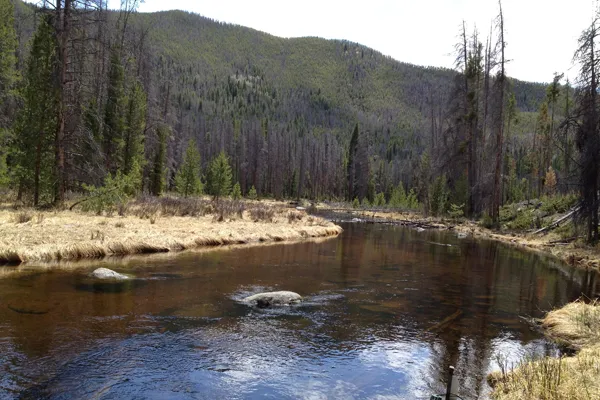
This Research in Action article was provided to LiveScience in partnership with the National Science Foundation.
Hydrological studies in the Rocky Mountains involving the tiny mountain pine beetle — a species of bark beetle — have big implications for water resource management in Colorado and elsewhere. A team of National Science Foundation-funded scientists is investigating how a rampant beetle infestation could change the quantity and quality of drinking water in Colorado.
Beetles burrowing into pines create open areas in the trees' bark.
(Image credit: Lindsay Bearup)
Scientists say bark beetles have killed about 90 percent of Colorado's lodgepole pines — 4.5 million acres of trees. The loss of trees and tree canopy affects processes important to the water cycle, including the buildup and melting of the snowpack under trees. It also changes patterns in evapotranspiration (evaporation plus transpiration — a process by which plants take up water via their root systems and release it into the atmosphere as vapor).
In earlier years, cooler temperatures in fall and winter checked bark beetle populations in western North America. But with warming temperatures and trees weakened by drought, there have been massive outbreaks.
With so many dead trees available as fuel, forest fires are a concern. And so are changes to the quality of drinking water. Decomposing pine needles on the forest floor mix with runoff to create a "pine tree tea" — foul tasting and smelling. Scientists have found evidence that the fallen needles affect the natural chemical makeup of Colorado's drinking water, and these researchers continue to study the problem.
Scientists take soil and microbial samples beneath a beetle-killed tree.
(Image credit: Thomas Cooper, Lightbox Images)
You can learn more about this environmental problem in a video the National Science Foundation created with NBC Learn, "Sustainability: Water — Dead Trees & Dirty Water in the Rockies." It is one of seven videos in a sustainability and water series released earlier this month.
Editor's Note: Any opinions, findings, and conclusions or recommendations expressed in this material are those of the author and do not necessarily reflect the views of the National Science Foundation. See the Research in Action archive.
Sign up for the Live Science daily newsletter now
Get the world’s most fascinating discoveries delivered straight to your inbox.