
Hooks, Graps & Spines: IDing Moth Genitalia

New moth species
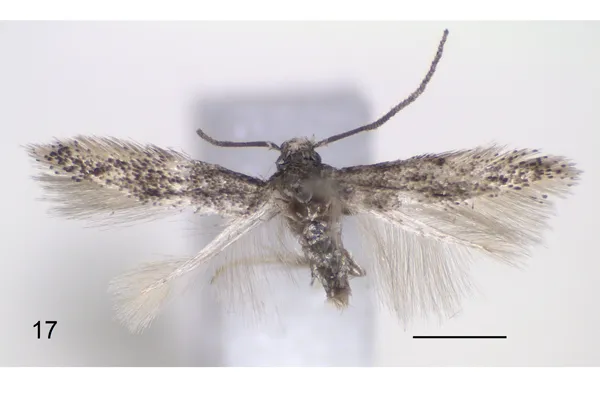
Three new species of moths have been discovered in South Africa's Tswaing Crater Reserve. Here, a male of the newly-discovered species Urodeta trilobata is shown. All three of the new moths, collected and described by Jurate de Prins, of Belgium's Royal Museum for Central Africa, are tiny, with fringe-like scales on their wings. None have wingspans larger than 7 millimeters (about 0.25 inch).
Moth genitalia

The new moths were identified partially due to de Prins' examination of the bugs' genitals (pictured: male U. trilobata genitals, stained with purple dye). That's because for many years, studying the genitalia of lepidoptera (butterflies and moths) has been "the best indicator to diagnose a species," de Prins said. "Especially in savanna areas, a lot of species have the same wing pattern, but genitalia are like lock and key," she said.
Lock and key

Experienced taxonomists can match males and females of the same species simply by looking at how their private parts fit together, since each species has evolved a different "lock and key" mechanism, with males serving as the "key" and females as the "lock."
Article continues belowFemale genitalia

Female U. trilobata genitalia, stained with black dye, appear like bizarre alien flowers on these slides, prepared by de Prins.
Another female

The female genitalia of U. quadrifida, another new species, are markedly different ...
Similar looks

... though the moths don't appear all that different from far away.
That's why moth genital differences are actually an important adaptation, says Chris Grinter, an entomologist at the Denver Museum of Nature and Science, because male bugs "tend not to be very discriminating once they find something that kind of looks similar to mate with."
Old-school technique
Genitalia analysis is a very old-fashioned technique, over 100 years old. The tools and chemicals haven't changed much in that time, Grinter says. "It's convenient to work with ... especially with lepidoptera. They can be small and covered with scales. Getting to the genitalia is often easier than getting to the exoskeleton."
