It's quick and easy to access Live Science Plus, simply enter your email below. We'll send you a confirmation and sign you up for our daily newsletter, keeping you up to date with the latest science news.
Australian pygmy moths that are well equipped for courtship are appropriately borrowing their name from the 18th century Italian philanderer and adventurer Giacomo Casanova.
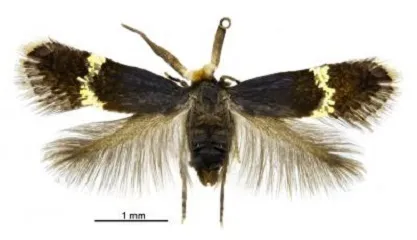
Researchers say they named the newly designated subgenus "Casanovula" (within the genus Pectinivalva) because these metallic-colored species sport mustache-like patches that seem to help them lure females by spreading their scent.
These patches — which look like overlapping shells up close — can be found on their front legs, wings or abdomen and they are thought to help disperse scent from a close range during courtship of the female.
Romantic bouquet: The male Pectinivalva minotaurus has two kinds of shell-like scent scales on the abdomen to woo the female.
(Image credit: Landcare Research and Naturalis Biodiversity Center)
One of the group's more remarkable species is Pectinivalva (Casanovula)minotaurus, named for the bull-headed Minotaur of Greek myths. The male of this species has two different kinds of the scent-spreading tufts on its abdomen and huge, bizarrely flattened antennae, researchers say.
The tiny moths, whose wingspan reaches only a third of an inch across (8 millimeters), belong to a family called Nepticulidae that dates back to the time of the dinosaurs, around 110 million years ago, researchers say. The Casanovula subgenus was described online this month in the journal ZooKeys.
For the science geek in everyone, Live Science offers a fascinating window into the natural and technological world, delivering comprehensive and compelling news and analysis on everything from dinosaur discoveries, archaeological finds and amazing animals to health, innovation and wearable technology. We aim to empower and inspire our readers with the tools needed to understand the world and appreciate its everyday awe.

 Live Science Plus