














Image: Aurora Dips South Across Canada

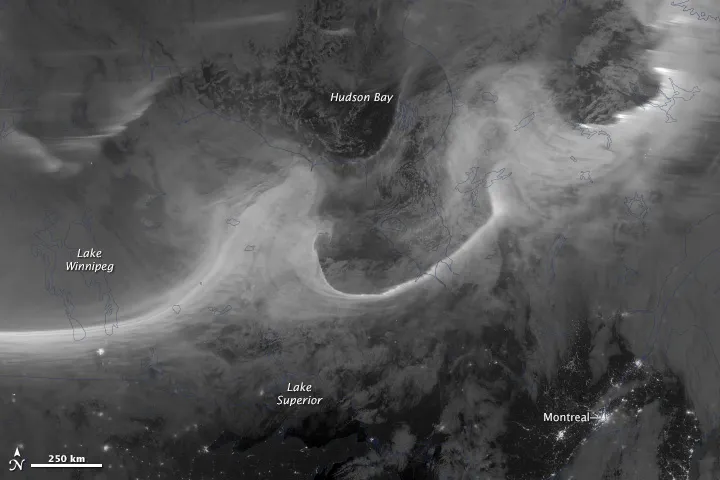
When a powerful solar flare, known as a coronal mass ejection, hit Earth's magnetic field on Oct. 8, people living in North America's northern latitudes were treated to a spectacular light show.
This visible light image from the Suomi National Polar-orbiting Partnership (Suomi NPP) satellite shows the northern lights swirling across Canada's Quebec and Ontario provinces. The city lights of Montreal also shine in the bottom of the image.
The aurora borealis, also called the northern lights, forms when charged particles from the sun collide with particles in Earth's magnetic field. The aurora is typically limited to high northern latitudes because the magnetic field sweeps the charged particles toward the poles. But when large solar flares bombard the Earth, the aurora can dip south to lower latitudes.
The coronal mass ejection that caused the display erupted from the sun on Oct. 4 at 11:24 p.m. ET and arrived at Earth on Oct. 8 at 12:30 a.m. ET, as observed by instruments aboard NASA's Advanced Composition Explorer (ACE) spacecraft, according to a statement from NASA..
When the sun's particles hit Earth's magnetic field, it caused a space weather phenomenon called a geomagnetic storm. This storm was categorized as a relatively mild G2, on a scale from G1 to G5.
Follow OurAmazingPlanet on Twitter @OAPlanet We're also on Facebook and Google+.
Get the world’s most fascinating discoveries delivered straight to your inbox.
