Live Science Plus





You are now subscribed
Your newsletter sign-up was successful
Want to add more newsletters?

Delivered Daily
Daily Newsletter
Sign up for the latest discoveries, groundbreaking research and fascinating breakthroughs that impact you and the wider world direct to your inbox.

Once a week
Life's Little Mysteries
Feed your curiosity with an exclusive mystery every week, solved with science and delivered direct to your inbox before it's seen anywhere else.

Once a week
How It Works
Sign up to our free science & technology newsletter for your weekly fix of fascinating articles, quick quizzes, amazing images, and more
Delivered daily
Space.com Newsletter
Breaking space news, the latest updates on rocket launches, skywatching events and more!

Once a month
Watch This Space
Sign up to our monthly entertainment newsletter to keep up with all our coverage of the latest sci-fi and space movies, tv shows, games and books.

Once a week
Night Sky This Week
Discover this week's must-see night sky events, moon phases, and stunning astrophotos. Sign up for our skywatching newsletter and explore the universe with us!
Join the club
Get full access to premium articles, exclusive features and a growing list of member rewards.
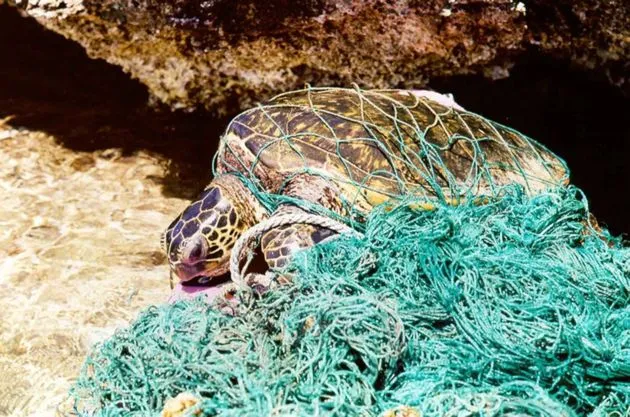
Huge swaths of the Pacific Ocean are loaded with discarded fishing nets that entangle marine mammals, turtles and sea birds, a new study found.
Researchers used satellites to get a better handle on the scope of the so-called ghostnet problem, then flew over specific areas to count the junk.
"There is a lot more trash out there than I expected," said James Churnside, a researcher with the National Oceanic and Atmospheric Administration (NOAA).
The nets tend to congregate, driven by wind and currents. Because they're made of synthetic materials, they decay slowly and can drift for years. Many end up on coral reefs, where removing them is time-consuming and costly -- knife-wielding divers cut the nets and load them into inflatable boats.
Divers have removed 77,000 pounds of old fishing nets from the reefs and shorelines of the Hawaiian Islands alone, according to Mary Donohue, Marine Debris Coordinator for the National Marine Fisheries Service in Honolulu.
In one tally of the consequences, divers have found 170 endangered Hawaiian monk seals entangled in nets since 1982.
Churnside and colleagues used satellites to plot convergence zones. Then this spring they flow over one of the zones during a three-day mission on a P-3 Orion Aircraft based in Honolulu. They spotted about 2,000 individual pieces of debris, including at least 100 nets or pieces of net. Some balled-up net fragments were 30 feet (10 meters) across.
"One piece of driftnet that was still stretched out, and presumably still fishing, was 200-300 meters long," Churnside said. That's at least twice the length of a football field.
It's not yet clear if the convergence zones are more efficient at trapping debris than expected or whether there simply is much more material floating in or near the zones and available for capture than suspected. Future flights and more research are planned to answer this question and figure out how to remove ghostnets from the ocean.
One strategy might be to develop a way to predict where in the ocean the debris is likely to accumulate, so that it can be cleaned up before it clings to a reef.
Related Stories
- Coral Reef Damage Rising Worldwide
- Silver Contaminates 'Pristine' North Pacific
- Gulf Dead Zone Starts Earlier, May Grow Larger
- Ship Noise Drowns Out Whale Talk, a Threat to Mating
Image Gallery