 Live Science Plus





You are now subscribed
Your newsletter sign-up was successful
Want to add more newsletters?

Delivered Daily
Daily Newsletter
Sign up for the latest discoveries, groundbreaking research and fascinating breakthroughs that impact you and the wider world direct to your inbox.

Once a week
Life's Little Mysteries
Feed your curiosity with an exclusive mystery every week, solved with science and delivered direct to your inbox before it's seen anywhere else.

Once a week
How It Works
Sign up to our free science & technology newsletter for your weekly fix of fascinating articles, quick quizzes, amazing images, and more

Delivered daily
Space.com Newsletter
Breaking space news, the latest updates on rocket launches, skywatching events and more!

Once a month
Watch This Space
Sign up to our monthly entertainment newsletter to keep up with all our coverage of the latest sci-fi and space movies, tv shows, games and books.

Once a week
Night Sky This Week
Discover this week's must-see night sky events, moon phases, and stunning astrophotos. Sign up for our skywatching newsletter and explore the universe with us!
Join the club
Get full access to premium articles, exclusive features and a growing list of member rewards.
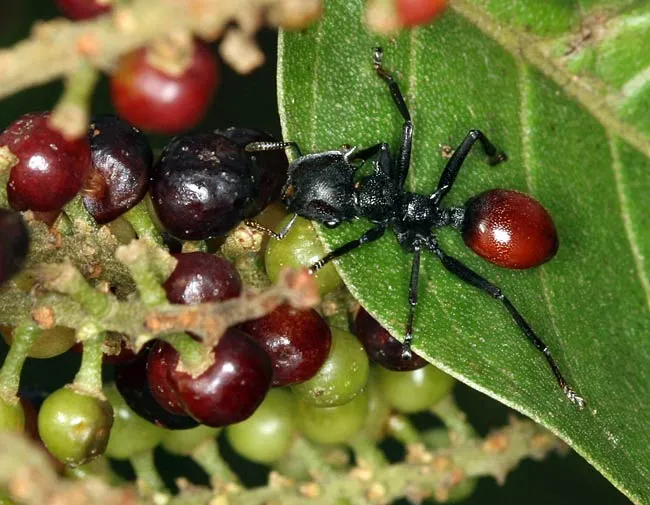
Infectious stomach flus may be gut-wrenching for us, but consider the plight of some tropical black ants: When infected by tiny nematode worms, the ants' rumps resemble a bright-red, bird-attracting berry.
The parasites' strange transformative ability might help it spread to other ant colonies, scientists report in two new studies. Birds normally avoid eating the foul-tasting ants, but the berry-like temptation may be too much, said researcher Steve Yanoviak, an insect ecologist at the University of Arkansas in Little Rock.
"These ants are strange. Half of the solid material they bring into their nests is bird poop, which they feed to their larvae," Yanoviak said of the ant specie, Cephalotes atratus. "That sets the stage for an easy, consistent way for the nematodes to get into a colony."
Yanoviak and his colleagues detail the ant-parasite relationship in an upcoming issue of the journal American Naturalist and describe the new species of nematode parasite — Myrmeconema neotropicum — in an upcoming edition of the journal Systematic Parasitology.
Recycled poop
When ants lug infected bird doo-doo into their colony and feed it to helpless larvae, Yanoviak said, the parasites migrate into their abdomens, or gasters.
Once settled into the pencil-eraser-sized gaster, the worms partially dissolve the insect's jet-black exoskeleton to make it translucent.
"When you combine that with the amber color of the eggs and shine sunlight on it, you get something that looks remarkably like a berry," Yanoviak told LiveScience, noting that the infestation also causes the ant's rear to stick up in the air. "We think birds confuse [the gaster] for local varieties of berries, completing the parasite's life cycle."
The infestation seems horrific, but Yanoviak said he isn't sure it reduces ant lifespan all that much.
"I've cut open a lot of these ants and their digestive tracts are still in tact," Yanoviak said, comparing the invasion to a wild case of tapeworms in humans. "The nutrition goes directly to the parasites, which makes for a scrawny ant, but I've tracked ants that lived for at least 3 months."
Ants unaffected by the parasite live for about 6 months, he said.
Berry bum evolution
Yanoviak thinks the parasite evolved as a result of the unique relationship between tropical birds and their dung-recycling ants, which are also known for their mid-air gliding ability.
"You see similar parasites in fire ants and beetles from other regions, but they don't cause the red discoloration," Yanoviak said. "All the pieces seem to be in place for this parasite to evolve the way it did."
He explained that birds tend to carry a lot of parasites, and that the ants tend to collect bird droppings during the day. Over time, he noted, the parasite exploited the unoccupied ecological niche.
"There's almost no end to the amazing things that parasites can do," Yanoviak said, "no matter how simple they are."
- See the Video: Ant Parasites
- Gallery: Ants of the World
- Videos: Ant Bite, High Jump, Long Jump
