













Ships Drown Out Right Whales' Songs

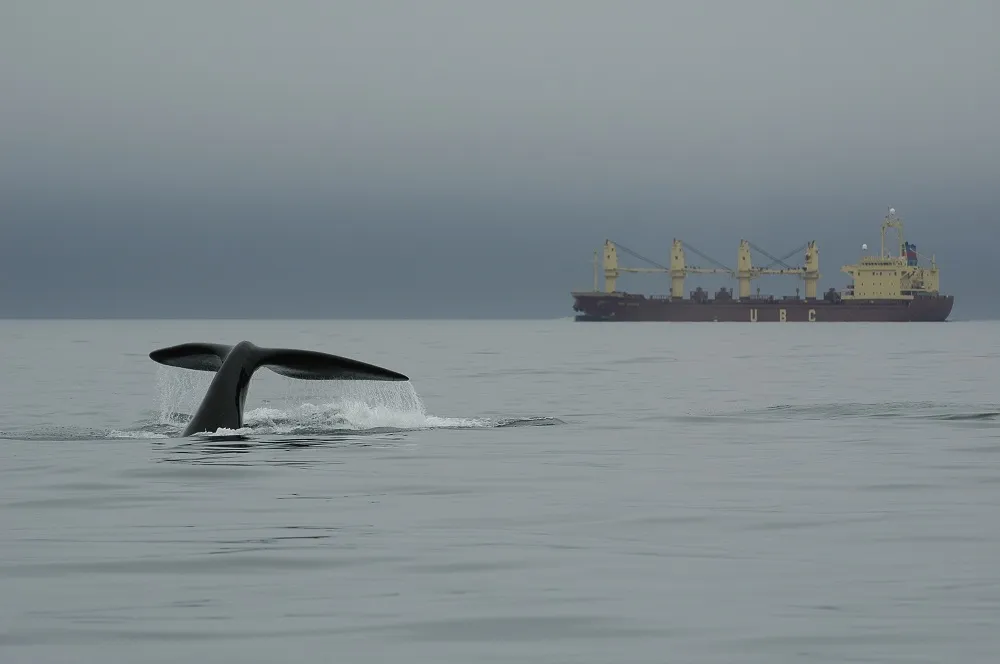
Ever-increasing noise in the ocean has been recognized as a major threat to whales, who sing at low frequencies to communicate with each other over long distances. Now researchers say underwater noise, mainly from ship sounds, drastically cut the ability of North Atlantic right whales to talk to each other in the past five decades.
Researchers monitored noise levels around the Stellwagen Bank National Marine Sanctuary in Massachusetts Bay from 2007 to 2010. As part of the study, they measured sound levels associated with ships and recorded calls made by different species of endangered baleen whales, including the upcalls — which begin low and rise in pitch — used by the critically endangered right whales to stay in touch with each other.
The researchers then compared noise levels from commercial ships today with noise conditions from nearly a half-century ago. Based on this data, they reported in the journal Current Biology that right whales have lost, on average, 63 to 67 percent of their access to underwater airwaves in the sanctuary and its surrounding waters, according to a statement from NOAA.
"A good analogy would be a visually impaired person, who relies on hearing to move safely within their community, which is located near a noisy airport," said Leila Hatch, a NOAA marine ecologist at the sanctuary, who led the study. "Large whales, such as right whales, rely on their ability to hear far more than their ability to see. Chronic noise is likely reducing their opportunities to gather and share vital information that helps them find food and mates, navigate, avoid predators and take care of their young."
The noise from a just one ship could make it nearly impossible for a right whale to be heard by other whales, said Christopher Clark, of Cornell University, who also was involved in the study.
"What we've shown here is that in today's ocean off Boston, compared to 40 or 50 years ago, the cumulative noise from all the shipping traffic is making it difficult for all the right whales in the area to hear each other most of the time, not just once in a while," Clark said in a statement from NOAA. "Basically, the whales off Boston now find themselves living in a world full of our acoustic smog."
More noise means the whales' communication range for feeding or mating, could shrink and stress levels on individual animals may rise. Previous studies have shown that right whales might increase the amplitude in their calls as background noise increases. But changing calling habits can come at a price. Researchers say louder calls require more energy and could garble the whale's message.
Get the world’s most fascinating discoveries delivered straight to your inbox.
