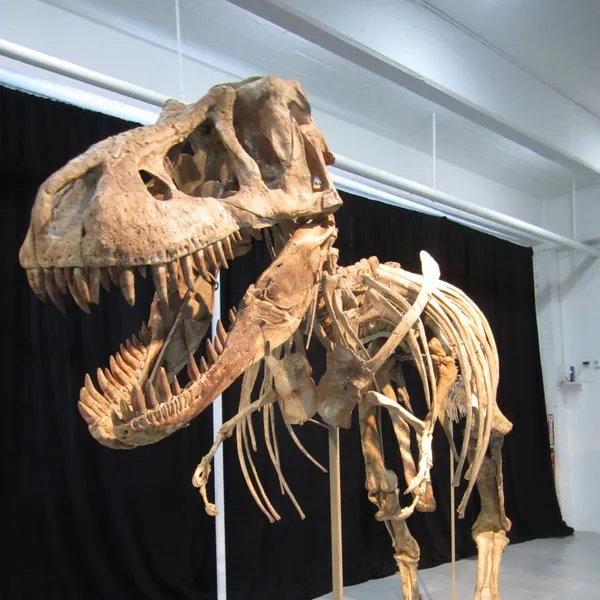
The nearly complete dinosaur that went up for auction on Sunday (May 20) and is now the subject of a legal battle had a special draw thanks to its close relationship to the infamous predatory Tyrannosaurus rex.
Identified by the auction house, Heritage Auctions, as a Tyrannosaurus bataar, this skeleton belongs to a species that most paleontologists call Tarbosaurus bataar.
"Tarbosaurus bataar is in a sense the Asian version of the Tyrannosaurus rex, they are close cousins," said Lawrence Witmer, an anatomist and paleontologist at Ohio University.
Latest Videos From
Both had powerful jaws and teeth, big back legs and tiny arms, although Tarbosaurus had arms that were even smaller than those of T. rex, according to Philip Currie, a paleontologist at the University of Alberta.
The largest Tyrannosaurus found measured about 45 feet (14 meters) long, while the largest Tarbosaurus measured about 40 feet (12 meters) long, Currie told LiveScience in an email. "But there is always the possibility that bigger specimens will eventually be found for one or both."
While clearly identifiable, tarbosaurs have only been found in a roughly 70-million-year-old rock formation in Mongolia, Tyrannosaurus rex remains have turned up in many fossil beds in North America. Both were apex predators, meaning they were at the top of the food chain, and, thanks to their lineage, both are considered tyrannosaurs. [Other Auctioned Fossils Alarm Paleontologists]
You can follow LiveScience senior writer Wynne Parry on Twitter @Wynne_Parry. Follow LiveScience for the latest in science news and discoveries on Twitter @livescience and on Facebook.

 Live Science Plus