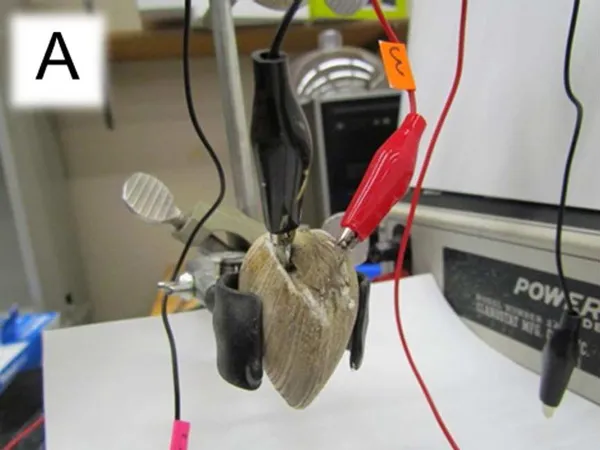
Animal cyborgs have already begun their rise as scientists transform creatures into living batteries capable of powering tiny spy gadgets or sensors. A lab has taken a new step toward that world of tomorrow by harvesting energy from clams to power an electric motor.
The same group previously showed how cyborg snails could survive hosting the first fully implanted biofuel cells. This time U.S. and Israeli researchers put implants in three living clams and then hooked the clams together as a battery to create enough electricity to turn an electric motor — a step toward the scenario in the 1999 film "The Matrix" in which Morpheus compares a human being to a Duracell battery.
"The challenge of the work with clams was in assembling individual cells in batteries," said Evgeny Katz, a professor of chemistry at Clarkson University in Potsdam, N.Y.
Katz and his colleagues implanted the biofuel cells by sticking electrodes into the clams' main body cavities filled with blood, so that the blood sugar served as the energy source for the biofuel cells. The researchers allowed the clams to rest between energy-harvesting periods so that the mollusks could rebuild blood sugar levels.
The researchers tried different ways to connect three clams at a time as a collective living battery. A serial circuit boosted the battery's voltage (electric potential), whereas a parallel circuit increased the current (rate of charge flow) — but the overall electricity available often changed depending on each clam's health.
Electrodes implanted in a living clam harvest energy from the animal's gluose blood sugar.
(Image credit: Journal of Energy & Environmental Science Clarkson University Ben- Gurion University of the Negev)
The variation "is trivial for 'normal' galvanic cells but not easy for living cells, because all of them have different electrical properties depending on physiological conditions of clams," Katz told InnovationNewsDaily.
The three-clam batteries charged a capacitor with almost 29 millijoules over an hour — enough to eventually turn an electrical motor about a quarter of a full turn. By comparison, a 75-watt light bulb uses 75 joules (75,000 millijoules) per second.
Sign up for the Live Science daily newsletter now
Get the world’s most fascinating discoveries delivered straight to your inbox.
Such a test is still a long way from the U.S. military or government agencies harnessing creatures as tiny spies capable of powering their own gadgets. But it represents one of a handful of experiments to try extracting electrical power from living organisms. Katz and colleagues found just three papers from other labs about biofuel cells implanted in a rabbit, rat and a cyborg insect.
"We need to resolve some engineering problems — most electronic devices require more power than we can get from our implanted cells," Katz said. His paper was published in the online edition of the journal Energy & Environmental Science April 12.
The researchers have begun looking to new experiments that would test how well living batteries can power microelectronic devices. Next up on the list: cyborg lobsters.
This story was provided by InnovationNewsDaily, a sister site to LiveScience. You can follow InnovationNewsDaily Senior Writer Jeremy Hsu on Twitter @ScienceHsu. Follow InnovationNewsDaily on Twitter @News_Innovation, or on Facebook.
Jeremy has written for publications such as Popular Science, Scientific American Mind and Reader's Digest Asia. He obtained his masters degree in science journalism from New York University, and completed his undergraduate education in the history and sociology of science at the University of Pennsylvania.