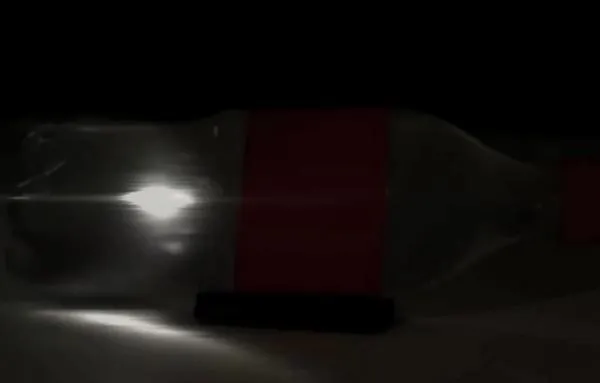
Forget about slow-motion shots of a bullet destroying an apple or a hummingbird shaking off water. Making a slow-motion video of light beams bouncing around inside a 1-liter bottle required a new super-fast imaging system — one capable of taking 1 trillion frames a second. MIT's Media Lab has now made such a system possible by harnessing camera technology usually found in chemistry experiments.
An imaging system that makes light seem slow speaks for itself, especially when light travels 700 million miles an hour on a good day in a vacuum. But to better appreciate 1 trillion frames per second (fps), consider that the iPhone 4S camera shoots HD video at just 30 fps. Even Hollywood has relied upon a mix of digital wizardry and cameras shooting at 24 fps to capture its beloved slow-motion explosions. ("Lord of the Rings" director Peter Jackson just recently stepped up his game by choosing to film "The Hobbit" prequels at 48 fps.)
"There’s nothing in the universe that looks fast to this camera," said Andreas Velten, a postdoctoral researcher at the MIT Media Lab.
The MIT researchers used a streak camera that has a narrow slit to allow in particles of light, known as photons. An electric field deflects the photons in a direction perpendicular to the slit, but deflects late-arriving photons more than early-arriving photons because it keeps changing.
Such a difference allows the streak camera to show the photons' arrival over time, but it also captures only one spatial dimension through its Slit view. To create two-dimensional images for their super-slow-mo video, the researchers had to perform the same light-passing-through-a-bottle experiment over and over again as they repositioned the camera slightly each time.
An hour's worth of work led to hundreds of thousands of data sets. Next, the MIT team, led by Ramesh Raskar, Media Lab associate professor, turned to computer algorithms to stitch the data together into the two-dimensional images.
Andreas Velten, a postdoctoral researcher at MIT's Media Lab, explains how the Camera Culture group set up an imaging system capable of taking video at one trillion frames per second.
(Image credit: MIT Media Lab. Pictures)
Such work came as a spinoff of another MIT Media Lab project by the Raskar's Camera Culture group — a camera capable of bouncing light off reflective surfaces and measuring the return time to see around corners.
Sign up for the Live Science daily newsletter now
Get the world’s most fascinating discoveries delivered straight to your inbox.
The "world's fastest slowest camera" won't have any practical filmmaking purposes anytime soon because of the time it takes and the need to repeat each scene many times, Raskar said.
But Raskar suggested that using information from how light bounces around different surfaces could allow researchers to analyze the structure of manufactured materials and biological tissues. Such technology might resemble "ultrasound with light," he said.
If the ultrafast imaging technology gets fine-tuned, Raskar envisions using it to figure out how light's photons travel through the world. That might allow his team to recreate photos taken by a portable camera with compact flash to give the illusion of studio lighting.
The streak camera and laser that created the light pulses came with a combined price tag of $250,000. They were provided by Moungi Bawendi, a professor of chemistry at MIT, who also participated in the research.
This story was provided by InnovationNewsDaily, a sister site to Live Science. Follow InnovationNewsDaily on Twitter @News_Innovation, or on Facebook.
For the science geek in everyone, Live Science offers a fascinating window into the natural and technological world, delivering comprehensive and compelling news and analysis on everything from dinosaur discoveries, archaeological finds and amazing animals to health, innovation and wearable technology. We aim to empower and inspire our readers with the tools needed to understand the world and appreciate its everyday awe.