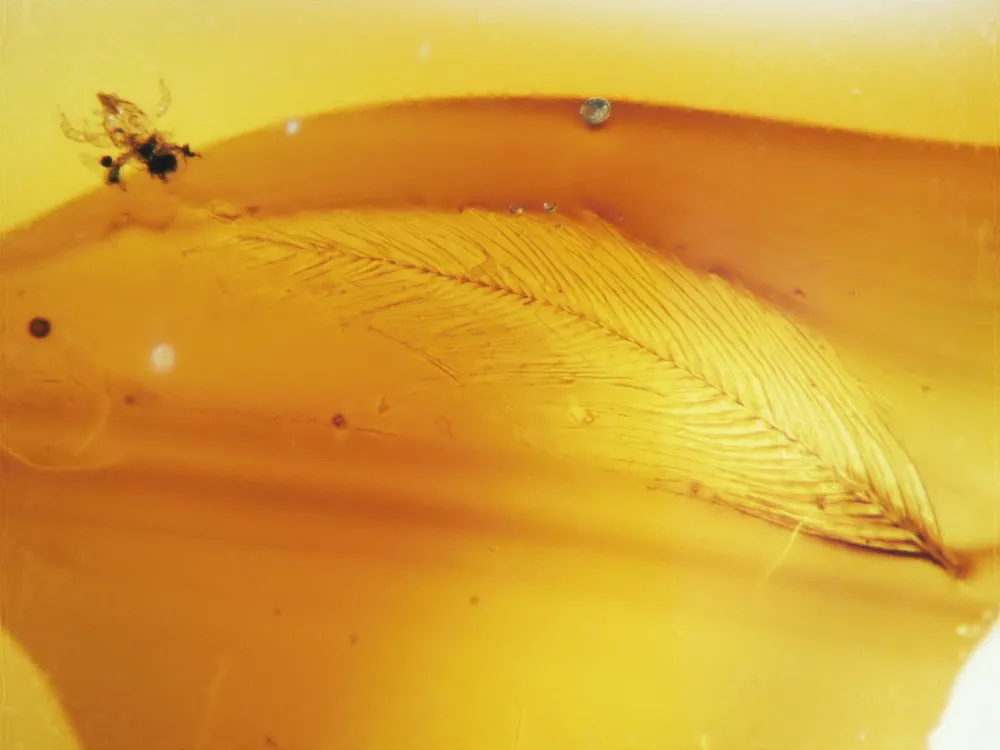
An isolated piece of feather, trapped within a tangled mass of spider’s web in Late Cretaceous Canadian amber. The feather branches may have been gray or black.
Simple Protofeathers
(Image credit: Science/AAAS)
Numerous individual filaments in Late Cretaceous Canadian amber. These filaments are similar to the protofeathers that have been found as fossils with some dinosaurs. These filaments range from clear to near-black.
Coiled For Diving
(Image credit: Science/AAAS)
A feather accompanied by a microphysid plant bug. The coiling observed in the feather is directly comparable to coils found in modern bird feathers specialized for water uptake and are suggestive of diving behavior, but similar structures can be used to transport water to the nest.
Pigmentation in these feathers gives it a beaded appearance. Pigment in the feather suggests it would have been medium- or dark-brown in color.
Curly Coils
(Image credit: Science/AAAS)
The cork-screw shaped structures in the image are the tightly coiled bases of feather barbules.
Modern Equivalent
(Image credit: Science/AAAS)
An isolated barb from a white belly feather of a modern grebe (Aechmophorus occidentalis), illustrating coiled barbule bases comparable to those in the Cretaceous specimen. In both cases, the coiling is a structural adaptation that allows the feather to absorb water.
Color-Producing Cells
(Image credit: Science/AAAS)
A feather barb that shows some indication of original coloration. The oblong brown masses within the image are regions of color within the barbules. In this specimen, the overall feather color appears to have been medium- or dark-brown.
Sign up for the Live Science daily newsletter now
Get the world’s most fascinating discoveries delivered straight to your inbox.
A clear example
(Image credit: Science/AAAS)
An isolated, unpigmented feather barb and a mite preserved in Canadian Late Cretaceous amber.
Jennifer Welsh is a Connecticut-based science writer and editor and a regular contributor to Live Science. She also has several years of bench work in cancer research and anti-viral drug discovery under her belt. She has previously written for Science News, VerywellHealth, The Scientist, Discover Magazine, WIRED Science, and Business Insider.