













Timeline of Events at Japan's Fukushima Nuclear Reactors

March 11:
A 9.0-magnitude earthquake (originally estimated at 8.9) struck off the coast of Honshu, Japan, and an enormous tsunami followed shortly after. Eleven nuclear reactors at the four nearest power plants automatically shut down upon sensing ground accelerations, stopping the nuclear fission of uranium in their cores. Nuclear fuel requires continued cooling even after a plant is shut down, though, because residual fission products continue to decay and produce a huge amount of heat. The Japanese plants use continually-pumped water, which absorbs a great deal of heat, to cool their nuclear reactors.
The earthquake knocked out the electricity at the Fukushima Daiichi plant run by Tokyo Electric Power Company (TEPCO). Emergency diesel generators were used to pump water to cool Reactor Units 1, 2 and 3, which had been operating at the time of the quake, but an hour later, the back-up generators were knocked out by tsunami flooding.
Insufficient power meant that water could not be pumped through the nuclear cores quickly enough. As the water inside the reactors heated up too high and started boiling, the water level dropped inside the cores, and the pressure rose from the steam. TEPCO declared a state of emergency. Japanese authorities ordered the evacuation of residents within a three-kilometer radius of Fukushima Daiichi, and told people within a 10-kilometre radius to remain indoors. This was a precautionary measure because, at that point, there had been no release of radiation from the nuclear power plant. The containment vessels housing the reactor vessels were withstanding the increase in pressure inside.
Workers at Fukushima Daiichi worked desperately to restore the diesel generators, and to hook up mobile power sources in order to pump sufficient water to cool the three hot reactors. Units 1 and 2 were both experiencing water level drops and rises in pressure, but the water level in all three reactor vessels remained above the fuel elements at the end of March 11.
A fire broke out at a nuclear power plant in Oganawa immediately after the earthquake. This was soon extinguished, and that plant saw no further problems.
March 12:
Get the world’s most fascinating discoveries delivered straight to your inbox.
At 9 am local Japan time, the pressure within the containment vessel of Fukushima Daiichi Unit 1 was as high as 840 kPa, compared to reference levels of 400 kPa. Officials vented the vessel to lower its pressure. The released water vapor was filtered to retain most of the radiation within the containment, but because the vapor had been through the reactor core, a certain release of radioactive substances such as caesium-137 and iodine-131 was inevitable. Tepco was also preparing to relieve pressure for Units 2 and 3.
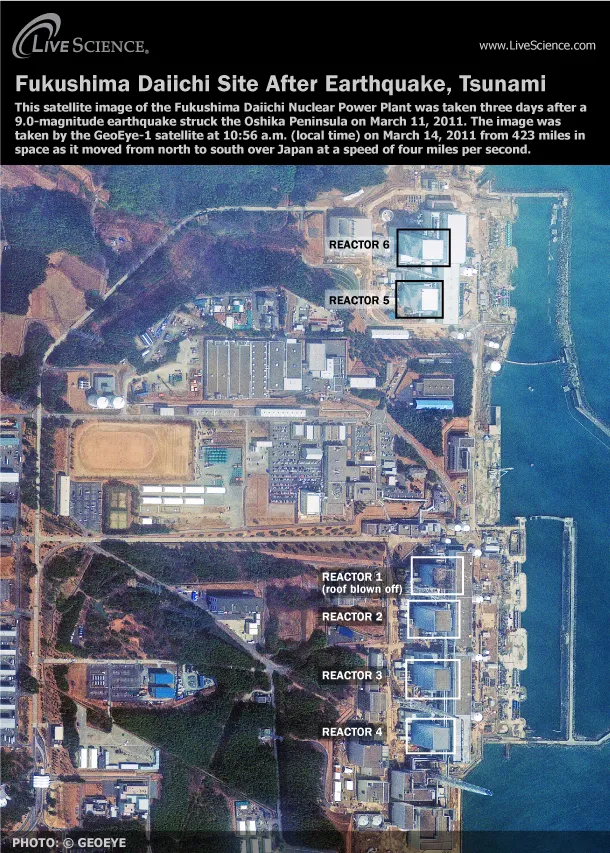
An explosion occurred at Unit 1, blowing off the roof and walls of the concrete structure built around it and leaving a naked steel structure behind. Four workers were injured. Tepco tamped down initial panic and confusion by explaining that the external building structure does not act as the containment, which is an airtight steel structure within, and that the containment was not damaged in the explosion. Hydrogen gas which had burned off of cladding around the fuel rods inside the reactors was the main substance released.
When radiation levels reached 500 microsieverts per hour around the facility due to pressure venting, non-radioactive potassium iodide tablets were brought into the area, but not distributed. Potassium iodide is quickly taken up by the body and its presence prevents the absorption of iodine-131 should people be exposed to it. The evacuation radius was also incrementally increased, eventually expanding to a 20-km radius around the facility. The injection of seawater into parts of the building near the reactor started at 8.20pm local time and was followed by the addition of boric acid, which inhibits nuclear reactions.
The nearby Fukushima Daini power plant encountered problems for the first time after safely shutting down four operational reactor units the day before. Daini Unit 1's isolation cooling system, supplemented by a back-up water condensate system, had been operating normally, but the back-up system stopped working at 5.32am local time when its suppression chamber reached 100 degrees Celsius. Residents within 10 kilometers of Daini were evacuated in case Tepco were to need to vent the containments of Daini units. The number of evacuees around both sites stood at 185,000.
March 13:
The containment of Reactor Unit 3 at Fukushima Daiichi was vented again in order to lower the pressure inside. Water levels in all three reactors were continuing to drop. Following the failure of a high pressure injection system and other attempts to cool the plant, injection of water, and later seawater, started.
Japanese officials said they believed a partial meltdown had probably occurred in at least two of the nuclear reactors, due to water levels having fallen below the level of the fuel rods inside them. [Infographic: What Is a Nuclear Meltdown?]
At Fukushima Daini Unit 1, plant operators were able to restore a residual heat remover system to cool the reactor, and workers at Units 2 and 4 were working to restore the same residual heat removal systems. Unit 3 was in a safe, cold shutdown. Radiation dose rate measurements observed at four locations around the plant's perimeter over a 16-hour period on 13 March were all normal.
March 14:
Throughout the day, all Fukushima Daiichi reactors were still being powered by mobile power generators on site, because power via off-site power supply or backup diesel generators had still not been restored.
A skeleton crew of 50 workers were continuing to inject seawater and boron into the reactor vessel to cool the reactor at Unit 1, while the reactor core in Unit 2 was being cooled through reactor core isolation cooling, a procedure used to remove heat from the core, via mobile power generators. The reactor water level was lower than normal but remained steady.
A seawater-boric acid combination continued to be injected into Unit 3. Water levels inside the reactor vessel increased steadily for a while but later stopped increasing for an unknown reason. The concentration of hydrogen was increasing inside the containment building, and a hydrogen explosion occurred at Unit 3 at 11:01 am local Japan time, injuring 11 workers. The primary containment vessel was not damaged.
Fortunately, prevailing winds were moving away from the Japanese coast to the East, carrying any radioactive materials released by venting and explosions out to sea.
The reactors Units 1, 2 and 3 of the Fukushima Daini nuclear power plant were pronounced to be in cold shutdown status, meaning the pressure of the water coolant in the three reactors was around atmospheric level and the temperature was below 100 degrees Celsius. Under these conditions, the reactors were considered to be safely under control. Unit 4 was not yet in a cold shutdown.
March 15:
A dose rate of 11.9 millisieverts (mSv) per hour was recorded early on March 15 and a 0.6 millisieverts (mSv) per hour rate was recorded six hours later, suggesting radiation levels were dropping off. Cooling via seawater injections was ongoing in all three units.
The spent fuel storage pond at the Unit 4 reactor of the Fukushima Daiichi nuclear power plant, which was thought to be in a cold shutdown, caught on fire. Radioactivity was being released directly into the atmosphere, and radiation doses of up to 400 millisieverts per hour were briefly reported between Units 3 and 4. That hourly dose is approximately 100 times the amount of background radiation the average person absorbs in a year.
The spent fuel fire was extinguished two hours after it began, and radiation levels dropped off again shortly after. Authorities said the fire may have been caused by an earlier hydrogen explosion. An explosion at the Unit 2 reactor at the Fukushima Daiichi plant had occurred at around 6:20 am local Japan time.
The 400 mSv per hour recorded radiation level caused workers to be temporarily evacuated, but they were later called back in. Officials advised residents within 30 km of Fukushima Daiichi to stay indoors.
It was determined that the hydrogen explosion at Unit 2 may have affected the integrity of its primary containment vessel, which would mean greater radiation leaks to the environment.
By the end of March 15, all units at Fukushima Daini had been brought to a cold shutdown.
March 16:
The pressure inside Unit 3 suddenly plunged, suggesting that either the gauges were malfunctioning or its containment vessel may have cracked. Radiation doses of about 250 millisieverts an hour had been detected 100 feet above the plant.
Early in the day, the water level in Unit 5 at Fukushima Daiichi, which was loaded with fuel but thought to be in a cold and safe shutdown, was found to be dropping. Diesel generators from Unit 6 were brought over to Unit 5 to pump its cooling system.
Due to ongoing power failures, temperatures at spent fuel pools at Fukushima Daiichi were rising by approximately 1 degree Celsius per day. The hottest was the pool near Unit 4, which was at 84 degrees Celsius. According to IAEA experts, a typical spent fuel pool temperature is kept below 25 ?C under normal operating conditions, which requires a constant power source.
Japanese Defense Minister Toshimi Kitazawa announced that Special Defense Forces helicopters planned to drop water onto the spent fuel rods near Unit 3, and officials were preparing to spray water into Unit 4 from ground positions.
Tepco confirmed that several workers had been injured over the previous few days. At least 17 workers had experienced some radiation exposure, and one worker suffered "significant" radiation exposure while venting a reactor unit. Two workers are missing.
March 17:
Four helicopters dropped water on the spent fuel rods of Unit 3, but this had little effect on their temperature. Military fire trucks later began spraying cooling water on them. Unit 3 was considered to be a greater threat than Unit 4, because it is the only one loaded with a mixed fuel known as MOX – which contains plutonium-239, a more dangerous radioactive material than depleted uranium-238.
An external grid power line cable was successfully attached to Unit 2. Power will be turned on in Unit 2 as soon as workers finish spraying of water on Unit 3.
March 18:
For the first time, Japanese officials admit that burying the damaged nuclear power plants in sand and concrete - the method used to seal huge radiation leakages from the Chernobyl meltdown in 1986 - maybe be the only way to prevent a massive radiation release.
"It is not impossible to encase the reactors in concrete. But our priority right now is to try and cool them down first," an official from the plant operator, Tokyo Electric Power Co, told a news conference. Officials said they still hoped to fix a power cable to at least two reactors to restart water pumps needed to cool overheating nuclear fuel rods at the Fukushima Dai-ichi plant.
New reports trickle out that, immediately after the nuclear damage was detected, Japan turned down an offer from the United States to provide technical support for cooling and dismantling the damaged reactors. At that point, Japanese officials said, the government and TEPCO still believed they could handle the situation themselves.
Meanwhile, Japan fallout reaches California but, according to an official, radiation is miniscule, far below health threat levels.
March 19 - 20:
Workers continued spraying Units 1, 2 and 3 with seawater and worked to reconnect the power supply to Unit 2 (which would then act as a hub to power Unit 1) in order to operate their cooling systems.
Unit 1's containment vessel appeared to be intact and pressure inside was restored, but the containments of Units 2 and 3 are both thought to have cracked during explosions in previous days. White smoke was seen to be emerging from both vessels, but seemed to diminish over time.
The spent fuel pools in Units 3 and 4 are still dangerously hot, and helicopters have continued dropping water on them.
The reactor cores and spent fuel pools of Units 5 and 6, which were in a cold shutdown at the time of the March 11 earthquake and had not since been problematic, began to heat up. Workers have turned on generators to pump water through them and have drilled holes in the roofs of their containment buildings to prevent the hydrogen explosions that damaged other units in previous days.
The Japanese government has advised evacuees who live within a 20 km radius of the Fukushima Daiichi plant to take iodide pills after heightened levels of radioactive iodine-31 were found in milk and vegetables grown in the area.
March 21:
The containment vessels of Reactor Units 2 and 3, which were suspected of having cracked in explosions, have been found to be intact.
Seawater injection is continuing in Units 1, 2 and 3. Plant officials said off-site power was about to be restored to Units 1 and 2, and had already been restored to Units 3 and 4. Restored power will allow normal cooling operations to resume in the reactors. A U.S. Nuclear Regulatory Commission (NRC) official described the situation at the Fukushima plant as "on the verge of stabilizing."
The NRC is planning a 90-day review of reactor safety to assess natural disaster preparations at 104 U.S. nuclear plants, some of which use the same model as the Fukushima plant. A report on the NRC’s initial findings will be released after 30 days. Bill Borchardt, executive director of operations at NRC, said he and his commission do not expect to find any significant weaknesses.
March 22:
Efforts to restore electricity to the Fukushima Daiichi plant in order to resume normal operation of its cooling system were sidetracked by rising temperatures at Unit 2's spent fuel pool. Steam was seen spewing from the pool. If water were to boil away and leave the spent fuel rods exposed, they would melt, sending radioactive materials into the air, so workers had to focus on cooling the pool down by spraying it with water.
A power line connected to Reactor Units 1 through 4 may be damaged, so technicians are working on fixing it while other workers continue to pump water through the Units via fire hoses.
Elevated levels of radioactive iodine and cesium have also been detected in the seawater near Fukushima, though not elevated enough to pose a direct threat to human health according to experts. The Japan Agency for Marine-Earth Science and Technology (JAMSTEC) have begun carrying out comprehensive measurements of the radioactivity in the marine environment. Sea water sampling from eight locations will be sampled and their radionuclide concentrations and dose rates will be analysed by the Japan Atomic Energy Agency (JAEA). Results will be provided on 24 March.
Radiation levels surpassing 400 times the normal level had been detected in soil about 25 miles from the Fukushima plant, according to the government's Science Ministry. Though drastically higher than normal, this is also said not to pose an immediate health risk.
March 23:
Workers continue their efforts to reconnect power to the plant, after temporarily evacuating due to higher than normal levels of radioactivity being detected around a smoking fuel pool near Reactor Unit 2. Off-site electricity is connected to a transformer in Unit 2, but technicians must conduct diagnostic tests to determine the integrity of the reactor's electrical systems before turning them on. When Unit 2 is powered up, workers will move to Unit 1, which sustained some damage during a hydrogen explosion and may take more time to get going.
Units 3 and 4 have not been hooked up to power yet, despite previously reports to the contrary. There is concern about the too-hot spent fuel pools at both units. Units 5 and 6 are hooked up to off-site power, and are not causes for immediate concern.
In Tokyo, iodine-131 was detected in water samples at a level of 210 becquerels per liter. The recommended limit for infants is 100 becquerels per liter, and for adults, the limit is 300 becquerels. Japan's Health Ministry said it was unlikely that there would be negative consequences to infants who drank the contaminated water, but that it should be avoided if possible.
Shipment of raw milk and parsley from Ibaraki Prefecture, adjacent to Fukushima, was suspended. Shipments of 11 contaminated vegetables from Fukushima Prefecture ended on Monday (March 21).
March 24:
Radioactive iodine found in water in Tokyo dropped back to safe levels after being considered dangerous for consumption by infants the day before, according to city authorities. The level fell to 79 becquerels per liter (Bq/L) and is considered safe for consumption by both infants and adults. In Japan, 100 Bq/L is safe for infants and 300 Bq/L is safe for adults. These limits are much stricter than those in the U.S., where infants are allowed to drink water containing radioactivity as high as 300 Bq/L, and adults are allowed to drink water with 3,000 Bq/L of radioactivity.
At the Fukushima Daiichi plant, 140 miles north of Tokyo, workers are still pumping seawater onto spent fuel pools at all six nuclear reactors, using a combination of sprayhoses, pump trucks, and water injection through functional cooling lines. The temperature of the fuel pool at Unit 2, the most worrisome of them all, climbed to 52 degrees Celsius on March 23 but has since dropped back to 47 degrees C. Spent fuel pools are normally kept under 25 degrees C.
Three contracted workers at Unit 3 were exposed to elevated levels of radiation, and were taken to hospital with beta-radiation burns on their feet and legs. The workers purportedly ignored the readings of their dosimeters while treading through contaminated water, believing the meters to be giving inaccurate readings.
The number of workers at the Fukushima Daiichi nuclear power plant found to have received more than 100 millisieverts of radiation dose totalled 17. These include the three contract workers, and fourteen Tepco employees.
March 25:
Japanese officials have begun assisting the evacuation of citizens in a larger radius around the Fukushima nuclear plant. They are now encouraging people living within 19 miles to leave. The mandatory evacuation radius remains at 12 miles around the plant, but the new extended radius for assisted evacuations suggests the officials do not consider the situation at the plant to be on the verge of stabilizing.
An official said there is evidence that the reactor vessel housing Unit 3 is damaged. Unit 3 is the reactor that burns mox fuel, a mix of uranium and plutonium, so there are grave concerns that these two dangerous substances could be released to the environment.
Fortunately, the effects of iodine-131 leaked to the environment appears not to have done significant thyroid damage in the first round of tests conducted March 24 and announced March 25. The thyroid glands in 66 children were examined at the Kawamata Town Health Center (40-50 km from Fukushima Daiichi) and Kawamata Town Yamakiya Branch Office (30-40 km from Fukushima Daiichi NPP). According to a press release form the Nuclear and Industrial Safety Agency, the results indicate that the dose rate "of all the 66 children including 14 infants from 1 to 6 years old had no big difference from the level of background and was at the level of 'no problem' in the view of the Nuclear Safety Commission."
The three contracted workers who were admitted to hospital March 24 for radiation exposure will be released on Monday. Rethy Chem, human health director at the International Atomic Energy Agency (IAEA), told a news conference that this means they were probably not seriously harmed.
With power not yet back on at the plant, manual seawater injection is continuing into Units 1, 2, 3 and into the spent fuel pool of Unit 3. The spent fuel pool of Unit 4 is being sprayed with seawater. Workers are still attempting to restore the cooling systems in the reactors.
March 26 - 27:
Over the weekend, workers switched from pumping sea water through the reactor cooling lines to using freshwater, which is less corrosive and leaves less deposits. The temperatures in the reactor pressure vessels of Units 1 to 3 all stabilized. Unit 1 was the hottest at 144 degrees-C. The pressures in the three vessels also stabilized at or around atmospheric pressure. Units 5 and 6 stayed in a cold shutdown with approximately stable temperatures and pressures. (The reactor vessel in Unit 4 contained no fuel rods at the time of the earthquake.)
White smoke was seen emanating from the spent fuel pools at Units 3 and 4, possibly carrying with it radioactive materials. Workers continued spraying the spent fuel pools with seawater.
Technicians managed to get all six units hooked up to off-site power. The lights are on in several of the units' control rooms, but individual components still needed to be checked before the electric cooling system could be energized.
Gamma radiation dose-rates, measured in the Tokyo region at 8 locations, ranged from 0.08 to 0.15 microsievert per hour, which is within or slightly above the normal background according to the International Atomic Energy Agency (IAEA). At distances of 30 to 41 km from the Fukushima nuclear power plant, the dose-rates ranged from 0.9 to 17 microsievert per hour - higher than the normal background.
Radiation levels in the Pacific Ocean were also assessed at several locations. According to the IAEA, the contamination at these locations is influenced by aerial deposition of fallout as well as by the migration of contaminated seawater from the discharge points at the reactor. The measured radiation doses rates above the sea remain consistently low (between 0.04 and 0.1 microsievert per hour).
March 28:
The state of the reactors themselves is much the same as on preceding days, as are efforts to restore electricity to the reactors. Before switching on full power, workers must remove water from the reactor turbine buildings. Unfortunately, in doing this, they discovered some bad news.
Radiation measuring 1,000 millisieverts per hour was detected in water in an overflow tunnel outside Unit 2's turbine building. (For comparison's sake, the maximum dose allowed for workers at the plant is 250 millisieverts per year). The tunnel leads to an opening just 180 feet from the sea, according to Hidehiko Nishiyama, deputy director-general for the Nuclear and Industrial Safety Agency. Contaminated water was also found at tunnels leading from the Unit 1 and 3 reactors, though with much lower levels of radiation.
The nuclear safety agency also reported that radioactive iodine 131 was detected March 27 at a concentration 1,150 times the maximum allowable level in a seawater sample taken about a mile north of the drainage outlets of Units 1 through 4. The amount of cesium 137 found in water 1,000 feet from plant was 20 times the normal level, the same level as readings taken a week ago.
No fishing has been allowed in this area since the earthquake, so, presumably, no contaminated food has entered the food chain via the sea.
March 29:
Yukiya Amano, IAEA Director General, says that the situation at the Fukushima nuclear power plant remains very serious. Workers are focusing on removing water that had previously been sprayed on the containment vessels and spent fuel pools, and safely storing it. The reactor buildings must be dried out before electrical cooling systems can be powered back up. Because the water inside them has become contaminated by proximity to the nuclear fuel, it must be stored and slowly decontaminated rather than released to the environment.
Plutonium, one of the most dangerous radioactive substances, has been found in soil samples near the nuclear plant. According to the IAEA, "Traces of plutonium are not uncommon in soil because they were deposited worldwide during the atmospheric nuclear testing era. However, the isotopic composition of the plutonium found at Fukushima Daiichi suggests the material came from the reactor site, according to Tepco officials. Still, the quantity of plutonium found does not exceed background levels ... tracked over the past 30 years." [Find out why plutonium is more dangerous than uranium]
March 30:
Officials publically acknowledged for the first time that Reactor Units 1 through 4 at the Fukushima Daiichi nuclear power plant will have to be permanently scrapped. The multi-billion dollar facilities have sustained too much damage by earthquakes, explosions, and seawater corrosion to ever function again.
They cannot be abandoned yet, however. Workers are still manually cooling the fuel in the facilities via freshwater injection. They are also pumping contaminated water out of the reactors' turbine buildings and into condensed water storage tanks in order to let the turbine buildings try out before restoring electric cooling systems.
This article was provided by Life's Little Mysteries, a sister site to LiveScience. Follow Natalie Wolchover on Twitter @nattyover

Natalie Wolchover was a staff writer for Live Science from 2010 to 2012 and is currently a senior physics writer and editor for Quanta Magazine. She holds a bachelor's degree in physics from Tufts University and has studied physics at the University of California, Berkeley. Along with the staff of Quanta, Wolchover won the 2022 Pulitzer Prize for explanatory writing for her work on the building of the James Webb Space Telescope. Her work has also appeared in the The Best American Science and Nature Writing and The Best Writing on Mathematics, Nature, The New Yorker and Popular Science. She was the 2016 winner of the Evert Clark/Seth Payne Award, an annual prize for young science journalists, as well as the winner of the 2017 Science Communication Award for the American Institute of Physics.