 Live Science Plus





You are now subscribed
Your newsletter sign-up was successful
Want to add more newsletters?

Delivered Daily
Daily Newsletter
Sign up for the latest discoveries, groundbreaking research and fascinating breakthroughs that impact you and the wider world direct to your inbox.

Once a week
Life's Little Mysteries
Feed your curiosity with an exclusive mystery every week, solved with science and delivered direct to your inbox before it's seen anywhere else.

Once a week
How It Works
Sign up to our free science & technology newsletter for your weekly fix of fascinating articles, quick quizzes, amazing images, and more

Delivered daily
Space.com Newsletter
Breaking space news, the latest updates on rocket launches, skywatching events and more!

Once a month
Watch This Space
Sign up to our monthly entertainment newsletter to keep up with all our coverage of the latest sci-fi and space movies, tv shows, games and books.

Once a week
Night Sky This Week
Discover this week's must-see night sky events, moon phases, and stunning astrophotos. Sign up for our skywatching newsletter and explore the universe with us!
Join the club
Get full access to premium articles, exclusive features and a growing list of member rewards.
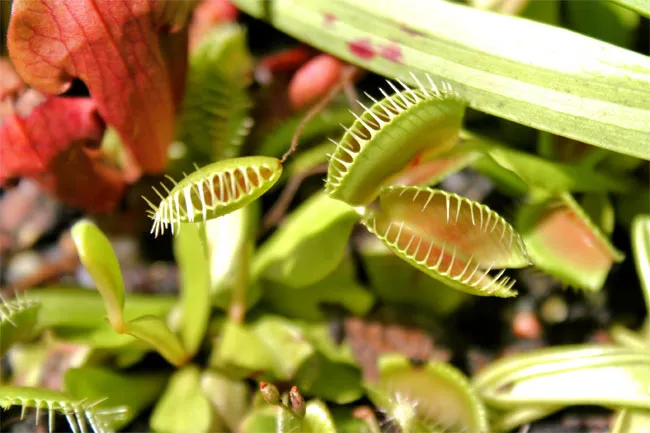
Venus flytraps nab their insect prey by snapping shut in response to pressure from little bug feet. Now, researchers have discovered the chemicals that protect the carnivorous plant from false alarms.
Venus flytraps "hunt" by luring their prey in with sweet nectar. Sensory hairs on the plant induce the trap, a pair of clamshell-shaped petals, to slam shut, trapping prey inside for digestion. But a single touch won't induce a flytrap to close: It takes at least two separate stimulations within 30 seconds to trigger a trap.
The new study finds two substances that must reach critical mass before flytraps slam shut. The researchers hypothesize that the chemicals build up as an insect brushes the plant's sensory hairs, helping to ensure that the plant traps a nourishing live meal rather than bits of leaf debris or other material.
To ferret out the trap-closing chemicals, researchers from the Universities of Tohoku, Hirosaki and Hiroshima in Japan cloned a strain of Venus flytraps and extracted the plants' chemicals. They then cut traps off of plants and soaked them in solutions of the extracts. Some of the solutions triggered the traps to close while others did nothing, enabling the researchers to whittle down the chemicals by process of elimination.
After multiple rounds of testing, two contestants were left standing: One, a potassium salt derived from a plant hormone called jasmonic acid, and the second a mixture of sugar components that has yet to be identified, because it has only ever been isolated in miniscule amounts.
Past research found the flytrap leaves close so quickly — in under a second — because they snap from convex to concave the same way that a contact lens can flip inside out.
The new findings suggest that a Venus flytrap's chemical signals work much like those in the human brain. Like neurotransmitters, the plant chemicals accumulate until they affect the plants' cell membranes, creating electrical imbalances that cells use to communicate. In the brain, these so-called "action potentials" are the language of neurons. In a Venus flytrap, they're the signal that spells dinnertime for the plant and slow digestion for its hapless prey.
The researchers reported their findings online Oct. 20 in the journal ChemBioChem.

