The volcanic eruption in the South Pacific Kingdom of Tonga peaked on Jan. 15 with more explosive force than 100 simultaneous Hiroshima bombs, NASA scientists reported on Monday (Jan 24).
Using a combination of satellite and surface-based surveys, researchers calculated the explosive power of the volcano based on the amount of rock that was removed during the blast from the island of Hunga Tonga-Hunga Ha'apai where it sits, the apparent height of the eruption cloud and several other factors.
"This is a preliminary estimate, but we think the amount of energy released by the eruption was equivalent to somewhere between 4 to 18 megatons of TNT," Jim Garvin, chief scientist at NASA's Goddard Space Flight Center, told NASA's Earth Observatory blog. (One megaton is equivalent to 1 million tons of TNT).
That makes the Tonga eruption potentially hundreds of times more explosive than the atomic bomb that the United States dropped on Hiroshima, Japan in August 1945, which is estimated to have exploded with 15 kilotons (15,000 tons) of energy. It also makes Tonga the most powerful volcanic eruption seen on Earth in more than 30 years, since the eruption of Mount Pinatubo in 1991.
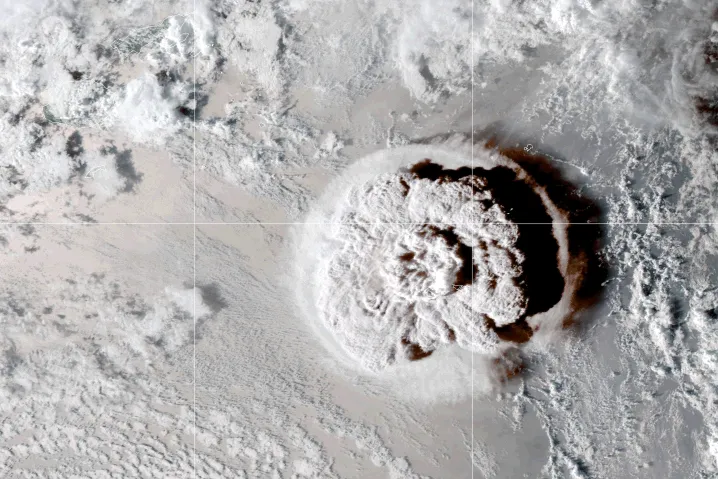
NOAA's GOES West satellite captured the explosive eruption of the Hunga Tonga-Hunga Ha'apai volcano, located in the South Pacific Kingdom of Tonga.
(Image credit: NOAA)
A new class of eruption
The Tonga volcano erupted violently on Jan. 15, several weeks after a series of smaller eruptions in late December 2021 shook the uninhabited island of Hunga Tonga-Hunga Ha'apai. The now-obliterated island formed the uppermost part of a massive underwater volcano, which rises 1.1 miles (1.8 kilometers) from the seafloor and spans 12 miles (20 km) across.
Garvin and his colleagues have been monitoring the Tonga volcano since 2015, when magma from the volcano pushed new land above the water's surface, connecting the islands of Hunga Tonga and Hunga Ha'apai. Frequent eruptions are to be expected from volcanoes like this one, where liquid water and scorching hot magma often come in contact, producing violent explosions of steam, Garvin said. Such eruptions are known as Surtseyan eruptions.
Sign up for the Live Science daily newsletter now
Get the world’s most fascinating discoveries delivered straight to your inbox.
However, the explosive Jan. 15 eruption — which sent a column of steam rising halfway to space — was far more violent than a typical Surtseyan eruption, Garvin said. This violence may be due to the unusually large amount of water involved.
"Some of my colleagues in volcanology think this type of event deserves its own designation," Garvin said. "For now, we're unofficially calling it an 'ultra Surtseyan' eruption."
Devastating as the eruption was, it is still just a glimpse of what Earth's most powerful volcanoes are capable of. For example, researchers estimate that the 1980 Mount St. Helens eruption exploded with 24 megatons of energy, while the 1883 Krakatoa eruption unleashed 200 megatons of energy, according to NASA.
Brandon is the space / physics editor at Live Science. With more than 20 years of editorial experience, his writing has appeared in The Washington Post, Reader's Digest, CBS.com, the Richard Dawkins Foundation website and other outlets. He holds a bachelor's degree in creative writing from the University of Arizona, with minors in journalism and media arts. His interests include black holes, asteroids and comets, and the search for extraterrestrial life.