
-
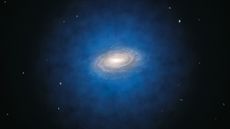 Echoes from the Big Bang suggest Earth is trapped inside a giant cosmic void, scientists claim
Astronomers claim to have found new evidence supporting a controversial observation that our galaxy is residing in an unusually sparse region in space. If it's correct, it could rewrite cosmology.
5 Commentscosmology -
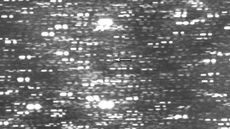 Watch newly discovered 'interstellar visitor' 3I/ATLAS shoot toward us in first livestream
You can see the recently identified "interstellar object" 3I/ATLAS shooting towards us through the solar system in a livestream from the Virtual Telescope Project.
comets -
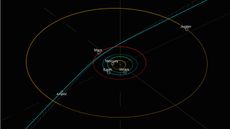 NASA confirms that mysterious object shooting through the solar system is an 'interstellar visitor' — and it has a new name
Experts have confirmed that the mysterious object hurtling towards us, previously dubbed A11pl3Z, is an "interstellar object." The cosmic interloper, officially named 3I/ATLAS, is only the third of its kind ever seen — and will shoot past Earth later this year.
20 Commentscomets -
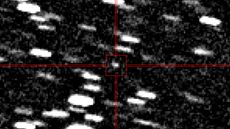 Astronomers spot potential 'interstellar visitor' shooting through the solar system toward Earth
A newly discovered object, dubbed A11pl3Z, appears to be moving too fast and straight to have originated in the solar system. If confirmed, it will be the third interstellar visitor ever spotted.
4 Commentsasteroids -
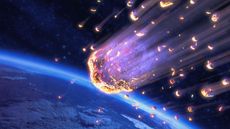 'City killer' asteroid 2024 YR4 could shower Earth with 'bullet-like' meteors if it hits the moon in 2032
There is currently a 4.3% chance that the giant space rock 2024 YR4 will hit the moon in seven years. If this does happen, debris from the nuclear bomb-like impact could trigger a "spectacular" meteor shower that will endanger Earth-orbiting satellites.
2 Commentsasteroids -
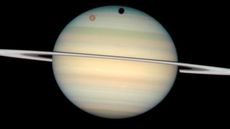 You can see a giant 'hole' shoot across Saturn this summer — and it won't happen again until 2040
There will be several chances to see the shadow of Saturn's largest moon, Titan, pass across the ringed planet's Earth-facing surface over the next few months. The rare spectacle is only visible every 15 years.
2 Commentsastronomy -
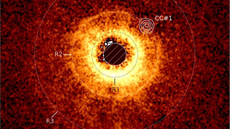 James Webb telescope discovers its first planet — a Saturn-size 'shepherd' still glowing red hot from its formation
Nestled inside a planetary ring 110 light-years from Earth, a planet spotted by the James Webb telescope is the lightest exoplanet ever detected.
exoplanets -
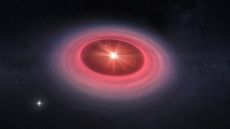 Alcohol-soaked star system could help explain 'why life, including us, was able to form'
The Atacama Large Millimeter/submillimeter Array has detected methanol isotopes around a nearby star, which could help explain why the ingredients for life are present on Earth.
6 Commentsexoplanets -
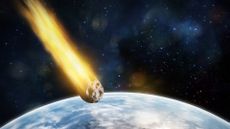 James Webb telescope ups the odds that 'city-killer' asteroid 2024 YR4 will hit the moon in 2032
The James Webb Space Telescope has taken another look at the potential "city-killer" asteroid 2024 YR4 and found its chances of hitting the moon in December 2032 have increased to 4.3%.
7 Commentsasteroids


