













Scientists built a perfectly self-replicating synthetic cell

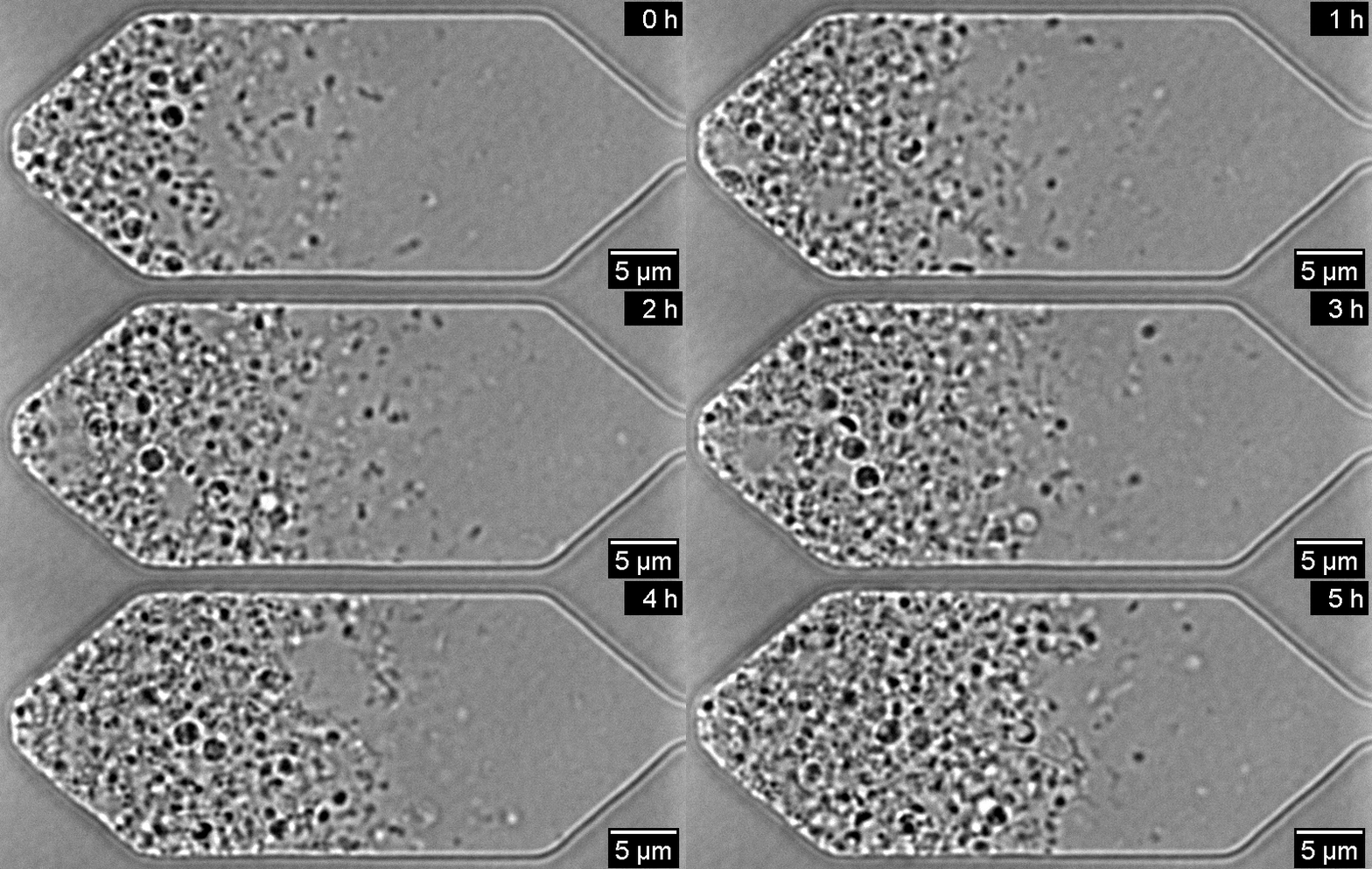
Scientists have crafted a single-celled synthetic organism that divides and multiplies just like the real thing. The advancement could someday help researchers to build miniscule computers and tiny drug-producing factories, all out of synthesized cells.
Of course, that future likely won't be realized for many years to come.
"There's just so many ways in which this coming century of biology could potentially change our daily lives for the better," said senior author Elizabeth Strychalski, leader of the Cellular Engineering Group at the National Institute of Standards and Technology (NIST). For example, Strychalski and her colleagues plan to engineer living sensors that can take measurements from their surrounding environments, monitoring the acidity, temperature and oxygen levels nearby.
Related: 11 body parts grown in the lab
These sensor cells could also be manufactured to produce specific products — namely medicines — and could potentially be placed inside the human body itself. "One vision is that when the cell senses a disease state, then it can make that therapeutic, and when a disease state is longer there, they could stop making that therapeutic," Strychalski said. Other cells could be cultured in the lab and used to efficiently produce food and fuel products, while still others could be made to perform computational functions at a molecular scale, she added.
But again, these are all visions for the future. To get there, scientists need to unpack the mysteries of the cell at a fundamental level before they can manipulate it in their synthetic organisms.
In the new study, Strychalski and her colleagues took a step toward that goal and published their results March 29 in the journal Cell. They began with an existing synthetic cell called JCVI-syn3.0, which was created in 2016 and contains only 473 genes, Scientific American reported. (For comparison, the bacterium Escherichia coli has about 4,000 genes, according to a statement.)
Get the world’s most fascinating discoveries delivered straight to your inbox.
This bare-bones cell was crafted from the bacterium Mycoplasma genitalium, a sexually transmitted microbe, which scientists stripped of its natural DNA and replaced with their own engineered DNA. In creating JCVI-syn3.0, the scientists wanted to learn which genes are absolutely essential for a cell to survive and function normally, and which are superfluous.
But while JCVI-syn3.0 could build proteins and replicate its DNA without issue, the minimalist cell could not divide into uniform spheres. Instead, it split haphazardly, producing daughter cells of many different shapes and sizes. Strychalski and her team set out to fix this problem by adding back genes to the stripped-down cell.

A previous version of a minimal cell, called JCVI-syn3.0, did not divide normally. This micrograph depicts how the cell would split into daughter cells of many different sizes.
After years of work, the scientists produced JCVI-syn3A, which contains a total of 492 genes. Seven of these genes are critical for normal cell division, they discovered.
"A number of the genes in the minimal cell did not have a known function," said co-first author James Pelletier, who at the time of the work was a graduate student at the Massachusetts Institute of Technology (MIT) Center for Bits and Atoms. Similarly, "it turned out that some of the genes that the cell needs to divide previously did not have a known function," he said. Reintroducing these genes allowed the minimal cell to split into perfectly uniform orbs.
Some of these important genes likely interact with the cell membrane, based on their genetic sequences, Pelletier said. This could mean that they alter the physical properties of the membrane, making it malleable enough to divide properly, or that they generate forces within the membrane that encourage the split, he said. But for now, the team doesn't know what specific mechanisms the genes use to help cells split, he noted.
Related Content
"Our study was not designed to figure out the mechanisms inside of the cell associated with each of these genes of unknown function," Strychalski said. "That's going to have to be a future study."
While researchers continue to probe the mysteries of the minimal cell, other synthetic biologists are working with even more simplistic systems. Synthetic biology exists on a spectrum, from "a soup of inanimate chemicals to the full glory of a mammalian cell or a bacterial cell," Strychalski said. The future of the field could lead us to innovative wonders like cell-sized computers, but for now, the work is largely driven by a curiosity about how the basic building blocks of life come together, and what that can tell us about ourselves, she said.
"How do we understand the most basic unit of life, the cell? … There's something very compelling about that," Strychalski said. "Later on, we can imagine all the things we can do with ... this minimal platform."
Originally published on Live Science.

Nicoletta Lanese is the health channel editor at Live Science and was previously a news editor and staff writer at the site. She is a recipient of the 2026 AHCJ International Health Study Fellowship, with a project focused on antibiotic stewardship practices in Japan and the U.S. They hold a graduate certificate in science communication from UC Santa Cruz and degrees in neuroscience and dance from the University of Florida. Beyond Live Science, Lanese's work has appeared in The Scientist, Science News, the Mercury News, Mongabay and Stanford Medicine Magazine, among other outlets. Based in NYC, she also remains involved in dance and performs in local choreographers' work.