













'Webb has shown us they are clearly wrong': How astrophysicist Sophie Koudmani's research on supermassive black holes is rewriting the history of our universe
How did supermassive black holes get big so fast? Astrophysicist Sophie Koudmani tells us how she and her colleagues are finding out.


A supermassive mystery lurks at the center of the Milky Way. Supermassive black holes are gigantic ruptures in space-time that sit in the middle of many galaxies, periodically sucking in matter before spitting it out at near light speeds to shape how galaxies evolve.
Yet how they came to be so enormous is a prevailing mystery in astrophysics, made even deeper by the James Webb Space Telescope (JWST). Since it came online in 2022, the telescope has found that the cosmic monsters are shockingly abundant and massive in the few million years after the Big Bang — a discovery that defies many of our best models for how black holes grew.
Sophie Koudmani is an astrophysicist at the University of Cambridge searching for answers to this problem. Live Science sat down with her at the New Scientist Live event in London to discuss the cosmic monsters, how they could have formed, and how her work using supercomputers to simulate them could rewrite the history of our universe.
Ben Turner: Why are supermassive black holes so important for understanding our universe?
Sophie Koudmani: In the universe, everything is connected and supermassive black holes play a very important role. They generate a huge amount of energy that comes from the region around the black holes. As gas falls in, its gravitational potential energy is converted into radiation. This makes the gas very hot, and as it heats up it starts glowing.
The gas is heated up to millions of degrees, and its radiation then influences the whole galaxy. It stops gas clumping together to form stars, pausing star formation in a way that's important to produce realistic galaxies. The energy [from supermassive black holes] can then travel out even further and influence the large-scale structure of the universe — which is really important for cosmology and understanding cosmic evolution.
BT: So when you talk about the energy flowing outwards, you're referring to relativistic jets, or near-light speed outflows from some black holes, right?
Get the world’s most fascinating discoveries delivered straight to your inbox.
SK: Yes. There's three kinds of ways that black holes "'speak"' to their host galaxies. One is through relativistic jets, another is by winds given off by the accretion disk [the cloud-like structure of gas, dust and plasma that orbits black holes] — these are not as thin as jets — and then there is radiation. So generally disks give off X-rays and radiation from other parts of the electromagnetic spectrum.
BT: You touched on this already, but what would galaxies look like if black holes didn't exist?
SK: So what you could get is what is often called "runaway star formation." All of the gas would get very quickly consumed, and you would get balls of stars. This is not what galaxies look like. To get the disk galaxies [we see in our universe] it's really important to have some kind of black hole. You need to get a realistic ratio between gas and stars, without them being eaten up straight away.

Sophie Koudmani.
BT: What drew you to studying black holes? What questions do you want to answer about them?
SK: One thing that I really like about supermassive black holes is that they are seemingly simple, but then this incredibly rich physics comes off them. You can actually characterize black holes with just two numbers — their mass and their spin — and that completely tells you what they behave like, it's called the "no hair theorem." From these two numbers you can get all of these different possibilities. For example, some black holes have jets and others don't, some have brightly-glowing accretion disks and others are completely quiet. It's the interaction with the galaxies that brings this out.
So it's a simple object at the center that can be incredibly powerful. It interacts with something that can be quite complex and messy, the galaxy — you get the gas, the dust, the stars, all being held together by dark matter which we don't understand very well. And all of these components interact with each other in ways that are really complex to understand.
BT: It's interesting that you described them as simple, because in relativistic physics they're where all of our equations break down and where we might want to look for theories of quantum gravity. Do they only look simple because our theories of them are?
SK: It depends what you're interested in. If you're interested in what's going on inside the event horizon, then yeah, sure, the singularity is where our theories break down. We don't know exactly about other physical phenomena, like Hawking radiation, that could actually come from inside of the black hole.
If you're worrying about all of this, yes, you have a very difficult job! But if you're thinking about astrophysical black holes, you're interested in the gas flows and radiation around the black hole. As an astrophysicist, you can be quite happy to locate the event horizon, see what it does to the region around it, and be relatively agnostic about what's inside. The location of that horizon itself is uniquely determined by the mass and the spin.
BT: What mysteries has JWST revealed about black holes that we didn't know before?
SK: We didn't know that there would be so many supermassive black holes so early on. They exist in such high numbers [in the early universe] and inside pretty small galaxies, that was surprising.
My PhD was on modeling black holes in small galaxies, it was lucky that I happened to be working on that because it's become very relevant for the early universe. JWST is telling us that black hole activity happened at very early times and in more galaxies than was thought possible. In fact, the activity seems to be more efficient than in the present-day universe.

Two merging black holes.
BT: Why might that be?
SK: We all know about cosmic expansion — so the Big Bang happens and the whole universe expands — and this means that in the early times of the universe everything was a bit closer together so gas inflows were stronger, this might have helped to feed black holes.
One problem is that black holes and supernovae kind of compete with one another. Both star formation and black holes consume gas. The black hole blows gas away, so do the supernovae, and supernovae also evacuate the gas from the central region, and then black holes can't grow because the supernovae have kicked out all of the gas. It could be that in the early universe, for one reason or another, this doesn't happen as much, and the black hole just wins out in that process.
In fact, there's a strong hint that the black holes win out [in the early universe]. It almost suggests, because of how massive these black holes are, that black holes assembled faster than their host galaxies.
BT: You also mentioned black hole efficiency. What does that mean, how can black holes have efficiency?
SK: There are various ways. One way is, when they draw in gas, how highly accreting [the speed at which the accretion disk grows] is it? There's a thing called a black hole speed limit called the Eddington Limit. We often measure, as a fraction of that theoretical upper limit, how much the black hole is growing by sucking in gas. For some objects measured by the JWST the efficiency is over 100% — so they are really extremely efficient.
That also means that it's not a hard limit, and there's always some theory and assumptions that went into it, and some of those assumptions might be wrong. In fact, Webb has shown us they are clearly wrong in those scenarios because they manage to break the limit and grow even faster.
BT: And so why does that efficiency decrease as we get into the later stages of the cosmos, the local universe?
SK: So if you have more star formation, there's simply less gas around. So galaxies might get progressively more gas poor, some of it being ejected elsewhere, some turned into stars, and some being consumed by black holes. Very old galaxies are usually dominated by their stars, so-called elliptical galaxies.
BT: How do black holes grow in the first place? There are three key ways, right? Take us through them.
SK: So, the first one is to the first generation of stars. So these would have been much more massive than our sun, around 100 times its mass. When these come to the end of their life and collapse, they collapse into black holes. This could be a good starting point [for supermassive black holes], or it could be a challenging one, as we're starting at 100 [solar masses] and we want to get to 1 million.
A much easier starting point would be huge gas clouds. These collapse directly into black holes, and they start off at something like 100,000 times the mass of the sun, that makes it much easier to get to supermassive black hole [mass scales]. And then there is an in-between scenario called nuclear star clusters, where lots of stars spawn in the center of galaxies and these collapse into black holes.
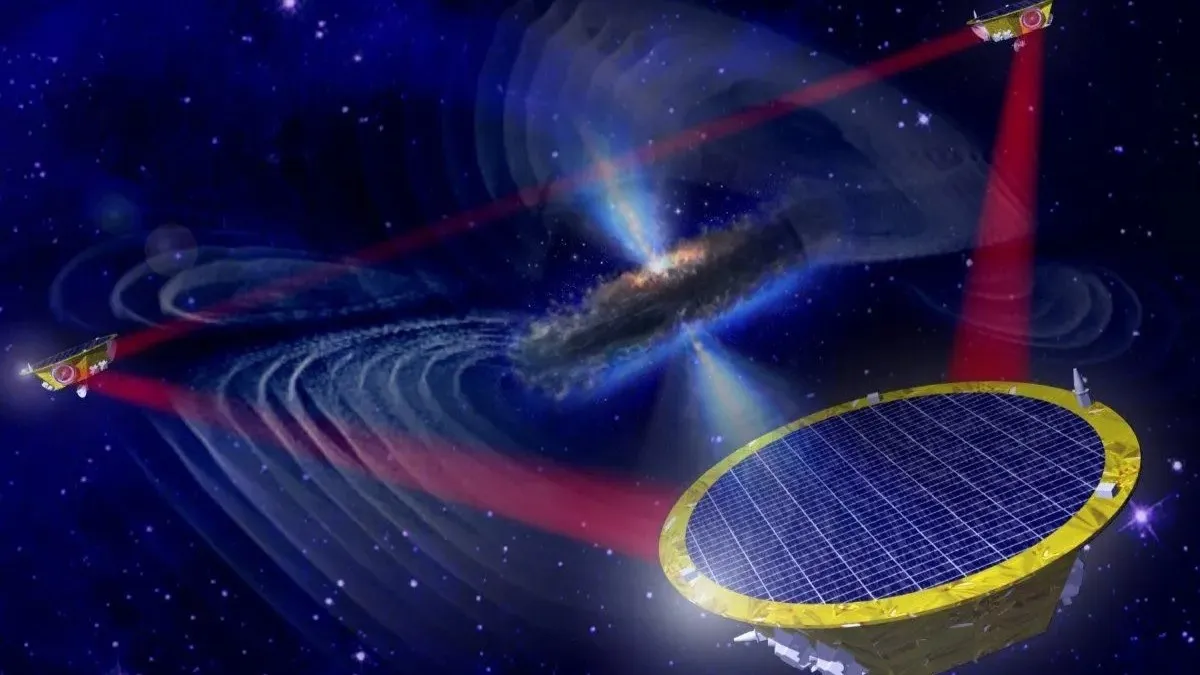
An artist's impression of the LISA detector, and the gravitational waves it will search for.
BT: There's also another option out there, hypothesized primordial black holes — possible relics from a time before the Big Bang. It's a very out-there theory, do we see much evidence for it?
SK: It is a very out-there theory. We're getting more constraints on it, and it's certainly not ruled out. I think the exciting thing about this question right now is that nothing is ruled out. The constraints get tighter as we push closer and closer to the times these black holes formed.
BT: How could we finally rule it out? What are those constraints?
SK: Some people are saying that, now that we have found massive black holes so early in the universe, that this means they have to have formed from direct collapse. There are several papers published suggesting that the observations prove this.
But what we are now doing is that we are revising our models of how black holes grew in the early universe to see if there are still other options for other models. Especially if black holes grow efficiently, there's still just enough time for them to grow from a very light seed. So I would say right now, the exciting thing is that none of the models are ruled out.
BT: So how are we looking for answers? We've mentioned the JWST spotting earlier and earlier black holes, are there other pathways we're exploring to find answers?
SK: A really cool way is with gravitational waves. [Detecting them] will allow us to map the supermassive black hole population in a whole different way. Because right now, unless a black hole is very close to us and we can map out these stellar orbits, the only way to spot supermassive black holes is if they're in an active phase.
But when we have gravitational wave instruments that can spot supermassive black hole mergers we will have a second channel that will help us estimate their masses. And that would go back to the early universe because these instruments would be incredibly sensitive. Then we can spot merger signals and find viable mechanisms for their growth.
RELATED STORIES
BT: Your work is on using simulations to spot possible growth pathways. How do they help us to find answers?
SK: It's a constant interplay between observation and simulation. So an observation, for example the early supermassive black holes, gives us something to explain. That then means we might need to adjust models to allow for that kind of growth early on. The simulations then help us know what to look for, and when those observations come back we can adjust our models again.
I work very closely with observers, and I'm part of a large program of the JWST that will take observations next year and do follow ups of these supermassive black holes in their infancy to understand them better.
BT: So finally, what areas of new research into giant black holes are you most excited about?
SK: I'm super excited about the gravitational wave detector LISA that will come online in the 2030s then we'll finally be able measure gravitational waves not just from small black holes but supermassive black holes. You need to be in space to do that.
I'm also quite nerdy when it comes to coding and building models, so I'm also excited about technical development. A really interesting example that's all over the news is, of course, AI.
We're using AI to accelerate our simulations, to make them even more accurate, and to try and bridge all the scales from the huge space of the cosmic web all the way down to event horizons. This is something that's impossible to do even directly right now, because the computational resources of even the biggest, best supercomputers find it too intensive, but we can use AI to develop solutions to that.
Editor's note: This interview has been condensed and edited for clarity.

Ben Turner is a U.K. based writer and editor at Live Science. He covers physics and astronomy, tech and climate change. He graduated from University College London with a degree in particle physics before training as a journalist. When he's not writing, Ben enjoys reading literature, playing the guitar and embarrassing himself with chess.