Get the world’s most fascinating discoveries delivered straight to your inbox.
You are now subscribed
Your newsletter sign-up was successful
Want to add more newsletters?
Join the club
Get full access to premium articles, exclusive features and a growing list of member rewards.
An account already exists for this email address, please log in.
James Webb telescope spots trouble in Orion Nebula: Stellar winds are eroding planet-forming material around a young star
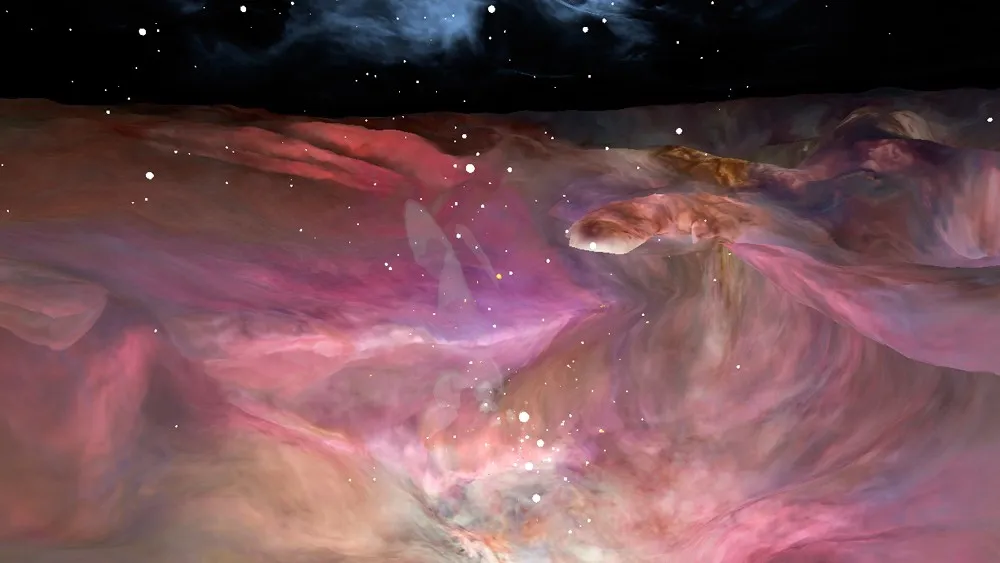
A group of extremely bright stars may be slowly reshaping the Orion Nebula and stopping one of their neighbors from forming planets, new James Webb Space Telescope observations suggest.
Many of us have had to deal with pesky neighbors, but for at least one dusty region in the constellation Orion, the problem's existential.
Observations by the James Webb Space Telescope (JWST) show that a compact disk of gas and dust around a young star in the Orion Nebula is losing massive amounts of hydrogen each year. The disk, known as a protoplanetary disk, is the region in which new planets can form, so the loss of significant amounts of material could limit this process.
This hydrogen loss is being driven by intense ultraviolet (UV) radiation pouring in from a group of massive neighboring stars. The UV radiation is so strong that it may be preventing large planets from ever forming in the region, a new study suggests. The findings could shed light on the sway massive stars hold on fledgling planetary systems.
"Over the timescale of a million years, all the mass should be gone from this disk," said Olivier Berné, a research scientist at the French National Centre for Scientific Research (CNRS) and the lead author of the new study. Current models of planet formation indicate an orb the size of Jupiter would take at least that long to coalesce, so the rapidly escaping material is "in competition with formation of planets," Berné told Live Science.
The team's findings were published Thursday (Feb. 29) in the journal Science.
Ultraviolent stars
Stars in the Trapezium cluster — a crowded home of many young stars, including the well-known group at Orion's heart — are each about 10 times more massive than our sun and 100,000 times brighter. The team's new JWST observations show that UV radiation from these ultra-bright stars is significantly heating up gas in the nearby protoplanetary disk, formally named d203-506, causing loads of valuable planet-forming material to break free and blow off into space.
The disk d203-506 is at most a few million years old, although it's difficult to obtain a precise age, Berné said. The Orion Nebula itself is believed to be roughly 3 million years old, "which for us astronomers is very young," he said.
Sign up for the Live Science daily newsletter now
Get the world’s most fascinating discoveries delivered straight to your inbox.
Hubble image of the Orion Nebula, and a zoom in on the protoplanetary disc d203-506 taken with the James Webb Space Telescope (JWST).
(Image credit: NASA/STScI/Rice Univ./C.O'Dell et al / O. Berné, I. Schrotter, PDRs4All)
The nascent nebula is about 30 to 40 light-years in diameter, so there is a good chance that the gas being ejected from the protoplanetary disk remains within it — although it's forever lost for any future planets that would sprout in the disk itself. It appears this system is also losing entire oceans' worth of water every month from the ultraviolet assault, according to a related paper from the same team published Feb. 23 in the journal Nature Astronomy.
The gas puffing away from the disk is carrying with it at least some dust grains, so it's an open question whether rocky planets like Earth can ever birth in this system, Berné said.
Studies of meteorites show that our own solar system, which is 4,000 times older than d203-506, was also influenced by one or more nearby massive stars during its formation. Evidence for this includes the presence of radioactive elements in comets and asteroids — such as aluminum-26, which is known to form in very hot conditions like those seen in exploding stars — that may have wafted into our solar system thanks to a closeby supernova.
"Looking at this system [d203-506] is really like looking into the past of our solar system in a way," Berné said.
Compared with our own sun, d203-506's star is five to 10 times smaller, so it also has a weaker grip on its system, which may explain why the planet-forming material is escaping so easily.
Berné said his team has applied for more time on telescopes to observe this disk and others within the Orion Nebula. As the current findings are based on only one system, the researchers said future observations could paint a more complete picture of how massive stars impact young planetary systems like d203-506.
"It's just the tip of the iceberg that we've been looking at so far," Berné said.
Sharmila Kuthunur is an independent space journalist based in Bengaluru, India. Her work has also appeared in Scientific American, Science, Astronomy and Space.com, among other publications. She holds a master's degree in journalism from Northeastern University in Boston. Follow her on BlueSky @skuthunur.bsky.social