













Silver plate showing topless Scythian goddess unearthed in Russia
The plate depicts the fertility goddess Argimpasa surrounded by mythical creatures.

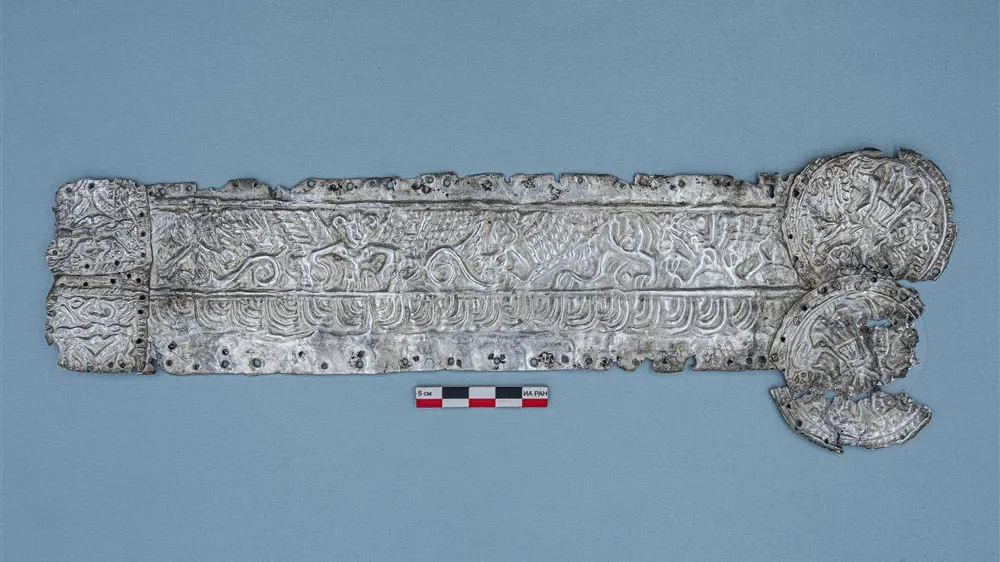
Archaeologists have discovered a silver plate decorated with an image of a topless Scythian goddess in an ancient cemetery in the Ostrogozhsky district of southwest Russia. The plate depicts Argimpasa, a goddess associated with human and animal fertility, surrounded by mythical creatures.
The plate dates to between 900 B.C. and 200 B.C., when a people called the Scythians flourished in the region. The Scythians were semi-nomadic and were renowned for being excellent warriors who could move quickly across the battlefield. "None who attacks them can escape, and none can catch them if they desire not to be found," the ancient Greek historian Herodotus (circa 484 to 425 B.C.) wrote in his book "The Histories." The Scythians were also known for their elaborate gold-working skills.
Related: The 25 most mysterious archaeological finds on Earth
The ancient cemetery where the plate was found contains 19 burial mounds. The excavation team found the silver plate inside a mound that had been partially robbed in ancient times. Despite the robbery, archaeologists discovered the silver plate near the skeletal remains of a man who was between 40 and 49 years old when he died.
The team also found Scythian pendants made from bone, horse harness material, including decorated bronze cheek plates shaped like wolves, as well as a goblet, jar and a bear jaw, which may be evidence that a "bear cult" existed in the area, archaeologists wrote in a statement.
RELATED CONTENT
The silver plate — which measures 13.6 inches (34.7 centimeters) long and 3 inches (7.5 cm) wide — depicts a topless Argimpasa, who is shown wearing what is likely a crown. She is surrounded by "winged eagle-headed griffons" and other pawed creatures that the researchers are still trying to understand, the archaeologists wrote in the statement. The plate may have served as a burial good for the man in the burial. While many Scythian sites have been excavated, few silver plates like this one have been found.
There is "great work to be done on studying and interpreting of such an unusual divine figure," Valeriy Gulyaev, an archaeologist with the Russian Academy of Sciences who led the research team, said in the statement. Gulyaev did not respond to requests for comment at time of publication.
Get the world’s most fascinating discoveries delivered straight to your inbox.
Originally published on Live Science.

Owen Jarus is a regular contributor to Live Science who writes about archaeology and humans' past. He has also written for The Independent (UK), The Canadian Press (CP) and The Associated Press (AP), among others. Owen has a bachelor of arts degree from the University of Toronto and a journalism degree from Ryerson University.