














'Interplanetary Shock' Seen for 1st Time
A team of four NASA spacecraft finally caught sight of a phenomenon scientists have been hunting for years: an interplanetary shock.
The spacecraft comprise a NASA project called the Magnetospheric Multiscale mission, nicknamed MMS, which launched in 2015. The mission is focused on studying the magnetic environment surrounding Earth. To do so, it relies on four identical spacecraft that cooperate to map what's happening.
In new research, scientists dissect a particularly intriguing phenomenon that occurred in the magnetic field in January 2018. Because the individual satellites were deployed within just 12 miles (20 kilometers) of each other, they got a prime view of what was happening.
Related: Amazing New Sun Photos from Space
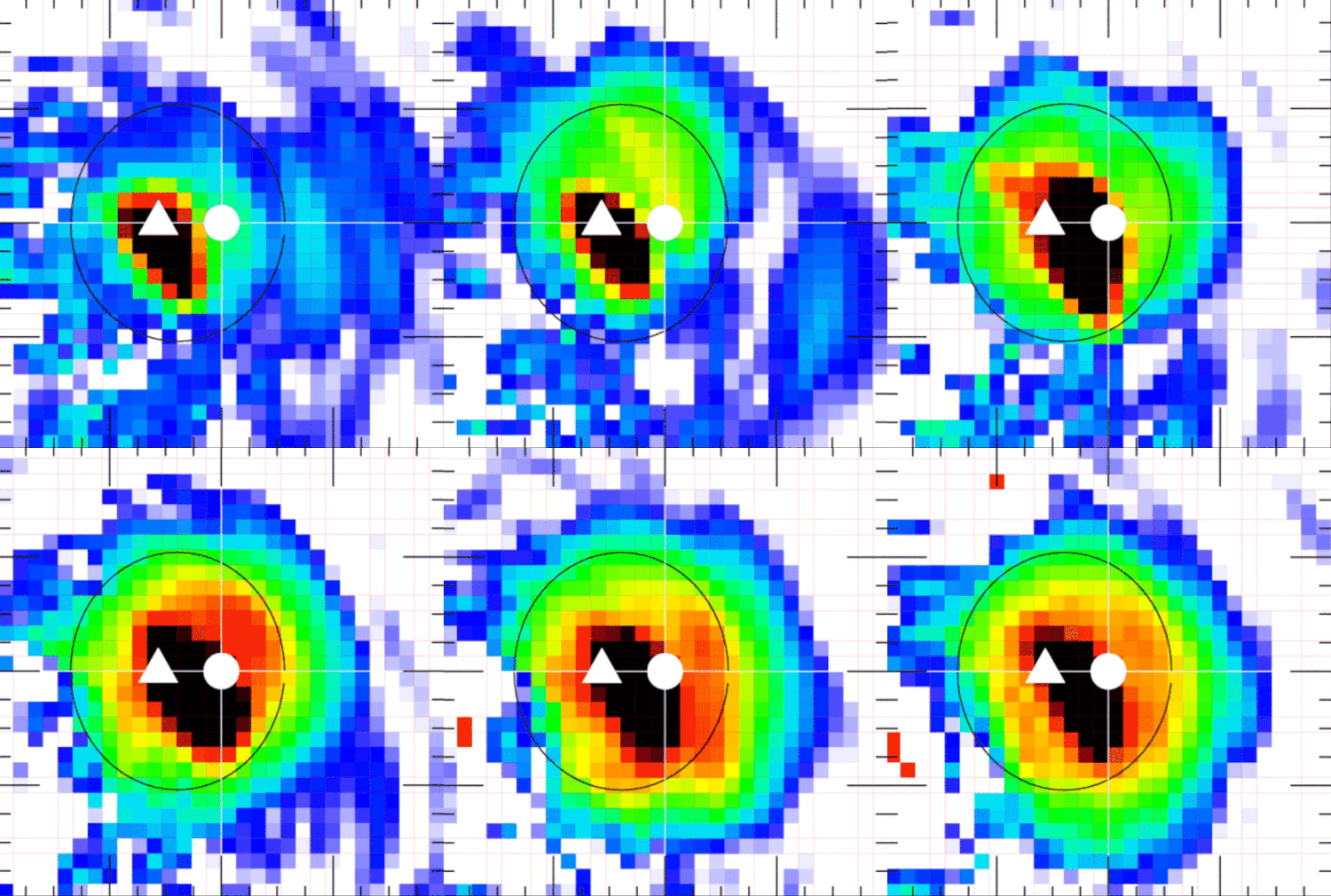
This animation shows the shock and reflected ions as they washed over NASA's Magnetospheric Multiscale Mission spacecraft. The colors represent the amount of ions seen with warmer colors indicating higher numbers of ions. Yellow pixels represent reflected ions.
The phenomenon was an interplanetary shock, which is an interaction between two different patches of the stream of charged particles constantly flowing off the sun, which scientists refer to as the solar wind.
When a fast patch of solar wind overtakes a slower patch, scientists believe it transfers energy to that slower patch and creates a shock. During the January 2018 observation, the MMS spacecraft caught the first glimpse of that energy transfer taking place.
But while the observations were a long time coming, the team behind the research hopes to see similar phenomena in the future, since the mission should be able to see an interplanetary shock as often as once a week. The scientists behind the new research hope that future observations made by the mission's spacecraft fleet will offer them even more detailed looks at the anatomy of an individual interplanetary shock.
Get the world’s most fascinating discoveries delivered straight to your inbox.
The research is described in a paper published June 18 in the journal JGR Space Physics.
NASA launched the $1.1 billion MMS mission in 2015 on a two-year primary mission to study the explosive phenomenon known as magnetic reconnection in Earth's magnetosphere. To date, the mission has lasted twice as long as originally planned.
- Satellite Quartet: NASA's Magnetospheric Multiscale Mission in Pictures
- Space Weather: Sunspots, Solar Flares & Coronal Mass Ejections
- What's Inside the Sun? A Star Tour from the Inside Out
Email Meghan Bartels at [email protected] or follow her @meghanbartels. Follow us on Twitter @Spacedotcom and on Facebook.
Meghan is a senior writer at Space.com and has more than five years' experience as a science journalist based in New York City. She joined Space.com in July 2018, with previous writing published in outlets including Newsweek and Audubon. Meghan earned an MA in science journalism from New York University and a BA in classics from Georgetown University, and in her free time she enjoys reading and visiting museums. Follow her on Twitter at @meghanbartels.