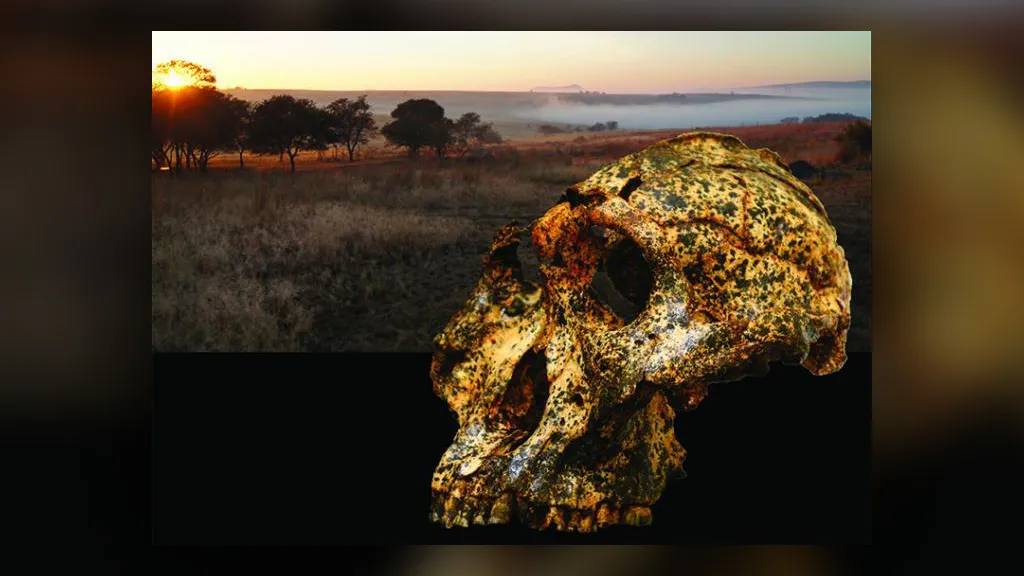
The recently discovered skull of an ancient human relative reveals that the species underwent dramatic changes in a short period of time, a phenomenon known as microevolution, a new study finds.
Previously, males of Paranthropus robustus, an extinct australopithecine species (relatives of Lucy), were thought to be substantially larger than females. This dichotomy is well known among some modern-day primates, including gorillas, orangutans and baboons. However, a new fossil unearthed in South Africa indicates that differences attributed to sex are actually due to microevolution, as the species rapidly evolved during a turbulent period of local climate change about 2 million years ago.
"Demonstrating that Paranthropus robustus is not especially sexually dimorphic removes much of the impetus for supposing that they lived in social structures similar to gorillas, with large dominant males living in a group of smaller females," study lead researcher Jesse Martin, a doctoral candidate in the Archaeology Department at La Trobe University in Melbourne, Australia, said in a statement.
Study researchers Angeline Leece (left) and Jesse Martin (right) look at the skull.
(Image credit: Andy Herries/La Trobe Archaeology)
Researchers have known about P.robustus since 1938, but the new fossil find — a male's skull discovered on June 20, 2018, earning it the nickname Father's Day Fossil — sheds new light on the species. Based on earlier discoveries, scientists knew that P.robustus was a large-toothed, small-brained hominin (a group that includes humans, our ancestors and our close evolutionary cousins) that lived at the same time as other human ancestors, including Homo erectus and Australopithecus, Live Science previously reported.
For the new finding, unearthed in Drimolen Main Quarry north of Johannesburg, researchers digitally scanned fragments of the skull, allowing them to digitally reconstruct it and see anatomical details they might have otherwise missed. This analysis revealed that the male's skull is actually quite similar to female P.robustus remains found at the same site. In contrast, at another fossil site known as the Swartkrans cave, the males are "appreciably different," from a previously found female at Drimolen, which led to the idea that the males lumbered over the females, Martin said.
"It now looks as if the difference between the two sites cannot simply be explained as differences between males and females, but rather as population-level differences between the sites," Martin said in a statement. "Our recent work has shown that Drimolen predates Swartkrans by about 200,000 years, so we believe that P. robustus evolved over time, with Drimolen representing an early population and Swartkrans representing a later, more [evolved] population."
Sign up for the Live Science daily newsletter now
Get the world’s most fascinating discoveries delivered straight to your inbox.
Image 1 of 7
The excavation site at the Drimolen Main Quarry in South Africa.
(Image credit: Andy Herries/La Trobe Archaeology)
The student who discovered the skull, Samantha Good, stands at the excavation site.
(Image credit: Andy Herries/La Trobe Archaeology)
Study researchers Angeline Leece and Stephanie Baker help excavate the skull.
(Image credit: Andy Herries/La Trobe Archaeology)
Researchers prepared the skull after its excavation.
(Image credit: Andy Herries/La Trobe Archaeology)
The male Paranthropus robustus skull.
(Image credit: Andy Herries/La Trobe Archaeology)
Angeline Leece examines the 2 million-year-old skull.
(Image credit: Andy Herries/La Trobe Archaeology)
An illustration of the newly unearthed Paranthropus robustus skull.
(Image credit: Andy Herries/La Trobe Archaeology)
These anatomical changes are the first high-resolution example of microevolution within an early hominin species, the researchers said. Taken together, the P.robustus fossils show that the unique way this species chewed developed incrementally, likely over hundreds of thousands of years. (A study published in 2018 in the journal Royal Society Open Science found that P.robustus had an unusual "twist" in its tooth roots, suggesting that the species chewed with a slight rotational and back-and-forth movement with its jaw as it ate.)
P.robustus likely underwent microevolution because of local climate change, when what is now South Africa was drying out. Previously, researchers knew that soon after P.robustus appeared, Australopithecus went extinct. Around that time, Homo erectus also emerged in that region. This transition happened quickly, evolutionarily speaking, likely on the order of a few tens of thousands of years.
"The working hypothesis has been that climate change created stress in populations of Australopithecus leading eventually to their demise, but that environmental conditions were more favorable for Homo and Paranthropus, who may have dispersed into the region from elsewhere," study co-researcher David Strait, professor of biological anthropology at Washington University in St. Louis, said in the statement. "We now see that environmental conditions were probably stressful for Paranthropus as well, and that they needed to adapt to survive."
Due to microevolution, it appears that P.robustus likely evolved a chewing ability that could grind tough plants, such as tubers, study co-researcher Angeline Leece, an archaeologist at La Trobe University.
Laura is the managing editor at Live Science. She also runs the archaeology section and the Life's Little Mysteries series. Her work has appeared in The New York Times, Scholastic, Popular Science and Spectrum, a site on autism research. She has won multiple awards from the Society of Professional Journalists and the Washington Newspaper Publishers Association for her reporting at a weekly newspaper near Seattle. Laura holds a bachelor's degree in English literature and psychology from Washington University in St. Louis and a master's degree in science writing from NYU.