













Jupiter and Venus 'kiss' in a stunning planetary conjunction tonight. Here's how to watch.
On March 1 and 2, Jupiter and Venus will appear side by side in the night sky in an event called a conjunction, which is visible without a telescope or binoculars.

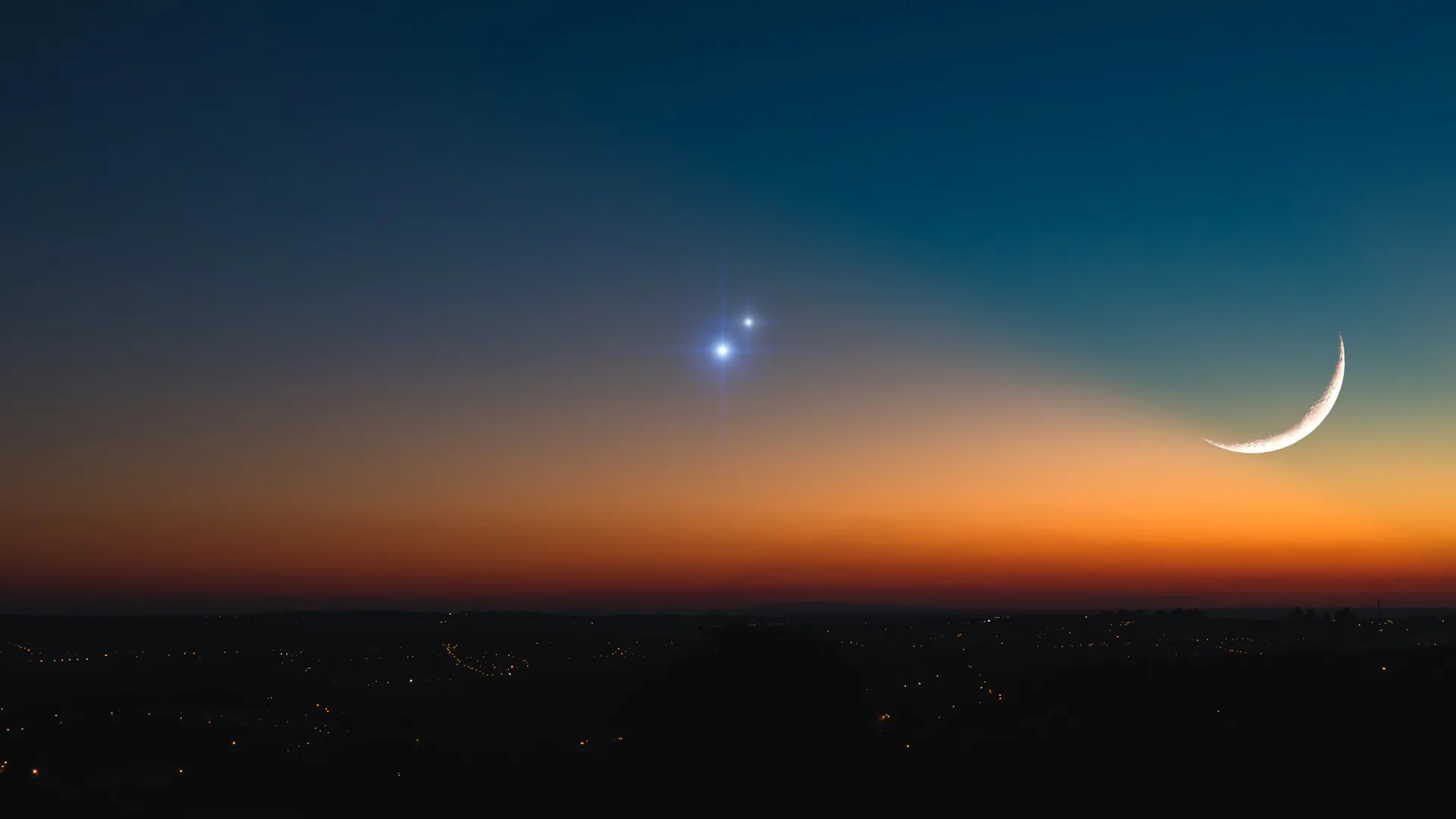
On Wednesday (March 1) and Thursday (March 2), two bright planets will appear as if they were about to collide in the night sky.
Jupiter, the largest planet in the solar system, and Venus, one of the brightest objects in Earth's sky, will come within about half a degree of each other — or roughly one full moon's width apart. For weeks, the two bodies have been inching closer together, building toward a phenomenon called a conjunction, which occurs whenever two objects in the sky — such as moons, planets or stars — appear exceptionally close together.
This phenomenon is, of course, a trick of perspective. The two bright planets are in fact millions of miles apart; only from our point of view on Earth do they appear to butt against each other. Thanks to the orbital patterns of Earth, Jupiter and Venus, conjunctions like this occur once every year or so.
Related stories
You won't need a telescope or binoculars to see the two bright planets. Simply look to the west after sunset, and the two canoodling objects should be apparent to the naked eye. They will look like exceptionally bright stars; Jupiter will shine twice as bright as Sirius, the brightest star in the sky, while Venus will blaze six times brighter than Jupiter, according to Live Science's sister site Space.com.
However, skywatchers who do view the planets through a pair of binoculars may have the bonus of seeing three of Jupiter's largest moons: Io, Ganymede and Callisto. If you want to pick up a pair of binoculars to see the conjunction more clearly, check out our guide to the best binoculars for stargazing for our recommendations.
The two planets will be separated a bit too widely to appear in the same field of view of a telescope, according to In-The-Sky.org.
If you can't catch this spectacle in the sky, you can watch a livestream of the conjunction, as seen from Rome, courtesy of the Virtual Telescope Project. The stream begins at 1:30 p.m. EST (1830 GMT) on March 1.
Get the world’s most fascinating discoveries delivered straight to your inbox.

Brandon is the space / physics editor at Live Science. With more than 20 years of editorial experience, his writing has appeared in The Washington Post, Reader's Digest, CBS.com, the Richard Dawkins Foundation website and other outlets. He holds a bachelor's degree in creative writing from the University of Arizona, with minors in journalism and media arts. His interests include black holes, asteroids and comets, and the search for extraterrestrial life.