


560 million-year-old tentacled creature may be the animal kingdom's first known predator
The fossil was discovered in the U.K.

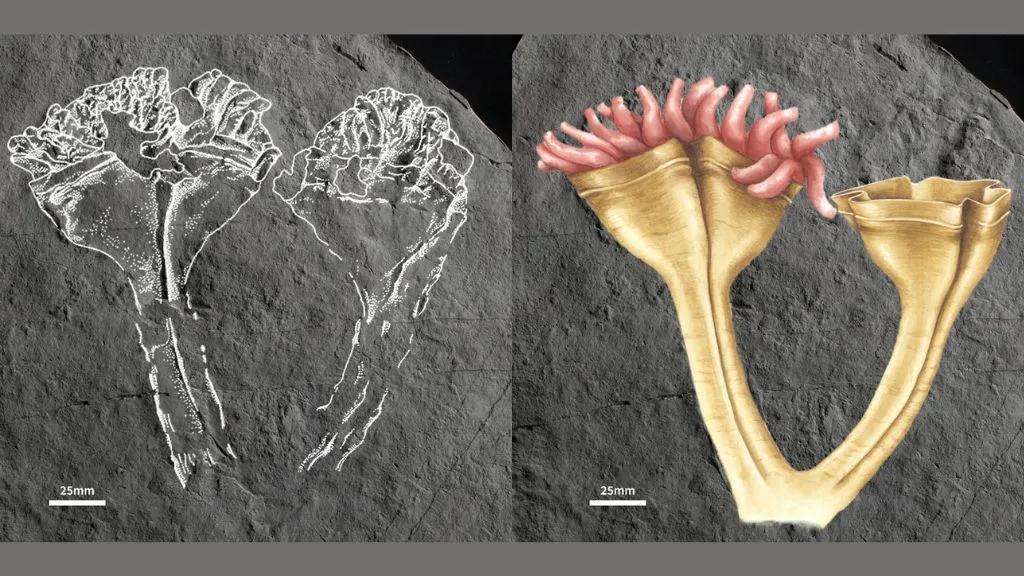
A bizarre, tentacled creature that lived in the deep ocean 560 million years ago resembled a goblet crammed full of wriggling fingers. It may be an ancient relative of modern jellyfish and the earliest known predator in the animal kingdom, analysis of a newly described fossil suggests.
More than a decade ago, scientists uncovered a fossil of the purported jellyfish relative in an outcrop of volcanic and sedimentary rocks called the Bradgate Formation in Leicestershire, England. Located in Charnwood Forest, the outcrop formed about 557 million to 562 million years ago, during the Ediacaran period (635 million to 541 million years ago).
This means that the newly identified fossil predates the Cambrian explosion, a 55-million-year episode in which life on Earth rapidly diversified. During the Cambrian period (541 million to 485.4 million years ago), many animal forms evolved, including arthropod ancestors of insects, spiders and crustaceans; clamlike and hard-shelled brachiopods; and chordates — creatures with a spinal nerve cord.
It's almost unheard of for Precambrian fossils to resemble forms seen in animals alive today, so the discovery of an Ediacaran animal resembling a jellyfish is exceptional, said Philip Donoghue, a professor of palaeobiology at the University of Bristol in England, who was not involved in the study. "They found an animal, a member of a modern group of animals, in the Precambrian, where they're classically not meant to be found," Donoghue told Live Science. (Although not involved in the new work, Donoghue was formerly the doctoral advisor to several authors on the paper.)
Related: Largest crown jellyfish ever discovered is a blood red, saucer-like weirdo
To date, the vast majority of Ediacaran fossils don't share structural features with any living animals, so they're generally thought to belong to extinct animal groups, Donoghue said. "This fossil's probably the oldest one recognized, with quite convincing evidence, to be a member of one of the living phyla," or large groups of related animals, Donoghue said.
The researchers named the newly identified creature Auroralumina attenboroughii and described the animal in a new study, published Monday (July 25) in the journal Nature Ecology & Evolution. The genus name, Auroralumina, translates to "dawn lantern" in Latin and references the fossil's old age and its torch-like shape. The species name honors broadcaster and biologist Sir David Attenborough for "his work raising awareness of the Ediacaran fossils of Charnwood Forest," the authors wrote in their report.
Get the world’s most fascinating discoveries delivered straight to your inbox.
The world's oldest known predator?
The research team uncovered A. attenboroughii during a 2007 expedition in Charnwood Forest, but the first major fossil discoveries there date to the 1950s, when two children, first Tina Negus and then Roger Mason, stumbled upon a fern-shaped fossil in a quarry, according to the University of Reading in England. That organism, named Charnia masoni, was the first fossil that could be confidently dated to the Ediacaran period, and since its discovery, many paleontologists have traveled to Charnwood to hunt for similar snapshots of Precambrian life.
On their 2007 expedition, the scientists focused their search on a rockface that rose from the forest floor at a 45-degree angle and wore a thick coat of lichen and dirt. The team dug into the rockface while dangling from ropes, using toothbrushes, toothpicks and high-pressure water jets to expose any fossils hidden under the muck.
"As soon as we cleaned off all the dirt, all of sudden, rather than just a couple scrappy fossils there were a thousand fossils on this surface," said paleobiologist Philip Wilby, a team leader for Palaeontology at the British Geological Survey and senior author of the study. The fossils, which likely represent 20 to 30 different species, were preserved as impressions in the rock; excluding A. attenboroughii, many of the fossils resembled the frond-like creatures previously found in Precambrian rocks.
"Beautifully preserved — some of them absolutely stunning," Wilby told Live Science.
The team made rubber casts of the fossil-filled rockface and transported the casts back to the lab. Such impressions can be difficult to work with "because they're all squidged, flattened," which makes the animals' internal anatomy and body shapes challenging to interpret, Donoghue said. To create 3D models of their flat fossil casts, the researchers used a technique that involved illuminating the casts from different angles and snapping lots of photos; these photos were then compiled into a virtual 3D model that could be manipulated digitally.
Related: Coral reefs have 'halos,' and they can be seen from the heavens
These reconstructions revealed that one of the fossil creatures resembled a simple candelabra, with two goblet-like structures branching off from a single node. "They seem to have actually budded off from one another," Wilby said. The tips of short tentacles could be seen poking over the edge of each goblet, like stubby fingers reaching from the center of a cup. Ridges that ran up the sides of the fossil suggest that these "goblets" were supported by a stiff skeleton.
RELATED STORIES
"This is the first creature, the first animal that we're aware of that actually grew a skeleton," Wilby said. Its tentacle structure hints that A. attenboroughii likely fed on plankton and protists, which would make it the earliest known predator in the animal kingdom.
A. attenboroughii shares many core characteristics with Cambrian fossils of Medusozoa, a group that includes modern jellyfish and other animals that transform into free-swimming, bell-shaped creatures for part of their life cycle. "That's what leads us to believe that it is a Medusozoan," Wilby said. While the fossil might not look like a jellyfish at first glance, it's important to note that, for part of their life cycle, neither do Medusozoans. For a chapter of their lives, the animals anchor themselves to the seafloor to reproduce asexually. During this life stage they resemble anemones — and A. attenboroughii.
If A. attenboroughii is indeed a member of Medusozoa, it would belong to a broader group of organisms known as the cnidarians, which also includes corals, sea pens and sea anemones. Prior to the new study, fossil evidence suggested that the basic "blueprint" for cnidarians didn't emerge until the Cambrian period. However, "what we're able to show here is that, at least 20 million years before that, the blueprint for cnidarians was actually set," Wilby said.
This not only pushes back the evolutionary history of cnidarians but also provides hints about what animals must have come before them, Donoghue said. Prior research suggests that cnidarians and bilaterians — a group of animals that includes humans — split off from a common ancestor. If A. attenboroughii existed 560 million years ago, it’s possible that the split already occurred and the earliest bilaterians were already roaming the planet.
"The fossil's not just important for showing us, clearly, cnidarians are here — by implication, their sibling lineage must have also evolved by this time," Donoghue said.
Originally published on Live Science.

Nicoletta Lanese is the health channel editor at Live Science and was previously a news editor and staff writer at the site. She is a recipient of the 2026 AHCJ International Health Study Fellowship, with a project focused on antibiotic stewardship practices in Japan and the U.S. They hold a graduate certificate in science communication from UC Santa Cruz and degrees in neuroscience and dance from the University of Florida. Beyond Live Science, Lanese's work has appeared in The Scientist, Science News, the Mercury News, Mongabay and Stanford Medicine Magazine, among other outlets. Based in NYC, she also remains involved in dance and performs in local choreographers' work.