













32,000 mph fireball spotted soaring over North Carolina
More than 80 people reported seeing the blazing visitor from space

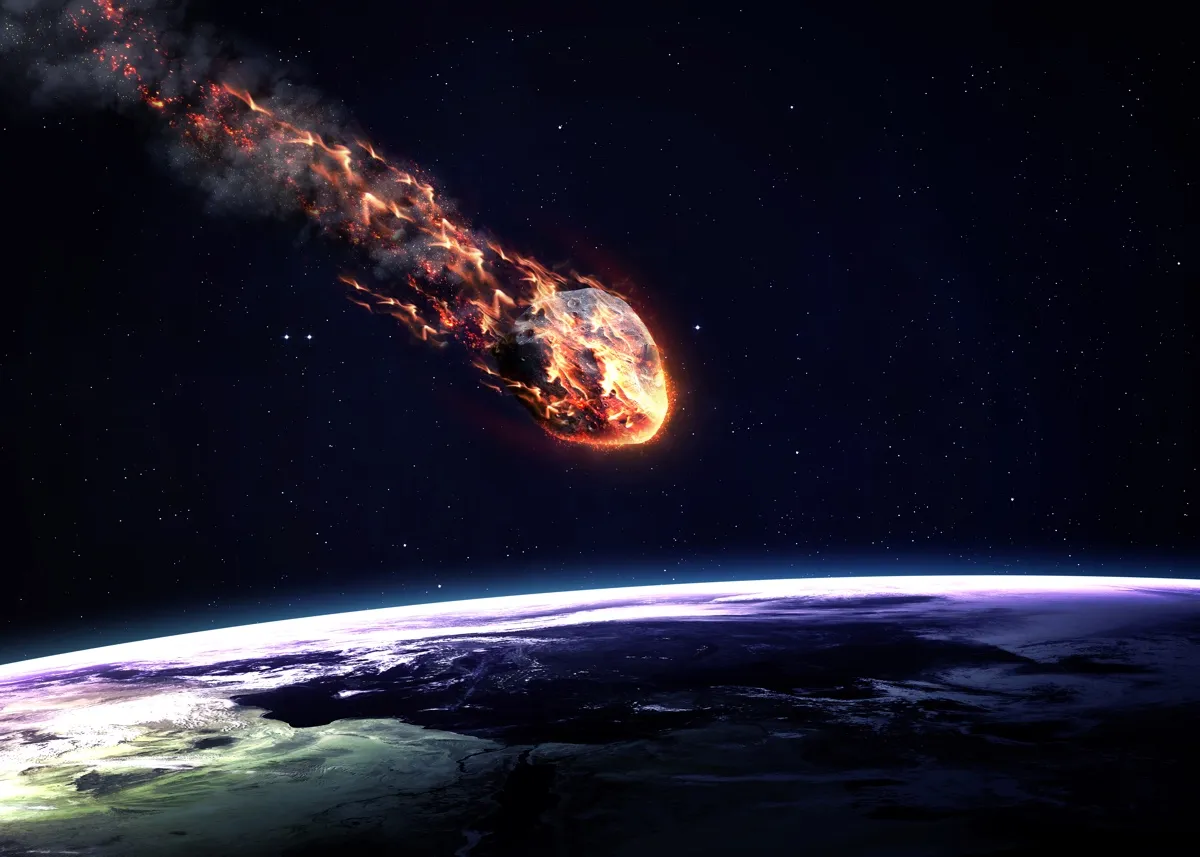
Newly released footage shows a spectacular fireball blazing at 32,000 mph (51,500 km/h) across the skies above North Carolina on Friday evening (Sept. 24), the American Meteor Society (AMS) reported.
More than 80 people spotted the fireball, which NASA said was just one of five such meteors reported soaring over the United States that evening. The fiery meteor "skimmed the coast of North Carolina, becoming visible 48 miles [77 kilometers] above the ocean off Camp Lejeune," at around 7:40 p.m. ET, NASA said.
The brightly-burning meteor followed a northeasterly trajectory "traveling 26 miles [42 km] through Earth’s upper atmosphere" before disintegrating 28 miles (45 km) above Morehead City, North Carolina.
Related: Space-y tales: The 5 strangest meteorites
Fireballs are meteors that appear as brighter than the planet Venus, according to the AMS, meaning that they are in theory visible by daylight — such as the March 2021 fireball that lit up the afternoon sky across parts of the United Kingdom, Live Science previously reported.
RELATED CONTENT
The blazing space rocks owe their startling brilliance to their large sizes and blistering speeds — which create a significant amount of friction when the rocks hit Earth's atmosphere. As the fireballs enter the atmosphere at speeds far exceeding the sound barrier — between 25,000 and 160,000 mph (about 40,000 to just under 260,000 km/h), according to the AMS — they can also arrive accompanied by a tremendous sonic boom.
At the lower end of this speed range, the 32,000 mph (51,500 km/h) fireball isn't even particularly fast compared to others. For comparison, the Draconid meteor shower — which is expected to light up northern skies between October 7 and 11 of this year — travels at 43,200 mph (69524 km/h). On the speedier side of the scale, the Leonid meteor shower travels at a scorching 158,000 mph (254,276 km/h ).
Get the world’s most fascinating discoveries delivered straight to your inbox.
The video footage, which was captured from the porch camera of a home in Rowland Pond, North Carolina, shows the bright rock leaving a dazzling, fiery trail in the night sky before disappearing behind distant tree cover.
If a fireball explodes overhead, it can cause serious damage. The most explosive meteor event in recent history, which occurred over the city of Chelyabinsk in central Russia in 2013, created a blast roughly equivalent to 400-500 kilotons of TNT, or 26 to 33 times the energy released by the Hiroshima bomb. Fireballs rained down over Chelyabinsk and its surroundings, damaging buildings, smashing windows and injuring approximately 1,200 people.
The Chelyabinsk explosion is far from the most apocalyptic event caused by a fireball. Recent archaeological evidence suggests that a fireball could have detonated over the ancient Middle Eastern city of Tall el-Hamman around 3,600 years ago. It's possible that the explosion, which was roughly 1,000 times more powerful than the Hiroshima bomb, set the city instantly ablaze before levelling it with a powerful shockwave, killing all of its inhabitants, Live Science previously reported.
Originally published on Live Science.

Ben Turner is a U.K. based writer and editor at Live Science. He covers physics and astronomy, tech and climate change. He graduated from University College London with a degree in particle physics before training as a journalist. When he's not writing, Ben enjoys reading literature, playing the guitar and embarrassing himself with chess.